
Allahabad High Court

Revenue Cannot Appeal Assessment Order Under Income Tax Act, Can Only Seek Revision: Allahabad High Court
The Allahabad High Court has recently held that under the Income Tax Act, 1961, the revenue has no right of appeal against an assessment order, as the assessment order is the stated case of the revenue itself. It held that where the revenue is aggrieved by an assessment order, its remedy is to seek revision where the assessment order is found to be "erroneous in so far as it is prejudicial to the interest of revenue." The court held that in an assessment proceeding the Assessing Authority...
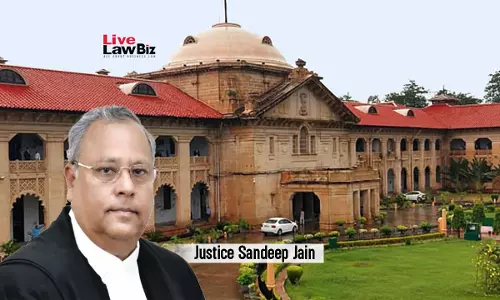
Sitting Judge Moves Allahabad HC Against Denial of Exemption On Statutory Allowances Under New Income Tax Regime
The court called for instructions from the State on the plea, observing that the interim relief sought was in the nature of final relief.
Registration Of Customs Appeal Cannot Be Refused For Non-Payment Of Pre-Deposit: Allahabad High Court
The Allahabad High Court has held that an appellate authority cannot refuse to register an appeal merely because the appellant has not made the mandatory pre-deposit under Section 129E of the Customs Act, holding that the statutory requirement applies only at the stage of "entertaining" the appeal and not at the stage of its filing or registration. A Division Bench of Justices Saumitra Dayal Singh and Swarupama Chaturvedi disposed of a writ petition filed by Runway Impex, directing the...
Transit State Lacks Jurisdiction To Levy GST Penalty Without Taxable Transaction: Allahabad High Court
The Allahabad High Court has held that a State through which goods merely transit cannot invoke Section 129 of the Central Goods and Services Tax Act, 2017, to detain goods and levy penalty for the absence of an e-tax invoice where no taxable transaction takes place within that State. A Division Bench of Justices Saumitra Dayal Singh and Swarupama Chaturvedi on 14 May allowed a writ petition filed by Maruti Enterprises and connected matters, holding that the Uttar Pradesh GST authorities lacked...
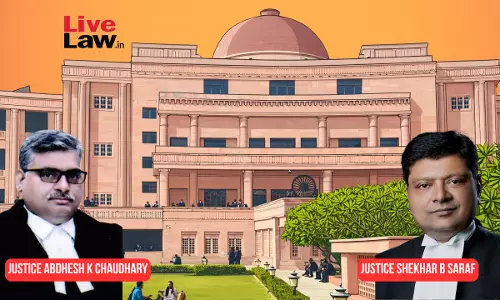
GST Writ Petition Not Maintainable After Statutory Appeal Limitation Expires: Allahabad High Court
The Allahabad High Court has held that a taxpayer cannot invoke writ jurisdiction to bypass the statutory limitation period prescribed for filing an appeal under the GST Act, refusing to entertain a challenge to an assessment order filed after the expiry of the appellate limitation period. A Division Bench comprising Justices Shekhar B. Saraf and Abdhesh Kumar Chaudhary dismissed a writ petition filed by Mishra Security Services, holding that entertaining the petition would undermine the...

Arbitral Seat Cannot Be Shifted Merely Due To Convenience Venue: Allahabad High Court
The Allahabad High Court on 27 May held that the jurisdictional seat of arbitration cannot be altered merely because arbitral proceedings were conducted at another venue for convenience, once the seat has been contractually designated. Justice Piyush Agrawal allowed the petition by Bb Coachtech India Private Limited and set aside the order of the Commercial Court, Kanpur, remanding the matter for fresh consideration. He observed: “the hearing of the arbitration may have been taken place at...
Result Of Assessment Proceedings Has Bearing On Criminal Prosecution Under GST: Allahabad High Court
The Allahabad High Court on 20 May held that the outcome of assessment proceedings can have a material bearing on criminal prosecution under the Goods and Services Tax (GST) regime. Justice Vikram D. Chauhan granted bail to Shakib Qureshi and observed that, although criminal prosecution and assessment proceedings are independent, findings in assessment proceedings may affect a criminal case. He observed: “Although criminal prosecution is not barred and are independent proceedings. However,...
Section 11 Arbitration Orders Not Reviewable, Article 215 Powers Limited: Allahabad High Court
On 14 May, the Allahabad High Court held that it cannot review an order passed under Section 11 of the Arbitration and Conciliation Act, 1996, while exercising its statutory jurisdiction. However, as a Court of Record, it may invoke its inherent powers under Article 215 of the Constitution to correct the record or remedy a grave error that may otherwise result in a failure of justice. A Bench of Justice Jaspreet Singh dismissed an application seeking recall of an earlier order constituting a...
Dealership Agreements Terminable On Notice Cannot Be Restored Through Arbitration: Allahabad High Court
The Lucknow Bench of the Allahabad High Court on 15 May held that an arbitral tribunal cannot restore a dealership agreement that either party can terminate by notice. Such a contract is determinable in nature and Section 14 of the Specific Relief Act bars its specific enforcement. A Division Bench of Chief Justice Arun Bhansali and Justice Jaspreet Singh allowed Indian Oil Corporation Limited's (IOCL) appeal, set aside the arbitral award directing restoration of the dealership, and quashed the...
Allahabad High Court Orders Release Of GST Taxpayer Over Arrest Papers Lacking CBIC-DIN
The Allahabad High Court has recently directed the release of a GST taxpayer after holding that his arrest and detention were illegal because the grounds of arrest did not bear a CBIC-DIN and the arrest memo failed to disclose the place of arrest. Petitioner Ashish Tyagi was arrested in connection with proceedings under Section 132(1)(a), 132(1)(f) and 132(1)(i) of the CGST Act, 2017 in a case initiated by the Directorate General of GST Intelligence (DGGI), Ghaziabad. The case pertained to...
Wrong Rubber Stamp Below Signature Does Not Invalidate Show Cause Notice: Allahabad High Court
The Allahabad High Court has recently held that the use of an incorrect rubber stamp beneath the signature on a show-cause notice does not create a jurisdictional defect. The Court said this would not affect jurisdiction where the authority issuing the notice is otherwise vested with powers under the relevant Act and Rules. Rejecting a jurisdictional challenge raised by Dev Trading Company to a show-cause notice issued under the Health Security se National Security Cess Rules, 2026, a Division...
Allahabad High Court Says GSTN Portal Should Allow Online Filing Of Additional Replies To Show Cause Notices
The Allahabad High Court has recently observed that the GSTN portal should be refined to allow the filing of additional or supplementary replies online. It also directed that a copy of its order be communicated to GSTN for consideration and compliance. The court noted that notices, replies, and orders are otherwise exchanged through the portal. While dealing with the rejection of Tejashva Tractors And Motors' refund application, the bench of Justice Saumitra Dayal Singh and Justice Vivek Saran...