
Supreme Court

States Cannot Levy Local VAT On Inter-State Sales Even If Sale Is Deemed To Occur Within The State: Supreme Court
The Supreme Court on Friday held that a state cannot impose its own Value-Added Tax (VAT) on a transaction that qualifies as an inter-state sale merely because the Central Sales Tax Act deems the sale to have taken place within that state for the limited purpose of identifying which state may collect tax. A bench of Justice J.K. Maheshwari and Justice Atul S Chandurkar held that where the statutory provision defining an inter-state sale conflicts with the provision determining the deemed...
Supreme Court Refuses To Interfere With Ruling In Tata Steel Case, Upholds Entry Tax On H.R. Sheets
The Supreme Court of India on Monday declined to interfere with a ruling of the Allahabad High Court that hot rolled (H.R.) coils and H.R. sheets are not the same commodity, and that tax exemption available to coils cannot be claimed for sheets, thereby restoring entry tax and penalty against Tata Steel Processing and Distribution Ltd.A Bench of Justices Sanjay Kumar and Vipul M. Pancholi found no ground to interfere with the order of the Allahabad high court and dismissed the special leave...

Supreme Court Restores VAT Appeal, Holds No Fresh Pre-Deposit Needed Where Earlier Deposit Meets 12.5% Requirement
The Supreme Court has held that the appeal filed by Telangana State Cooperative Marketing Federation Limited against a reassessment order could not be rejected for non-payment of statutory pre-deposit, as the amount already deposited by it in the earlier round of litigation exceeded the 12.5% requirement under the Telangana Value Added Tax Act. A Bench of Justice Manoj Misra and Justice Ujjal Bhuyan restored the Federation's VAT appeal before the appellate authority, holding that the statutory...
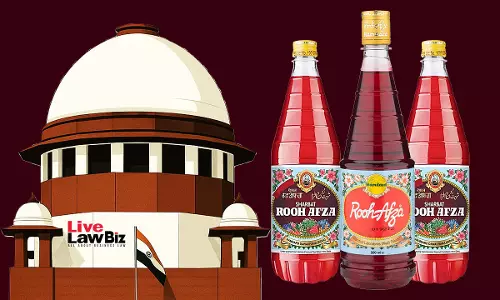
Rooh Afza Is Fruit Drink, Not Residuary Goods; Supreme Court Applies 4% VAT Under Uttar Pradesh VAT Act
The Supreme Court on Wednesday held that “Sharbat Rooh Afza” manufactured by Hamdard (Wakf) Laboratories is classifiable as a “fruit drink / processed fruit product” under Entry 103 of Schedule II Part A of the Uttar Pradesh Value Added Tax Act, 2008, and not under the residuary entry taxable at 12.5%. A Bench of Justice B.V. Nagarathna and Justice R. Mahadevan allowed the appeals and set aside the Allahabad High Court's judgments dated July 2, 2018 and August 3, 2022, which had upheld taxing...
Supreme Court Lets LG Electronics Withdraw Challenge To Rajasthan HC Entry Tax Ruling
The Supreme Court on Wednesday permitted LG Electronics India Pvt. Ltd. to withdraw its Special Leave Petitions challenging a Rajasthan High Court ruling on entry tax, granting it liberty to seek a review before the High Court as the constitutional validity of the provision remains pending. A Bench of Justices Pamidighantam Sri Narasimha and Alok Aradhe recorded the submission that the vires of the provision had not been examined in the proceedings leading to the impugned judgment, since...
Supreme Court Refuses To Interfere With Delhi HC Ruling On CST Exemption For Inter-State Sales In Mitsubishi Case
The Supreme Court of India has refused to interfere with a Delhi High Court ruling that allowed a tax exemption claimed by Mitsubishi Corporation India for inter-state sales, rejecting the tax department's argument that the benefit was unavailable because an earlier sale of the goods was already exempt from tax. A bench of Justices J.B. Pardiwala and R. Mahadevan said the case did not warrant interference. “We see no good reason to interfere in the impugned judgment and order passed by the High...
ITC Cannot Be Denied To Bona Fide Purchasers If Seller Defaults On Tax Payment : Supreme Court
The Supreme Court recently held that the Input Tax Credit (ITC) on goods purchased from registered dealers cannot be denied to bona fide purchasers merely because the seller failed to deposit the Value Added Tax (VAT) with the government.A bench of Justice Manoj Misra and Justice Nongmeikapam Kotiswar Singh observed that there was no infirmity in the order of Delhi High Court granting credit to the respondent, a bonafide purchaser. “We do not find a good reason to interfere with the order...
Dealers Cannot Claim Input Tax Credit For Purchases Linked To Exempt Sales Under UPVAT Act : Supreme Court
Emphasizing that tax statutes must be strictly construed with statutory language taking precedence over policy intent, the Supreme Court, in a case concerning the Uttar Pradesh Value Added Tax Act, 2008 (“VAT Act”), held that a dealer is not entitled to claim Input Tax Credit (“ITC”) on the purchase of goods where the subsequent sale of those goods is exempt from tax.“Section 13(7) outlines the circumstances under which such a benefit cannot be allowed. Section 13(7) also sets out that no...
Supreme Court Upholds Allahabad HC Decision That Chargers Sold With Cell Phones Cannot Be Taxed Separately Under UP VAT Act 2008
The Supreme Court recently upheld the decision of the Allahabad High Court which observed that the charger sold with a cell phone under the MRP cannot be taxed separately under the UP VAT Act 2008. The bench of Justice BV Nagarathna and Justice SC Sharma was hearing a challenge to the order of the Allahabad High Court which held that a mobile charger contained in a composite package with the cell phone cannot be taxed separately under Entry 28 Part B Schedule II U.P. VAT Act 2008. The...
Benefit Of Input Tax Credit Can't Be Reduced Without Statutory Sanction : Supreme Court
The Supreme Court recently held that Rule 21(8) of the Punjab Value Added Tax Rules, 2005, which was notified on January 25, 2014, could not be applied to transactions before April 1, 2014, as the enabling amendment to Section 13 of the parent statute, the Punjab Value Added Tax Act, 2005, was effective from that date.This means businesses that bought goods at a higher tax rate before this date are not subject to the limitation imposed by Rule 21(8) when claiming ITC, even if the tax rate was...
Gujarat Value Added Tax Act | 'Purchase Price' Definition Doesn't Include Value Added Tax : Supreme Court
While Interpreting the definition of the 'Purchase Price' under the Gujarat Value Added Tax Act of 2003 (“GVAT”), the Supreme Court on Friday (August 2) observed that the value-added tax would not be included in the definition of the purchase price. The Court held that no value-added tax would be added to the purchase price to calculate tax as the same is not mentioned in the categories of tax/duties enumerated under Section 2(18) of the GVAT. “The purchase price, therefore, would be the...

S.16 UPVAT Act | Invoices, RTGS Details Not Sufficient For Deciding ITC Claim, Transportation Details Must Be Produced: Allahabad High Court
Placing reliance on the judgment of the Supreme Court in State of Karnataka vs. M/s Ecom Gill Coffee Trading Private Limited, the Allahabad High Court has held that input tax credit cannot be granted based solely on invoices and RTGS payment details.While dealing with Section 70 of the Karnataka Value Added Tax Act, 2003 the Supreme Court in M/s Ecom Gill Coffee Trading Private Limited held that burden to prove that claim for input tax credit and the genuineness of the transaction lies solely on...