
Rooh Afza Is Fruit Drink, Not Residuary Goods; Supreme Court Applies 4% VAT Under Uttar Pradesh VAT Act
Rajnandini Dutta
26 Feb 2026 10:16 AM IST
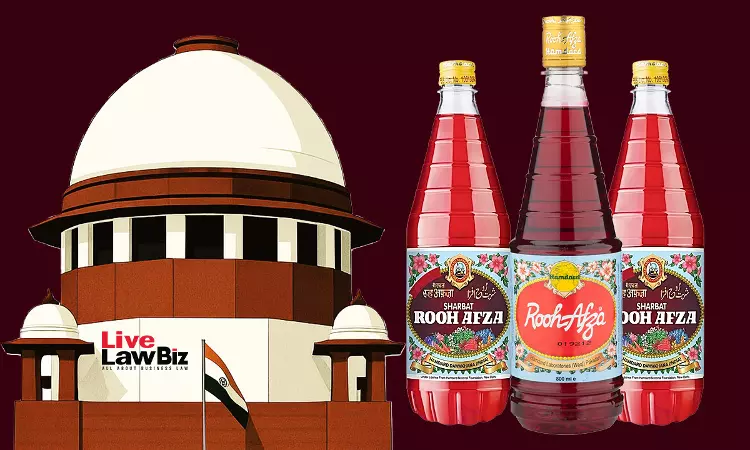
The Supreme Court on Wednesday held that “Sharbat Rooh Afza” manufactured by Hamdard (Wakf) Laboratories is classifiable as a “fruit drink / processed fruit product” under Entry 103 of Schedule II Part A of the Uttar Pradesh Value Added Tax Act, 2008, and not under the residuary entry taxable at 12.5%.
A Bench of Justice B.V. Nagarathna and Justice R. Mahadevan allowed the appeals and set aside the Allahabad High Court's judgments dated July 2, 2018 and August 3, 2022, which had upheld taxing the product under the residuary entry.
The case relates to the assessment period between January 1, 2008 and March 31, 2012. During these years, Hamdard (Wakf) Laboratories treated Rooh Afza as a fruit drink and paid VAT at 4% under Entry 103. That entry covers processed or preserved vegetables and fruits, including fruit jams, jelly, pickle, fruit squash, paste, fruit drink and fruit juice.
The Commercial Tax Department, however, treated Rooh Afza as an unclassified product under Schedule V, which applies to “all goods except goods mentioned in other Schedules,” and levied VAT at 12.5%. This view was upheld by the assessing authority, the appellate authority, the tribunal and the High Court.
In doing so, the High Court relied on the Fruit Products Order (FPO), which requires a minimum fruit juice content of 25% for a product to qualify as fruit syrup. Since Rooh Afza contains 10% fruit juice, it was treated as a “non-fruit syrup” and held not to qualify as a fruit drink for VAT purposes.
The Supreme Court rejected that reasoning. It held that regulatory enactments such as the FPO operate in a distinct domain concerned with quality control, safety, and licensing. “They are neither determinative nor conclusive for purposes of fiscal classification unless a taxing statute expressly incorporates or adopts such definitions,” the court said.
The bench noted that the term “fruit drink” is not defined under the UPVAT Act. In the absence of a statutory definition, classification must be based on how the product is understood in common or commercial parlance.
“Classification must be determined on the basis of how the product is understood in common or commercial parlance, having regard to tangible material such as its composition, product literature, label, character, and user, and not merely on technical or regulatory descriptions,” the Court said.
The court found that the tax authorities had not produced any trade enquiry, consumer survey, or market material to show that Rooh Afza is not understood in commercial circles as a fruit-based beverage preparation.
On the revenue's contention that invert sugar syrup constitutes about 80% of the product and therefore it is essentially sugar-based, the court applied the essential character test. It held that sugar syrup functions as a carrier, sweetening agent, and preservative medium, while the fruit juices and distillates impart the flavor, aroma and beverage identity.
The court observed that quantitative predominance alone is not determinative. What matters is the component that gives the product its essential character.
It further held that Entry 103 is inclusive in nature and does not prescribe any minimum percentage of fruit content. The Court declined to read into the entry a 25% threshold that the legislature had not provided.
Reiterating the principles governing residuary entries, the Bench held that the burden lies on the Department when it seeks to classify a product under the residuary entry. “Classification relates directly to chargeability; therefore, the onus of establishing applicability of a taxing entry rests upon the Department.”
It added that a residuary entry can be invoked only when a product cannot reasonably be brought within any specific entry. “Such inability must be established by the Revenue on the basis of relevant material; the residuary entry cannot be invoked merely because the specific entry is construed narrowly or because some ambiguity is perceived.”
The court also noted that in several other states, including Delhi, Gujarat, West Bengal, Madhya Pradesh, and Andhra Pradesh, Rooh Afza has been taxed under fruit-based entries at concessional rates.
Allowing the appeals, the Supreme Court held that Rooh Afza is taxable at 4% under Entry 103 during the relevant assessment years. It set aside the impugned judgments and directed the authorities to grant consequential relief, including a refund or adjustment of excess tax paid, in accordance with law.
For Appellant: Senior Advocate Arvind P. Datar, Advocate Aditya Bhattacharya, Advocate Abhishek Kumar Singh (AOR), Advocate Ritwik Tyagi, Advocate Simran Tandon, Advocate Akriti Sharma, Advocate Vipin Upadhyay.
For Respondent: Advocate Bhakti Vardhan Singh (AOR), Advocate Vikas Singh Jangra, Advocate Samar Vijay Singh, Advocate Pawan Kishore Singh, Advocate J. Tarun Kumar, Advocate Sandeep Singh Somaria