
Kerala High Court

Kerala High Court Directs SBI To Pay Interest On FD Subject To Auto-Renewal Under Its Own Circular
The Kerala High Court has recently directed the State Bank of India to pay interest on a firm's fixed deposit for the period between its maturity and May 12, 2013. The court held that SBI's own circular required the deposit to be automatically renewed in the absence of any contrary instructions.Justice M.A. Abdul Hakhim therefore, observed, "Ext.P18 Circular of the Respondent No.1 itself provides that on maturity, the Term Deposit is to be automatically renewed for the same period at the rate of...
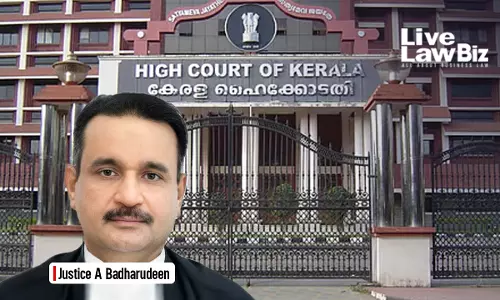
Loan To Relative Despite Earlier Default Cannot Discredit Cheque Case Under NI Act: Kerala High Court
The Kerala High Court on 16 July held that a complainant's case under Section 138 of the Negotiable Instruments Act, 1881 (NI Act) cannot be disbelieved merely because she advanced a further loan to a relative despite an earlier loan remaining unpaid, or because the accused issued a typewritten cheque. Justice A Badharudeen set aside the Magistrate's acquittal order and convicted Sreekala, the accused, for cheque dishonour under Section 138 of the NI Act, holding that Shiny Nair, the...
Kerala High Court Revises Its Guidelines On Freezing Bank Accounts Suspected Of Money Mule Activity
The Kerala High Court on 14 July held that banks can freeze accounts suspected to be “money mule” accounts based on their own assessment of suspicious activity, even without a requisition from a law enforcement agency, as they are best placed to identify such accounts. Therefore, courts must give due weight to their assessment. Justice M.A. Abdul Hakhim revised the guidelines governing the freezing of suspected money mule accounts while disposing of a petition filed by Ajith P.R. seeking a...
Minor Admitted To Partnership Firm's Benefits Not Liable For Firm's Loan Default: Kerala High Court
The Kerala High Court on 7 July held that a person admitted only to the benefits of a partnership firm as a minor cannot be treated as a defaulter for the firm's loan merely because the firm failed to repay its dues. Justice M.A. Abdul Hakhim allowed a petition filed by Dhruv Hitesh Dattani challenging adverse remarks in his CIBIL report, observing that since the partnership firm had already dissolved before he attained majority, there was no occasion for him to exercise the option under...
Kerala High Court Warns Against Misuse Of Writ Petitions By “Money Mule” Account Holders
The Kerala High Court on 10 July cautioned against the misuse of writ petitions seeking the unfreezing of bank accounts allegedly used as “money mule” accounts in cyber fraud cases, observing that account holders were increasingly filing such petitions to obtain orders allowing them to continue operating accounts used to facilitate fraudulent transactions. Justice M.A. Abdul Hakhim dismissed a writ petition seeking the unfreezing of a bank account and directed the Station House Officer, Tanur...

Article 227 Cannot Be Used To Bypass NCLAT Remedy Against NCLT Orders: Kerala High Court
The Kerala High Court on 14 July held that parties cannot invoke the High Court's supervisory jurisdiction under Article 227 of the Constitution to challenge orders passed by the National Company Law Tribunal (NCLT) when the Insolvency and Bankruptcy Code, 2016 provides an effective statutory appellate remedy before the National Company Law Appellate Tribunal (NCLAT). Justice T.R. Ravi dismissed a petition filed by Erattupetta Municipality, observing: “When a person chooses not to take any...

MODVAT Credit On Furnace Oil Cannot Be Denied For Exempt Intermediate Goods: Madras High Court
The Madras High Court has held that MODVAT credit availed on furnace oil used to manufacture exempt intermediate goods need not be reversed where such goods are captively consumed or transferred within the same company for manufacturing dutiable final products. A Division Bench of Justices Dr. G. Jayachandran and R. Sakthivel upheld Tata Refractories Ltd.'s claim for MODVAT credit on furnace oil used in manufacturing Dead Burnt Magnesite (DBM), holding that the credit could not be denied merely...
Kerala High Court Upholds Rejection Of Education Loans Over Parents' Or Co-Borrowers' Poor Credit Scores
The Kerala High Court has upheld the rejection of educational loan applications filed by a batch of students after finding that their parents or co-borrowers had unsatisfactory credit scores or adverse credit histories. "In view of the aforesaid discussion, I find that the stand of the Respondents/Banks that the Applicants are not eligible for Educational Loan on account of the lower Credit Score/unsatisfactory Credit Report of the co-borrower/parent is sustainable.", the court...

Stamp Duty Amendments On Amalgamation Cannot Apply Retrospectively: Kerala High Court
The Kerala High Court on 3 July held that amendments to the Kerala Stamp Act, 1959, introducing stamp duty on amalgamations and reconstructions, cannot be applied retrospectively to transactions completed before the amendments came into force. Justice Harisankar V Menon allowed a petition filed by Zuri Hotels and Resorts Private Limited and quashed the stamp duty demand of Rs. 2.01 crore raised by the registration authorities along with the consequential revenue recovery proceedings. He held: ...

Arbitral Award Overlooking Enabling Statute Contravenes Fundamental Policy of Indian Law: Kerala High Court
The Kerala High Court has held that overlooking the provisions of the enabling statute while passing an arbitral award is an act in contravention of the fundamental policy of Indian law. It said such a glaring contravention justifies interference under Section 34 of the Arbitration and Conciliation Act, while upholding the setting aside of an arbitral award that had enhanced compensation for land acquired for the NH-47 bypass. Justice S. Manu observed, "Above all, the arbitrator has not...
Arbitral Tribunal Can Decide Claim Between Co-Respondents Under Tripartite Agreement: Kerala High Court
The Kerala High Court has held that an arbitral tribunal can decide a claim raised by one respondent against another under a tripartite agreement where the parties have agreed to refer all disputes arising out of the contract to arbitration. The court ruled that although the claim had been labelled a "counterclaim", it was, in substance, an independent contractual claim between parties to the same agreement. It also noted that Section 19 of the Arbitration and Conciliation Act, 1996 makes it...

Karnataka High Court Remands Quikr's ₹1.77 Crore Stamp Duty Dispute Over NCLT-Approved Amalgamation
The Karnataka High Court has set aside an order directing Quikr India Private Limited, which operates the online classifieds platform Quikr, to pay an additional ₹1.77 crore as stamp duty on a National Company Law Tribunal (NCLT)-approved scheme of amalgamation. The matter has been remitted to the District Registrar for fresh consideration. Justice M.G.S. Kamal observed that, for the purpose of levying stamp duty under the Karnataka Stamp Act, 1957, the NCLT's order approving the amalgamation...