
Supreme Court
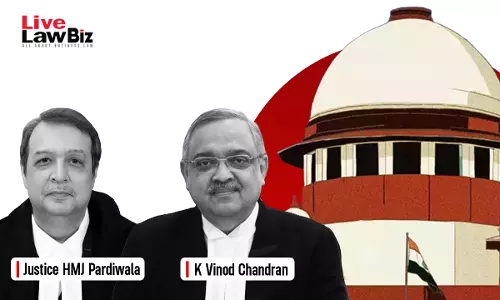
Taxpayer Cannot Revise Income-Tax Return Under Garb Of Revision After Deadline: Supreme Court
The Supreme Court has ruled that an assessee cannot use a revision remedy to effectively alter an income-tax return after the time allowed for filing a revised return has expired.A bench of Justice J.B. Pardiwala and Justice K. Vinod Chandran held that the assessee could not invoke Section 264 of the Income Tax Act, 1961 to revise its return after failing to do so within the prescribed period. The court set aside a Bombay High Court order that had remanded the case of Om Siddhakala Associates...
Defences Against Insider Trading Given Under 2015 SEBI Regulations Not Exhaustive, But Must Be Similar: Supreme Court
The Supreme Court on Tuesday ruled that the defences available against an insider trading allegation under the Securities and Exchange Board of India (Prohibition of Insider Trading) Regulations, 2015 are not exhaustive. Any additional defence, however, must be of the same or similar nature as those specifically listed in the regulations.The court was considering the six specific defences set out under Regulation 4(1) of the SEBI (Prohibition of Insider Trading) Regulations, 2015, which provides...
Rule 96(10) CGST Rules | Supreme Court Says Deleted Restriction On IGST Refunds Cannot Apply To Claims Pending On Omission
The Supreme Court has ruled in favour of exporters seeking refunds of integrated tax paid on exports, holding that a restriction that had earlier prevented some of them from claiming such refunds cannot be applied to their cases if the refund proceedings were pending when the restriction was removed.The restriction was contained in Rule 96(10) of the Central Goods and Services Tax Rules, 2017. Before it was omitted on October 8, 2024, the rule restricted refunds of integrated tax paid on exports...

Supreme Court Refers Non-Signatory Consultant Shareholder To Arbitration In Share Acquisition Dispute
The Supreme Court has held that a non-signatory consultant-shareholder whose performance under a separate Share Purchase Agreement is fundamental to completing a Memorandum of Settlement (MoS) can be treated as a "veritable party" to the settlement's arbitration agreement. Allowing an appeal filed by KKH Finvest Private Limited and Sensorise Digital Services Private Limited, a Division Bench of Justice Sanjay Kumar and Justice Sanjeev Sachdeva observed, "it is clear that the performance of his...

Delhi High Court Stays FSSAI Order Restricting Sale Of Dabur Products With '100% Natural', '100% Pure' Claims
The Delhi High Court on Friday stayed the Food Safety and Standards Authority of India's (FSSAI) prohibitory order restraining Dabur India Limited from selling several food products carrying "100% pure" or "100% natural" claims, prima facie holding that the regulator acted in violation of the principles of natural justice.Justice Amit Mahajan stayed FSSAI's August 3, 2026,, order after observing that Dabur had neither been issued a show-cause noticenor beenr given an opportunity of hearing...
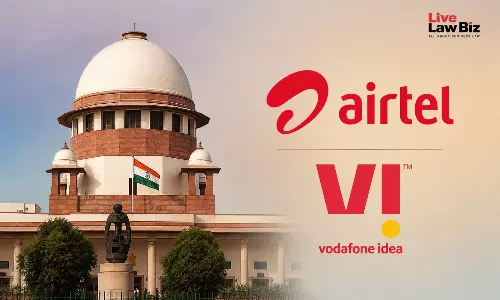
Supreme Court Issues Notice On Centre's Plea Against HC Order Quashing Spectrum Charges On Airtel, Vodafone Idea
The Supreme Court on Friday issued notice on the Union of India's appeal challenging the Bombay High Court's judgment quashing the Department of Telecommunications' (DoT) decision and demand notices imposing one-time spectrum charges (OTSC) on Bharti Airtel and Vodafone Idea. The Court held that although spectrum is a scarce natural resource held by the State in public trust, the Government remained bound by the terms of the licence agreements executed under Section 4 of the Telegraph Act...

Supreme Court Refuses To Stay Delhi HC Order Restraining Kent RO From Using KENT Mark For Fans
The Supreme Court on Friday refused to interfere with the Delhi High Court's interim order restraining Kent RO Systems from manufacturing and selling fans under the 'KENT' mark while permitting Kent Cables Pvt. Ltd. to continue using the mark for fans.The dispute arises from cross-suits between the parties over use of the 'KENT' mark for fans. The Delhi High Court had held that Kent Cables was the prior adopter of the mark for electrical goods and had prima facie established use of the mark for...
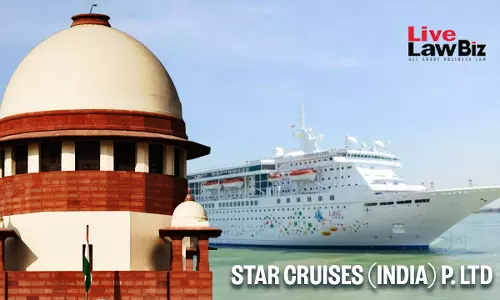
Cruise Does Not Cease To Be 'Carriage Of Passengers' Under Income Tax Act Because Of Onboard Hospitality: Supreme Court
The Supreme Court has recently ruled that hospitality and entertainment offered on board a cruise do not alter the essential nature of the activity as the carriage of passengers under the Income Tax Act. Ruling on the applicability of the presumptive taxation regime for non-resident shipping companies under Section 44B, the court observed that ancillary services provided during a voyage do not take the operation outside the scope of the provision.A bench of Justices S.V.N. Bhatti and N.V....
Star Health Data Breach: Supreme Court Directs Cybersecurity Expert To Appear Before Trial Court, Furnish Bail Bonds
The Supreme Court on Thursday directed cybersecurity researcher Himanshu Pathak to appear before the XI Metropolitan Magistrate, Chennai, and furnish bail bonds in the criminal case lodged against him by Star Health and Allied Insurance Company. The direction came while the Court was hearing Pathak's challenge against a Madras High Court judgment refusing to interfere with criminal proceedings initiated on Star Health's complaint.A bench of Chief Justice Surya Kant and Justices Joymalya Bagchi...
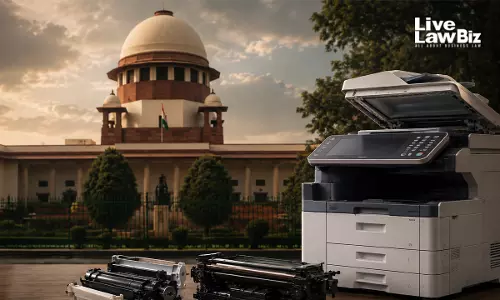
Xerox's 'Kitting' Of Imported Photocopier Modules Is Not 'Manufacture': Supreme Court Upholds CESTAT Ruling
The Supreme Court has held that Xerox India's practice of grouping, plugging and pinning imported photocopier modules according to customers' requirements, commonly known as "kitting", did not amount to "manufacture" under Section 2(f) of the Central Excise Act, 1944. As no manufacturing activity was found, the company was not liable to pay central excise duty. The court reiterated that a process amounts to manufacture only if it results in a new product with a distinct name, character, and...
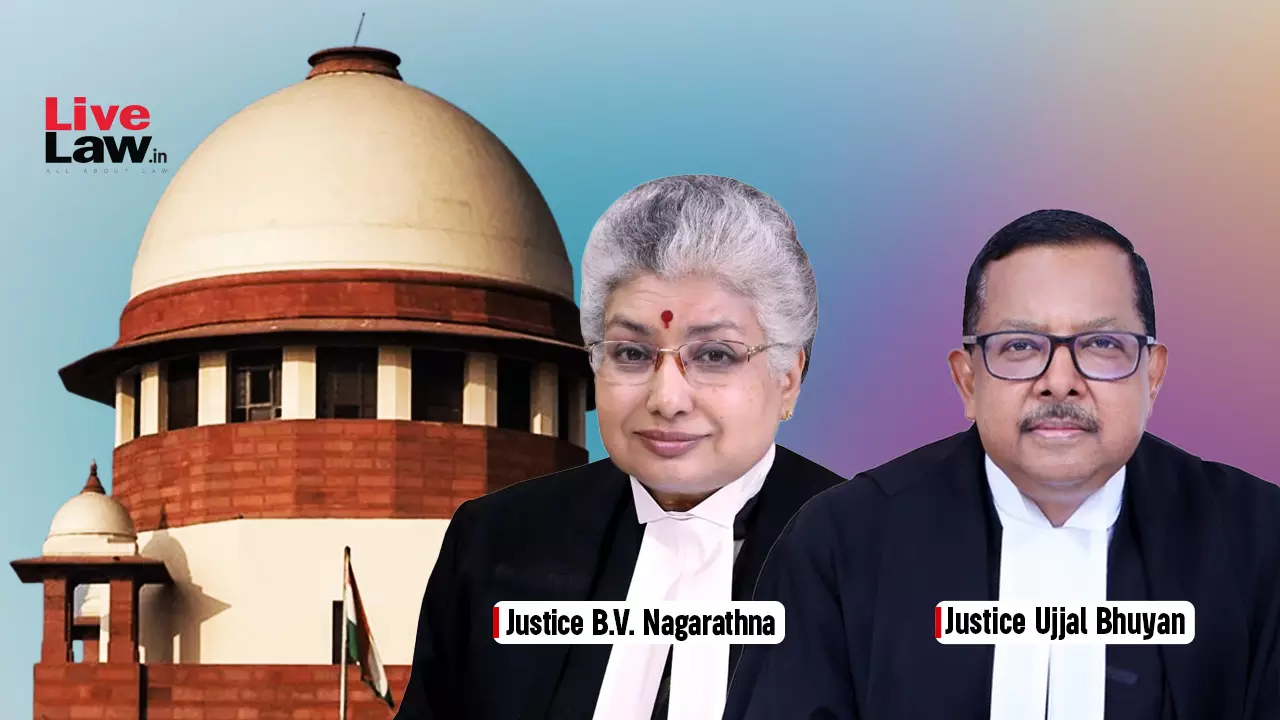
Mere Denial Can't Rebut Cheque Bounce Presumption, Accused Must Produce Probable Evidence: Supreme Court
The Supreme Court on Tuesday ruled that simply denying liability is not enough to rebut the statutory presumptions available to a complainant in a cheque bounce case. Once the execution of a cheque or the signature on it is admitted, the burden shifts to the accused, who must place probable material on record to show that no legally enforceable debt or liability existed.A Division Bench of Justice B.V. Nagarathna and Justice Ujjal Bhuyan observed,"A bare denial of the passing of any...
Uncrystallised EPFO Interest, Damages Are Contingent Liabilities Under IBC: Supreme Court
The Supreme Court has recently held that interest and damages on unpaid provident fund dues, if not determined before the commencement of the Corporate Insolvency Resolution Process (CIRP), are contingent liabilities. "Though PF dues are excluded from the liquidation estate under Section 36(4)(iii) of IBC, liability of CD towards interest and damages payable under Section 7Q and 14B of the 1952 Act, if not determined and finalized before CIRP commencement, would fall in the category of a...