
Kerala High Court
RBI Banking Ombudsman Cannot Review Or Recall Order After Disposing Complaint: Kerala High Court
The Kerala High Court has recently held that the RBI Banking Ombudsman has no authority to review or recall an order after disposing of a complaint, observing that the Ombudsman becomes functus officio once the proceedings conclude. "As a matter of fact, Banking Ombudsman has no right or authority to review or recall the original Ext.P4 Order. After disposal of the complaint, the Banking Ombudsman becomes functus officio. Accordingly, I find that Ext.R3(c) Order passed by the Banking Ombudsman...

KSEB Cannot Demand Previous Owner's Power Dues From Auction Purchaser: Kerala High Court
The Kerala High Court on Tuesday held that the Kerala State Electricity Board (KSEB) cannot insist that an auction purchaser of the assets of a company in liquidation clear the previous consumer's electricity arrears as a condition for obtaining a fresh electricity connection.A Division Bench of Justice A.K. Jayasankaran Nambiar and Justice Preeta A.K. ruled that the Electricity Act, 2003, the Kerala Electricity Supply Code, 2005; and the KSEB Terms and Conditions of Supply, 2005 do not...

Trade Marks Registry Cannot Remove Trademark Without Mandatory Notice: Kerala High Court
The Kerala High Court has held that the Trade Marks Registry cannot remove a registered trademark from the register without first complying with the mandatory notice requirement under Section 25(3) of the Trade Marks Act, 1999. Justice Shoba Annamma Eapen observed that the Registry was required to issue mandatory notice before removing the mark and held, "In the absence of compliance with the mandatory requirement of issuance of such notice under Section 25(3) of the Act, 1999, the respondents...
Director Must Prove He Was Not Responsible For Company's Unpaid VAT: Kerala High Court
The Kerala High Court has recently held that when tax authorities seek to recover a company's tax dues from one of its directors under the Kerala Value Added Tax (KVAT) Act, the burden is on the director to prove that the non-recovery was not caused by his negligence, misfeasance or breach of duty.",,as per Section 39 of the KVAT Act, the onus to prove that the non-recovery was not on account of negligence, misfeasance or breach of duty attributable to the Director, is on the said person and not...
Absence Of Audit Not A Ground To Reject KVAT Return Revision: Kerala High Court
The Kerala High Court on 15 July held that a taxpayer's request to revise returns under the Kerala Value Added Tax (KVAT) Act cannot be rejected solely because its accounts were not audited under Section 42 of the Act. A Bench of Justice Harisankar V. Menon allowed the petition filed by Bhima Enterprises, holding: “A reading of the aforesaid order would show that it pertains to the transportation of certain gold jewellery allegedly not supported by the documents required under the statute. In...
Court-Recorded Compromise In Arbitration Dispute Can Be Executed: Kerala High Court
The Kerala High court has held that a compromise recorded while disposing of proceedings under Section 9 of the Arbitration and Conciliation Act, 1996 is executable. It observed that a party which voluntarily enters into a settlement, secures its benefits and invites the court to pass an order in terms of the compromise cannot later contend that the order is unenforceable.Justice T.R. Ravi said, "After having arrived at a settlement and having invited the court to pass an order in terms of the...

Kerala High Court Quashes Stamp Duty Demand On Bank For ATM Installation In 2016
The court held that the authority lacked statutory power to recover the alleged deficit before amendment made in 2019

Kerala High Court Allows Handwriting Test Of Disputed Cheques In PTB Chits Cheque Dishonour Cases
The Kerala High Court on 29 June held that an accused facing prosecution for cheque dishonour under Section 138 of the Negotiable Instruments Act, 1881 cannot be denied an opportunity to seek expert handwriting examination of a disputed cheque when the complainant specifically claims that the accused personally filled the cheque entries.Justice G. Girish considered petitions filed by PTB Chits Private Limited and its directors challenging orders of the Judicial First Class Magistrate Court,...

Right To Cross-Examination Cannot Be Denied Over Unretracted GST Statements: Kerala High Court
The Kerala High Court on 8 July held that GST authorities cannot reject a taxpayer's request to cross-examine witnesses merely because the witnesses have not retracted their earlier statements, observing that cross-examination is necessary to test the truthfulness of evidence relied upon during adjudication. Justice A.A. Ziyad Rahman passed the order while allowing the writ petition filed by Emas Gold and Diamonds LLP against a GST adjudication order passed following an investigation by the...
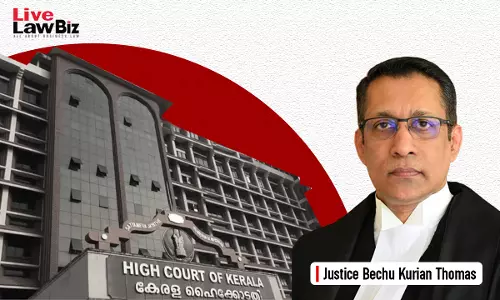
Kerala High Court Orders Registrar To Decide Trademark Applications Pending For Over A Decade In Three Months
The Kerala High Court has directed the Registrar of Trademarks to consider and pass orders on two trademark registration applications that have remained pending since 2012 and 2014, directing that a decision be taken within three months. Justice Bechu Kurian Thomas observed that the applications filed by Nisar Ali Pari, proprietor of Bella Bathware, had remained undisposed of despite the passage of more than a decade. "Despite the lapse of more than a decade, the applications have not been...
Kerala High Court Directs SBI To Pay Interest On FD Subject To Auto-Renewal Under Its Own Circular
The Kerala High Court has recently directed the State Bank of India to pay interest on a firm's fixed deposit for the period between its maturity and May 12, 2013. The court held that SBI's own circular required the deposit to be automatically renewed in the absence of any contrary instructions.Justice M.A. Abdul Hakhim therefore, observed, "Ext.P18 Circular of the Respondent No.1 itself provides that on maturity, the Term Deposit is to be automatically renewed for the same period at the rate of...
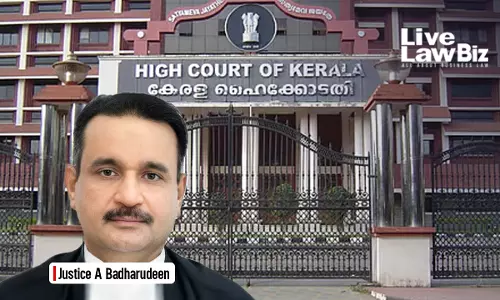
Loan To Relative Despite Earlier Default Cannot Discredit Cheque Case Under NI Act: Kerala High Court
The Kerala High Court on 16 July held that a complainant's case under Section 138 of the Negotiable Instruments Act, 1881 (NI Act) cannot be disbelieved merely because she advanced a further loan to a relative despite an earlier loan remaining unpaid, or because the accused issued a typewritten cheque. Justice A Badharudeen set aside the Magistrate's acquittal order and convicted Sreekala, the accused, for cheque dishonour under Section 138 of the NI Act, holding that Shiny Nair, the...