
Delhi High Court
Quashing Of Show Cause Notice On One Issue Doesn't Mean Other Demands Are Not Liable To Be Adjudicated: Delhi High Court
The Delhi High Court has made it clear that if a show cause notice is quashed by a higher authority on one issue, it doesn't mean that other issues raised in the SCN are not liable to be adjudicated.The observation was made by the bench of Justices Prathiba M. Singh and Dharmesh Sharma in a case where the SCN was quashed by another division bench of the High Court so far as the issue relating to duty on free supply of materials was concerned. However, the CESTAT proceeded to discharge the entire...
Customs Department Must Intimate Party About Disposal Of Confiscated Property Both Via Email And On Mobile: Delhi High Court
The Delhi High Court has held that the Customs Department must ensure that the intimation of disposal of detained or confiscated property is given to the concerned party both via email as also the mobile number.A division bench of Justices Prathiba M. Singh and Dharmesh Sharma reasoned this will ensure that a party who succeeded in Court or Tribunal against the detention of the property is not deprived of their properties.The observation was made while dealing with a case where despite the order...

TPO's Role Is To Determine ALP Of International Transactions, Can't Act As AO To Probe Legitimacy Of Such Transactions: Delhi High Court
The Delhi High Court has made it clear that the role of a Transfer Pricing Officer is to conduct a transfer pricing analysis and determine the arm's length price of an assessee's international transaction and the TPO cannot act as an Assessing Officer to probe the legitimacy of such transactions.A division bench of Justices Vibhu Bakhru and Swarana Kanta Sharma observed, “It is necessary to bear in mind that there is a distinction between the functions of a TPO and an AO. The TPO is required to...
ALP Not Concerned With Commercial Expediency Of International Transaction, Assessee Reporting Loss Not Grounds To Deem ALP Nil: Delhi HC
The Delhi High Court has held that a Transfer Pricing Officer cannot compute the arm's length price of an assessee's international transactions as nil, merely because despite the services availed from such transactions, the assessee incurred a loss in business.A division bench of Justices Vibhu Bakhru and Swarana Kanta Sharma observed that the TPO cannot weigh the ALP on the basis of financial benefits or commercial expediency of the transactions in question.It held, “The question whether the...

Delhi High Court Orders Customs To Release Traveller's Gold Worth ₹20 Lakh, Iphone, Playstation & More Over Failure To Issue SCN
The Delhi High Court recently ordered the Customs authorities to release a traveller's gold worth over ₹14 lakh and other branded articles like iPhone, PlayStation, etc. over the authority's failure to issue him a show cause notice.Section 124 of the Customs Act, 1962 contemplates issuance of a show cause notice before confiscation of goods.The Petitioner had landed at Delhi International airport with his family. He was intercepted carrying a gold chain, another three layered gold chain with...
High Court Within Whose Jurisdiction AO Passes Assessment Order Has Jurisdiction To Entertain Appeal U/S 260A Income Tax Act: Delhi HC
The Delhi High Court has reiterated that only such High Court within whose jurisdiction the Assessing Officer passing an impugned assessment order is situated would have the jurisdiction to entertain an appeal under Section 260A of the Income Tax Act, 1961.The Section makes provision for an appeal to the High Court from an order passed in appeal by the Appellate Tribunal.In the case at hand, the original assessment order was passed by the AO in Amritsar, making an addition of ₹4,37,046/- to the...
Transfer Pricing | Resolution Under Mutual Agreement Procedure Is By Consensus, Cannot Be Imposed Upon Assessee: Delhi HC
The Delhi High Court has made it clear that a dispute with respect to arm's length price in a transfer pricing can be resolved under Mutual Agreement Procedure (MAP) only by consent and negotiations between contracting parties.A division bench of Justices Vibhu Bakhru and Swarana Kanta Sharma observed that such a resolution cannot be imposed in a contested case, where there is no consensus.MAP procedure is based on an agreement between the competent authorities of the contracting states, which...

Delhi High Court Upholds Arbitral Award Against IRCTC In Dispute Over Reimbursement For Catering Services, Sets Aside Interest As 'Patently Illegal'
The Delhi High Court bench comprising Justice Navin Chawla and Justice Shalinder Kaur has reiterated the limited scope of interference under Sections 34 and 37 of the Arbitration and Conciliation Act, 1996 (“A&C Act”). The court upheld the arbitral award granted in favour of M/s Brandavan Food Products Ltd. (“Claimant”) in a dispute regarding the reimbursement of differential costs for meals and beverages supplied under a catering contract with the Indian Railways Catering and...
Award Cannot Be Set Aside When No Objections Were Raised Before Arbitrator Or Court U/S 12(5) Of Arbitration Act: Delhi High Court
The Delhi High Court bench of Justices C. Hari Shankar and Ajay Digpaul held that the award cannot be set aside solely on the ground that the appointment of the Arbitrator was illegal in view of section 12(5) of the Arbitration and Conciliation Act (Arbitration Act) when no such objections were raised before the Arbitrator or the court under section 34 of the Arbitration Act. Brief Facts: The dispute arose from a license agreement executed between Bhadra International India Pvt....
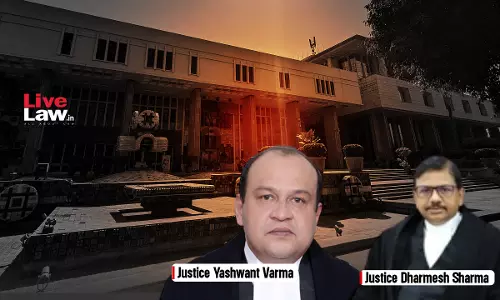
S.107 CGST Act Prescribes Independent Regime Of Limitation For Filing Appeals, Application Of S.5 Limitation Act Stands Excluded: Delhi HC
The Delhi High Court has held that since Section 107 of the Central Goods and Services Tax Act, 2017 prescribes an “independent regime” to determine the limitation period for filing statutory appeals, the provision for condonation of delay under Section 5 of the Limitation Act stands excluded.A division bench of Justices Yashwant Varma and Dharmesh Sharma observed, “The facility to seek condonation can be resorted provided the legislation does not construct an independent regime with respect to...
No Unfettered Right To Cross-Examine Person Making Statements U/S 138(B) Customs Act: Delhi High Court
The Delhi High Court has made it clear that a person facing charges under the Customs Act, 1962 does not have an unfettered right under Section 138B, to cross-examine the informant or person making incriminatory statements.Section 138(B) of the Customs Act of 1962 deals with the admissibility of statements made during customs proceedings.A division bench of Justices Prathiba M. Singh and Dharmesh Sharma relied on Kanungo & Co. v. Collector of Customs, Calcutta and Others (1983) where a...