
Delhi High Court

Uniqueness' Not A Statutory Test For Refusing Trademark Registration: Delhi High Court
The Delhi High Court has recently set aside an order refusing registration of the trademark 'OFFER' for alcoholic beverages. It held that the Registrar of Trade Marks rejected the application by applying the non-statutory test of "uniqueness" instead of examining whether the mark was distinctive in relation to the goods for which registration was sought.Justice Jyoti Singh was hearing an appeal filed by ADS Spirits, which had applied to register the mark OFFER in Class 33 for "alcoholic...
Delhi HC Allows SC, HC Judges To Show Allowances As 'Receipts Not In Nature Of Income' Under New Tax Regime
The Delhi High Court, by way of an interim direction, has allowed Supreme Court and High Court judges to file their income tax returns by showing prescribed judicial allowances as “receipts not in the nature of income”, even while opting for the new tax regime.The order came in a petition filed by the Delhi Tax Bar Association challenging a September 12, 2025, Office Memorandum issued by the CBDT, which, according to the petitioner, denied judges opting for the new tax regime the benefit of...
Delhi High Court Refuses To Examine GST Liability On Diagnostic Services, Directs Petitioner To AAR
The Delhi High Court has recently refused to examine a challenge to the levy of 18% Goods and Services Tax (GST) on diagnostic services rendered by a private lab, observing that the issue falls within the jurisdiction of the Authority for Advance Ruling (AAR) under the GST Act, 2017.A division bench of Justices Anil Kshetrapal and Amit Mahajan disposed of two writ petitions filed by a company after being informed that the vacancy in the Delhi Authority for Advance Ruling had been filled, thereby...

'Government Cannot Be Held Ransom': Delhi High Court Upholds Rejection Of Vedanta's Oil Block Contract Extension Bid
The Delhi High Court on Wednesday upheld the Union Government's decision rejecting Vedanta Ltd's application for a ten-year extension of its Production Sharing Contract (PSC) for an offshore oil and gas block in Gujarat.Observing that the government "cannot be held ransom to the whims of a private company", the court held that Vedanta had rendered itself ineligible for an extension. It found that the company had unilaterally deducted the Government's share of Profit Petroleum towards its Special...
Delhi High Court Temporarily Restrains NBFC From Using 'Zepto' And 'Zepto Finance' Marks
The Delhi High Court has temporarily restrained an NBFC, Naman Finlease, and its directors from using the marks 'Zepto' and 'Zepto Finance' for their lending business. Justice Jyoti Singh passed the ad-interim order in a trademark infringement suit filed by quick-commerce platform Zepto, represented by Senior Advocate Swati Sukumar. Zepto submitted that it is the registered proprietor of the word mark and device mark ZEPTO, a coined term with no descriptive meaning or connection to any...
Delhi High Court Restrains Havai Home Products From Using 'HAVAI' Mark in Havells Passing Off Suit
The Delhi High Court has restrained Havai Home Products Pvt. Ltd. and the proprietor of Advance Coolers from selling, marketing, advertising, or offering for sale electrical goods under the marks 'HAVAI' and its device forms. The court held that the marks are deceptively similar to Havells' registered trademarks. Justice Jyoti Singh granted the interim injunction in a suit filed by Havells India Limited. The Court found that Havells had made out a prima facie case of passing off. Havells, an...
Delhi High Court Refuses Stay On Encashment Of Bank Guarantees In Jodhpur Railway Station Redevelopment Dispute
The Delhi High Court has refused an interim plea under the Arbitration and Conciliation Act seeking to restrain North Western Railway from invoking performance bank guarantees worth about ₹17.24 crore furnished under a ₹474.52 crore EPC contract for the redevelopment of Jodhpur Railway Station. The court held that the contractor had failed to establish the limited grounds on which unconditional bank guarantees can be restrained.Justice Subramonium Prasad held that the contractor had neither...
No Fresh Notice Needed After Award Is Set Aside If Arbitration Was Already Invoked: Delhi High Court
The Delhi High Court on 16 July held that a party need not issue a fresh notice under Section 21 of the Arbitration and Conciliation Act, 1996 (which marks commencement of arbitral proceedings) before seeking appointment of a new arbitrator after an arbitral award is set aside, if arbitration had already commenced through a valid notice. A Single-Judge Bench of Justice Subramonium Prasad rejected the objection raised by Sumant Aggarwal and others and appointed Mr. Kapil Sankhla as the sole...
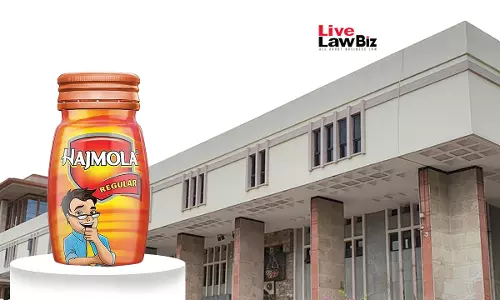
Delhi High Court Temporarily Restrains MDL Herbal From Using “HAJMOLA” Mark In Dispute With Dabur
The Delhi High Court on 8 July granted an ex-parte ad-interim injunction in favour of Dabur India Limited and restrained the proprietor of MDL Herbal Dhanvanatri Ayurvedic Mahamritunjay from using the mark “HAJMOLA” or any deceptively similar mark. Justice Anup Jairam Bhambhani held that Dabur had established a prima facie case of trademark infringement and passing off. He observed:“In the opinion of this court, the plaintiff has made-out a prima facie case in its favour and against the...
Delhi High Court Rules Section 43(3) Of Arbitration Act Cannot Save Void Arbitration Clause
The Delhi High Court has recently held that a provision empowering courts to extend the contractual time for commencing arbitration in cases of undue hardship cannot, by itself, validate a contractual clause that is otherwise void under the law.Referring to Section 43(3) of the Arbitration and Conciliation Act, 1996, the court observed,"The provision does not validate or positively enact the enforceability of contractual time-bar clauses. It addresses only the limited question of whether a court...
Delhi High Court Protects “BATA” From Counterfeiters, Directs Flipkart To Remove Infringing Listings
The Delhi High Court on 8 July granted an ex-parte ad interim injunction in favour of Bata India Limited, restraining the two individuals from selling or promoting footwear under the BATA trademark.A Bench of Justice Jyoti Singh also directed Flipkart Internet Pvt. Ltd. to remove the infringing listings, holding that identical marks and identical goods are likely to cause confusion and constitute prima facie infringement and passing off. She observed: “The marks being identical and the rival...
Delhi High Court Upholds Award In Turner Morrison's Construction Cost Recovery Dispute Against NIRLAC
The Delhi High Court on 16 July held that Courts cannot interfere under Section 37 of the Arbitration and Conciliation Act with an arbitral tribunal's plausible interpretation of a contract merely because another view is possible, while dismissing Turner Morrison Ltd.'s appeal against parts of an award. A Division Bench of Justices Anil Kshetrapal and Amit Mahajan upheld the tribunal's interpretation of the Construction Agreement with the Namgyal Institute for Research on Ladakhi Art and...