
Bombay High Court

Bombay High Court Quashes Fresh Scrutiny Of Thomson Reuters Over Modified Return Filed After Merger
The Bombay High Court on 8 September quashed the fresh scrutiny and transfer pricing proceedings initiated against Thomson Reuters International Services Private Limited for Assessment Year 2022-23. A Division Bench of Justices B.P. Colabawalla and Farhan P. Dubash held that filing a modified return after a business reorganisation does not require a fresh assessment when proceedings for the same year are already pending. Under Section 170A(2)(b) of the Income Tax Act, the modified return must...
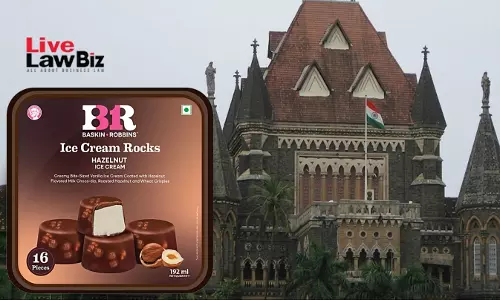
Bombay High Court Rejects Baskin Robbins Licensee Graviss Foods' 'ICE CREAM ROCKS' Trademark Bid
The Bombay High Court on 16 September dismissed petitions filed by Graviss Foods, the Indian licensee of Baskin Robbins, challenging the Registrar of Trade Marks' rejection of its applications to register “ICE CREAM ROCKS”. Justice Somasekhar Sundaresan observed that the phrase “ICE CREAM ROCKS” is too generic and descriptive to acquire distinctive character warranting trademark protection. The Bench observed: “Merely adding 'ROCKS' to 'ICE CREAM' does not turn the needle in favour of making...
Future Redevelopment Potential Cannot Be Treated As Certain Benefit For Stamp Duty Valuation: Bombay High Court
The Bombay High Court has held that future redevelopment potential of a property cannot be treated as a present and certain benefit while determining its market value for stamp duty. The uncertainty, expenses, delay, and legal difficulties involved in realising that potential must also be considered.Justice Amit Borkar observed, “A purchaser may be willing to pay something for future potential. But such potential cannot be treated as a present and certain benefit without considering the...
Bombay High Court Directs Department Not To Reassess Taxpayers Challenging Income Tax Act Sec. 147A
The Bombay High Court on 2 September directed the Income Tax Department not to proceed with reassessment proceedings against taxpayers who have challenged and pressed the constitutional validity of Section 147A of the Income Tax Act, 1961, including in petitions not presently listed with the main batch of cases. A Division Bench of Justices B.P. Colabawalla and Farhan P. Dubash passed the interim order in a batch of petitions led by Bharat Petroleum Corporation Limited. The judges extended the...

Bombay High Court Condones 530-Day Delay In Foreign Award Enforcement Amid Limitation Uncertainty
The Bombay High Court has condoned a 530-day delay in seeking enforcement of a foreign arbitral award, holding that the uncertainty over the limitation period applicable to enforcement of foreign awards constituted sufficient cause for the delay.Justice Arif S. Doctor observed that the delay arose from “the lack of clarity in the law at the time regarding the applicable period of limitation for the enforcement of a foreign award” and not from ignorance or misunderstanding of the law. The court...

State's Government Dues Cannot Override Secured Creditor's Priority By Mere Attachment: Bombay High Court
The Bombay High Court has ruled that merely attaching a property for recovery of government dues does not give the State priority over a secured creditor when the prescribed proclamation procedure has not been followed. The court also noted that the State's affidavit was silent on whether its claim had ever been registered with CERSAI.“By simply attaching the property and taking no steps towards proclamation in the manner as required, for recovery of dues, would not give priority to the said...

Assessment Order Need Not Discuss Every Claim; Reopening Same Issue Is 'Change Of Opinion': Bombay High Court
The Bombay High Court has ruled that an income tax assessment cannot be reopened where the record shows that an issue was examined during scrutiny and the assessee's claim was accepted, even if the original assessment order did not expressly discuss the issue.The bench of Justice B.P. Colabawalla and Justice Farhan P. Dubash observed that “it is not necessary for an Assessing Officer to discuss each and every issue elaborately to disclose his satisfaction” when accepting an assessee's claim. The...
“Defies All Logic”: Bombay High Court Directs Stock Exchange To Refund ₹10.58 Lakh For Annulled Share Trade
The Bombay High Court has held that the Stock Exchange, Bombay, could not insist on physical delivery of shares after the underlying trade had been annulled. Justice Aarti Sathe observed that forcing stockbroker Bipin Kantilal Kapadia to take delivery of shares that did not exist after annulment was “an action which defies all logic.”The court accordingly directed the Exchange to refund ₹10.58 lakh to Kapadia, with 9% interest from the date of filing of the suit until payment or realisation. It...

Bombay High Court Allows Microsoft's Plea Against ₹1.40 Crore VAT, CST Interest Demand
The Bombay High Court has ruled in favour of Microsoft Corporation (India) Pvt. Ltd. in a dispute over interest on VAT and CST payments. The court held that the company could not be treated as having delayed payment when it had paid tax within the time allowed for its six-monthly returns.“The present is a case where the tax has been paid in terms of the timeline prescribed by the Act and the rules as indicated earlier,” a Division Bench of Justice M.S. Karnik and Justice Sandesh D. Patil ruled....

Bombay High Court Quashes Criminal Case Against Britannia Dairy Over Sale Of Unsafe Cheese Cubes
The Bombay High Court on Friday quashed criminal proceedings against Britannia Dairy Pvt Ltd over allegations of unsafe cheese cubes, finding that the company was denied key statutory safeguards.Britannia was notified nearly six months after the product's shelf life had expired, while the Food Analyst's report was never furnished to it.“Considering the aforenoted facts, submissions, and settled position of law, I am of the considered opinion that the Applicant has made out a fit case for this...
Even Peripheral Question On Customs Duty Rate Can Take CESTAT Appeal To Supreme Court: Bombay High Court
The Bombay High Court has held that even a peripheral question touching the rate of customs duty can fall outside the High Court's appellate jurisdiction. Such an appeal would lie directly before the Supreme Court under Section 130E of the Customs Act, 1962.A Division Bench of Justice B.P. Colabawalla and Justice Farhan P. Dubash dismissed the Revenue's appeals against a CESTAT Mumbai order in favour of J M Baxi & Co. and others. The dispute concerned duty exemption on “stores” imported for...

Bombay High Court Says Income Tax Assessment Cannot Stand On Quashed Revision Order
The Bombay High Court has ruled that an assessment order cannot survive when the revision order on which it was based has already been quashed by the income tax tribunal.Justice G.S. Kulkarni and Justice Dr. Neela Gokhale observed that the Assessing Officer could not have proceeded with the assessment after the tribunal had quashed the underlying Section 263 order. The court also rejected the Revenue's contention that the pending challenge against the tribunal's decision changed this...