
Validity Of Vote Cast On Behalf Of Society At Company's AGM Cannot Be Decided By Who Voted First: Supreme Court
Kirit Singhania
3 Jun 2026 11:36 AM IST
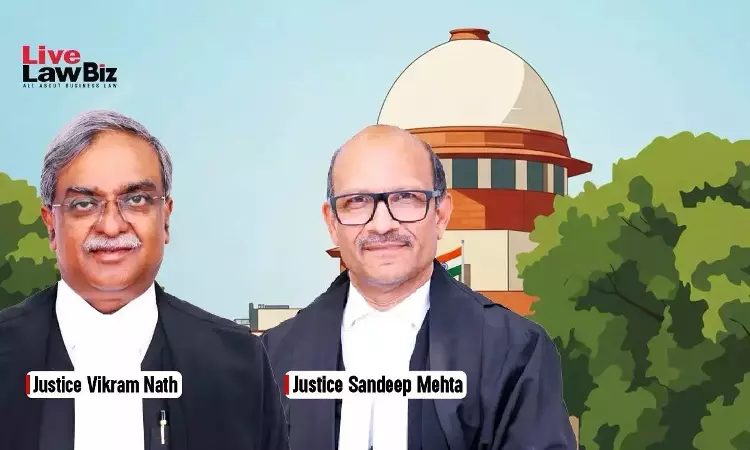
The Supreme Court has recently held that the validity of a vote cast on behalf of a society at a company's annual general meeting cannot be determined merely by who voted first. The Court ruled that voting authority must flow from the society's governing documents and the statutory framework regulating electronic voting.
A bench of Justices Vikram Nath and Sandeep Mehta allowed appeals filed by Hindustan Medical Institution, Eastern India Educational Institution and Belle Vue Clinic, all shareholders in Birla Corporation Ltd. The court also partly allowed connected appeals filed by Anamika Lodha. It set aside a Calcutta High Court judgment that had directed that the first vote cast on behalf of a society should be taken into account regardless of whether it was cast through the Board of Trustees or the Managing Committee.
The bench said that such an approach was contrary to both the societies' governing documents and the legal framework governing corporate voting.
"It is further held that the direction in the impugned judgment that the vote cast first by the plaintiff society, irrespective of whether it was cast through the Managing Committee or through the Board of Trustees, shall be taken into consideration, is unsustainable in law and is set aside. The validity of a vote cast on behalf of a society cannot be determined merely by priority in point of time and must rest upon lawful authority traceable to the governing documents of the society and the statutory framework governing voting," the court held.
The dispute concerned voting rights attached to shares held by the three societies in Birla Corporation. Rival groups within the societies claimed authority to vote on their behalf ahead of the company's annual general meeting held on September 27, 2022.
According to the court, the three societies are registered under the West Bengal Societies Registration Act and collectively hold a significant stake in Birla Corporation. Internal disputes arose over changes said to have been made to their Boards of Trustees and Managing Committees through resolutions passed in March 2021. Those changes were challenged by Anamika Lodha in separate proceedings, resulting in competing claims over who was entitled to act for the societies.
The controversy reached the Calcutta High Court after the societies sought directions to ensure that representatives authorised by their trustees would be allowed to exercise voting rights attached to the shares held in Birla Corporation.
A single judge declined interim relief, observing that the company could not be expected to determine internal disputes concerning authority within the societies. The single judge also held that the scrutiniser could not be directed at an interim stage to accept one rival claim of authority and reject another.
The division bench affirmed that decision but added a caveat. It held that where rival votes were cast on behalf of a society, the vote cast first would be taken into consideration, and later communications would not invalidate it.
The Supreme Court found that reasoning legally unsustainable.
Explaining why the High Court's approach could not stand, the Bench observed:
"We are also unable to sustain the direction in the impugned judgment that the vote cast first by the plaintiff society, irrespective of whether it was cast through the Managing Committee or the Board of Trustees, shall be taken into consideration. That direction could not have been justified even as an interim arrangement. The dispute before the High Court did not arise from any difficulty in counting votes already validly cast. It arose because rival persons asserted competing authority to vote on behalf of the same society. In such a situation, the Court could not resolve the matter by according primacy to the vote cast first in point of time. To do so was, in effect, to substitute chronology for authority. Such an approach not only travels beyond the statutory framework governing remote e-voting but also disregards the internal hierarchy of authority established under the constitutive documents of the societies, as already discussed while dealing with the second issue"
The court held that the Companies Act and the rules governing electronic voting do not recognise a principle under which an otherwise unauthorised vote becomes valid merely because it was cast before another vote.
Discussing the statutory framework governing remote electronic voting, the Bench said that authority to vote is not incidental to the voting process but forms an essential part of it.
The Court observed,
"Applying that principle here, once Section 108 of the Companies Act, 2013 read with Rule 20 of the Companies (Management and Administration) Rules, 2014 and the procedure framed thereunder govern the field of remote evoting, the Court could not have engrafted an additional norm that the vote cast first would prevail irrespective of the source of authority. Such a rule is not borne out by the statutory text. On the contrary, the procedural requirements for nonindividual shareholders, including production and verification of Board Resolution or authority letter, show that authority is not incidental to the voting process but integral to it. A vote cast first but without lawful authority cannot become valid merely by reason of priority in time. The law protects the first valid vote of the member against duplication or change. It does not validate the first unauthorised act of a rival claimant."
Clarifying when the first vote cast through the electronic voting system is protected, the bench ruled:
"A vote cast first in point of time is protected against duplication or subsequent alteration only if it is, in law, the vote of the member. In the case of a society or other nonindividual shareholder, that condition can be fulfilled only where the vote is cast by a person authorised in accordance with the governing documents of that entity and the authority is capable of verification by the scrutiniser under the prescribed procedure"
The High Court had relied on Section 48 of the Indian Trusts Act and held that trustees could bind the societies only if they acted in consonance. The Supreme Court disagreed, holding that the societies' own bye-laws expressly permitted decisions and delegations supported by a majority of trustees.
Under Clause 24 of the bylaws, trustees were authorised to delegate powers through resolutions evidenced in writing under the hands of a majority of trustees. Such resolutions were expressly declared to be as valid and effective as resolutions passed at a formal meeting.
The bench held that the High Court's interpretation effectively rendered that provision meaningless.
The Court further held that the High Court had wrongly treated the Managing Committee and the Board of Trustees as interchangeable bodies when determining voting authority.
On this aspect, the bench observed:
"The correct approach was first to identify, from the constitutive documents, the body in which authority inhered in relation to the shares and the rights flowing therefrom, and thereafter to examine whether and to what extent such authority stood delegated. Instead, the impugned judgment proceeded on a footing which treated the Managing Committee and the Board of Trustees as if they were normatively interchangeable for the purposes of authorising the vote of the society. "
According to the court, the societies' governing documents clearly vested their properties in the trustees and provided that the Managing Committee could exercise only those powers that had been delegated by the trustees. Any inquiry into voting authority therefore had to begin with the trustees and the question whether authority had been validly delegated.
Setting aside the High Court judgment, the Supreme Court restored the suits and related applications for fresh consideration.
The bench clarified that it was not deciding the validity of the disputed March 2021 resolutions or any subsequent authorizations, appointments, removals, cessations, or nominations. Those issues remain open to be decided independently by the appropriate forum on their own merits.