
Gujarat High Court
GST Authorities Must Give Taxpayers Reasonable Time To Furnish Audit Documents: Gujarat High Court
Tax authorities must inform taxpayers within a reasonable time if documents submitted for a GST audit are incomplete, the Gujarat High Court has held.“However, we are of the opinion that, where a registered person furnishes documents pursuant to a notice issued under Section 65 of the CGST Act but some documents remain outstanding, the tax authorities are required to inform the registered person of the missing or outstanding documents within a reasonable time, so that the audit can be completed...
Timely Reassessment Notice Cannot Cure Invalid Income Tax Sanction: Gujarat High Court
The Gujarat High Court has quashed a tax reassessment, ruling that a timely notice to a taxpayer cannot cure an approval obtained from the wrong authority. The court held that the tax department could not rely on the time given to the taxpayer to respond to a reassessment notice to justify the sanction granted by the Principal Commissioner of Income Tax.The tax department argued that excluding this period meant the approval granted by the Principal Commissioner of Income-tax was valid. The court...

Accepted Search Return Without Further Addition Can't Attract Concealment Penalty: Gujarat High Court
The Gujarat High Court on 14 October held that penalty for concealment of income under Section 271(1)(c) of the Income Tax Act cannot be levied where the Assessing Officer accepts additional income disclosed in a return filed in response to a search-related notice without making any further addition, leaving no tax sought to be evaded under Explanation 4(c). A Bench comprising Justices Bhargav D. Karia and Nirzar S. Desai set aside the Income Tax Appellate Tribunal's order restoring a penalty...
Gujarat High Court Quashes Reassessment Based On Broker's Register Without Live Nexus On-Money Payment
The Gujarat High Court on 8 October quashed a reassessment notice issued under Section 148 of the Income Tax Act, 1961, against Sanjaykumar Amrutlal Patel for Assessment Year 2022-23, holding that a seized broker's register entry, without a live nexus to the taxpayer, could not justify reopening the assessment. A Division Bench comprising Justices A.S. Supehia and Vaibhavi D. Nanavati held that the entry dated 16 January 2020, at best, reflected the asking rate for land in the Bhadaj area and...
Cheque Bounce Compensation Cannot Be Recovered Through Separate Civil Suit: Gujarat High Court
Compensation awarded in cheque dishonour cases under Section 138 of the Negotiable Instruments Act cannot be recovered through a separate civil suit, the Gujarat High Court has ruled, holding that the law provides a procedure for recovering such amounts.Justice Maulik J Shelat rejected a plea to amend a pending recovery suit to include compensation awarded in the criminal proceedings, interest and legal expenses incurred by the complainant.The dispute arose from a recovery suit filed in 2014...
Gujarat High Court Seeks Report After Tax Portal Issues Three Hearing Notices To Same Taxpayer Within Two Minutes
The Gujarat High Court has directed the Chief Commissioner of State Tax to explain how the department's portal allowed an officer to issue three personal hearing notices on the same day. Each notice fixed a different date and time for the hearing.The court warned that failure to file the report by the next hearing would invite strictures against the authorities. The notices were digitally signed within an interval of one minute and 40 seconds.“In view of the aforesaid facts, we direct the Chief...
Gujarat High Court Sets Aside Order Reopening 33-Year-Old Land Re-Grant Dispute Involving Reliance SEZ
The Gujarat High Court on 14 October set aside an order directing fresh consideration of a land re-grant claim filed 33 years after the original grant was cancelled, after the State Government had allotted the land to Reliance Industries Limited for developing a Special Economic Zone (SEZ). Justice Devan M. Desai allowed a petition filed by Reliance challenging the Secretary's order, which had overturned the Collector's rejection of a re-grant request made by Deva Sajan Rabari's legal heirs. He...

Gujarat High Court Quashes ₹43.43 Crore GST Demand Against Amul
The Gujarat High Court has recently quashed an IGST demand of ₹43.43 crore against Gujarat Co-operative Milk Marketing Federation Limited, popularly known as Amul. The court held that failure to allocate common expenses to branches through cross-charging does not, by itself, establish fraud or suppression of facts to evade GST.A Division Bench of Justice A.S. Supehia and Justice Vaibhavi D. Nanavati ruled that the tax authorities had failed to establish the conditions required to invoke Section...
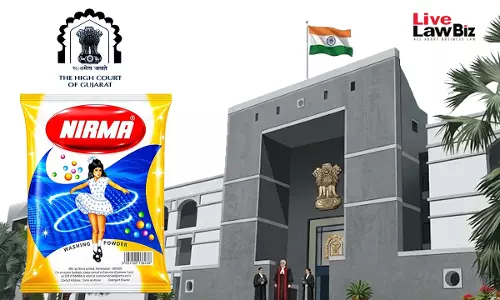
Gujarat High Court Holds ₹50 Cr. Nirma Trademark Sale Non-Taxable For Unascertainable Acquisition Cost
The Gujarat High Court on 9 October held that the Rs. 50 crore received by Shantaben K. Patel from the sale of the 'Nirma' and 'Nima' trademarks was not taxable as long-term capital gains because their cost of acquisition was unascertainable. A Division Bench comprising Justices Bhargav D. Karia and Pranav Trivedi dismissed the Revenue's appeals against the Income Tax Appellate Tribunal's orders and upheld the Tribunal's findings on the taxability of the receipt, the binding nature of the...
SARFAESI | Secured Creditor's Prior Charge Over Property Takes Precedence Over State VAT Charge: Gujarat High Court
The Gujarat High Court has reiterated that a secured creditor's charge over a property will take precedence over a subsequent charge created by the State VAT Department. The court applied the principle to a property purchased by auction purchasers in proceedings under the SARFAESI Act.The court relied on its earlier rulings, as well as the Supreme Court's judgment in Punjab National Bank v. Union of India.A division bench of Justice A.S. Supehia and Justice Vaibhavi D. Nanavati observed, “once...
Revenue Cannot Reopen Assessment Over Additions Already Pending In Tax Appeals: Gujarat High Court
The Gujarat High Court on 16 September held that the Revenue cannot reopen an assessment under Section 147 of the Income Tax Act and pursue parallel proceedings where the same additions have already been examined by the CIT(A) on merits and remain subject matter of tax appeals before the High Court. A Division Bench comprising Justices A.S. Supehia and Vaibhavi D. Nanavati quashed reassessment proceedings initiated against Venus Township (India) LLP, finding that the reassessment sought to...
Director Of Public Company Cannot Be Made Liable For Tax Dues Due To Substantial Shareholding: Gujarat High Court
The Gujarat High Court has held that a public limited company cannot be treated as a private company merely because one of its directors holds a substantial number of shares. Thus, a director cannot be held personally liable for the company's unpaid tax merely because the director holds substantial shares in the company.The case concerned Section 179 of the Income Tax Act. The provision allows the Income Tax Department, in certain circumstances, to recover a private company's unpaid tax from its...