
Gujarat High Court Quashes Move To Reopen Income Tax Assessment Over Vague Third-Party Material
Mehak Dhiman
20 April 2026 10:59 AM IST
The Gujarat High Court has quashed reassessment notices against a taxpayer, ruling that the Income Tax Department cannot reopen completed assessments based on vague third-party documents that have no clear link to the person concerned.
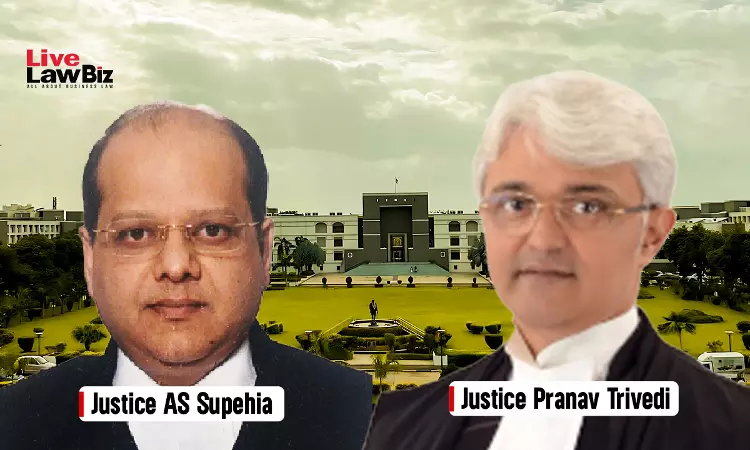
The ruling was delivered by a Division Bench comprising Justice A. S. Supehia and Justice Pranav Trivedi in a batch of petitions led by Bhavnaben Darshanbhai Patel, challenging reassessment proceedings for Assessment Year 2020–21.
The case arose after a search under Section 132 was conducted in the cases of B Safal Real Estate Group and a brokerage firm, City Estate Management India, during which an enquiry register was seized.
The Revenue relied on entries in the register allegedly indicating unaccounted consideration of Rs. 2.73 crore in relation to a land transaction linked to the petitioner. Based on this material, and after recording satisfaction and obtaining sanction under Section 151, notices under Section 148 were issued alleging escapement of income.
The petitioner contended that the seized enquiry register was a third-party document containing only tentative property details, did not bear her name, and did not evidence any actual transaction or flow of funds.
It was further submitted that the land had been purchased through a registered sale deed for Rs. 15 crore via banking channels, which was higher than the stamp duty valuation, thereby negating any allegation of “on-money.” It was also pointed out that the seized document was dated July 2020, whereas the purchase had taken place in May 2019, and even the broker's statement did not implicate the petitioner.
The Revenue, on the other hand, argued that the expressions “pertains to” and “relates to” under Explanation 2 to Section 148 have a wide ambit and that at the stage of reopening, only prima facie material is required, not conclusive proof. Reliance was placed on decisions of the Supreme Court to contend that sufficiency of material cannot be examined at the notice stage.
Rejecting the Revenue's stand, the High Court held that even for reopening, there must exist a “live link” between the seized material and the assessee.
The Court found that the loose paper relied upon by the Department merely contained general property details without any reference to the petitioner, and the alleged transaction was sought to be inferred by linking survey details from external sources.
The bench stated that "the date mentioned in the loose paper i.e. the incriminating material, is dated 24.07.2020, whereas the petitioner has purchased the land on 01.06.2019 through a registered sale deed by paying the amount through banking channels, except the material as mentioned herein above. Hence, there is no live link coming forth which would establish that the petitioner has purchased the land in question by paying the cash as “on-money”."
The Court observed that such vague and non-specific material, especially when dated subsequent to the actual registered transaction, cannot justify an inference of unaccounted payment.
The bench opined that "It is true that the cash transactions are done in a clandestine manner using coded script, however, the revenue, before re-opening the assessment has to establish a live link of the assessee on the basis of seized material only. The expression “ relates to” and “pertains to” used in Clause(iv) to Explanation 2 to Section 148 of the Act cannot be used in vacuum. The revenue after the seizure of incriminating material is under an obligation to analyze such material, in light of attendant circumstances and record relevancy and a prima facie opinion linking such material establishing escapement of income at the hands of the assessee. The information which is derived from the incriminating material in the instant case, does not establish live-link."
The bench emphasized that while sufficiency of evidence may not be scrutinized at the reopening stage, the existence of relevant and tangible material establishing a prima facie nexus is mandatory. In the absence of such a link, the invocation of Section 148 was held to be unsustainable.
The bench stated that "At the stage of notice of reopening of the assessment, albeit, the Court cannot go into the sufficiency of evidence, however, simultaneously the Court has to examine the aspect as to whether there is even prima facie some material, which could enable the department to reopen the assessment. In the present case, the reopening is based on a vague, irrelevant, and non-specific information."
Accordingly, the Court allowed the writ petitions and quashed the impugned reassessment notices along with all consequential proceedings.
For Petitioner: Advocate Dhinal A Shah
For Respondent: Advocate Aaditya Bhatt