
Supreme Court Pleadings Cannot Decide Legal Status Of Nair Service Society: Kerala High Court
Shilpa Soman
31 July 2026 4:50 PM IST
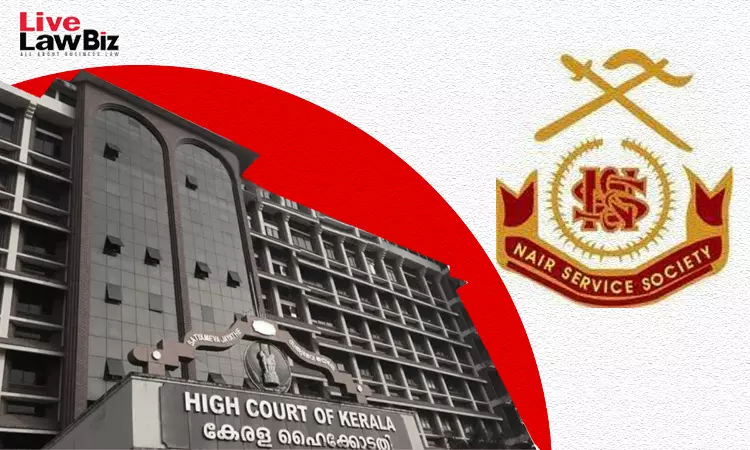
The Kerala High Court on 17 July dismissed a writ appeal filed by a member of the Nair Service Society (NSS) seeking action against the Society and its directors for alleged violations of the Companies Act, 2013.
A Division Bench of Justices Raja Vijayaraghavan V and K.V. Jayakumar held that pleadings filed before the Supreme Court could not determine the Society's regulatory framework. The judges observed:
“It can thus be held that the “court of record” attribute under Article 129 does not mean that it is binding on its substantive content. All that it guarantees is that the record faithfully and unimpeachably shows the assertion was made and not that the assertion is legally correct or has been judicially adopted.”
The member alleged that NSS, a company limited by guarantee, violated the Companies Act, 2013 by denying members their statutory rights to attend annual general meetings, vote and contest elections. He further alleged that NSS appointed directors without obtaining mandatory Director Identification Numbers. He sought directions to the Registrar of Companies and the Inspector General of Registration to initiate action against NSS and its directors.
The Single Judge had dismissed the writ petition after observing that the member had not first approached the statutory authorities.
Before the Division Bench, the member relied on pleadings filed by NSS before the Supreme Court in an earlier writ petition to contend that the Society had admitted that it was governed by the Companies Act, 2013. He argued that since the Supreme Court is a “Court of Record” under Article 129 of the Constitution, NSS could not later take a contrary stand.
The Registrar of Companies and NSS contended that the Society was governed by the Kerala Non-Trading Companies Act, 1961 and that the Registrar of Companies had no statutory jurisdiction over NSS. They also argued that the member had invoked the writ jurisdiction of the Court without first approaching the competent authorities.
Rejecting the contention, the Division Bench held that Article 129 only guarantees the authenticity of the Supreme Court's records and does not make the contents of pleadings legally binding.
The Court held that whether an entity is governed by the Companies Act, 2013 or the Kerala Non-Trading Companies Act, 1961 must be determined by the statutory framework and the nature of the entity, and not by admissions or pleadings made by parties.
Further, the Bench held that a mere assertion in pleadings, without any adjudication or finding by the Supreme Court, does not acquire legal sanctity or amount to a declaration of law under Article 141 of the Constitution. It observed:
“A mere assertion made by a party in its pleadings, without any adjudication or finding by the Hon'ble Supreme Court on that issue, does not acquire any legal sanctity. Such an assertion cannot even be elevated to the status of an obiter dictum, as the Court has neither expressed any opinion nor recorded any finding, whether favourable or otherwise, on the issue. It follows that no declaration of law within the meaning of Article 141 of the Constitution can be said to have emerged from such pleadings, for the simple reason that the Court has declared nothing on the point.”
It also took note of the Registrar of Companies' stand that regulatory control over NSS had been transferred to the Inspector General of Registration in 1962 and that the Registrar no longer exercised statutory authority over the Society. It held:
“Had the petitioner approached respondents 1 and 2 and ascertained the correct legal and factual position before rushing to invoke the writ jurisdiction of this Court, considerable judicial time, as well as the time and effort of the parties, could have been avoided.”
Accordingly, the Division Bench dismissed the writ appeal, finding no infirmity in the Single Judge's decision.
For Appellant: Advocates K.P Prasanth and Yeswanth Shenoy
For Respondents: Advocates Vivek A.V, CGC, Pranoy Harilal and Nandakumar E.K