
Karnataka High Court

RTI Cannot Be Used To Obtain Spouse's Income Tax Returns In Maintenance Dispute Without Larger Public Interest: Karnataka High Court
The Karnataka High Court, in a recent noteworthy ruling, has held that income tax returns and financial details of a spouse constitute “personal information” under the Right to Information Act, 2005, and cannot be disclosed in the absence of a demonstrable larger public interest, even in maintenance disputes. Observing that private matrimonial disputes do not by themselves satisfy the statutory requirement for disclosure, a single bench, Justice Suraj Govindaraj, held, "While the need for a...
Karnataka High Court Sets Aside Ex-Parte GST Order Passed Without Allowing Reply To Show Cause Notice
The Karnataka High Court has set aside an ex-parte GST order passed against Medizen Labs Pvt. Ltd. after noting that the adjudicating authority issued the order without considering any reply from the taxpayer. The court observed that, in the facts of the case, it would be appropriate to give the assessee an opportunity to respond to the show cause notice before the matter is decided on merits. A single-judge bench of Justice S. Sunil Dutt Yadav was hearing a writ petition filed by the...
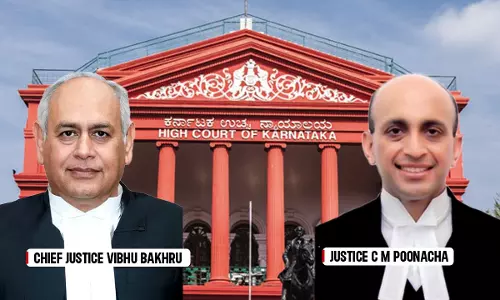
Arbitration Act | Karnataka High Court Upholds Refusal Of Interim Measures In Coorg Cineplex Lease Dispute With Landlord
The Karnataka High Court has recently upheld a Commercial Court order rejecting a plea for interim measures filed by Coorg Cineplex and its partners, holding that after the expiry of the lease, the landlord cannot be restrained from raising objections before the licensing authority regarding the renewal of a theatre licence. A Division Bench comprising Chief Justice Vibhu Bakhru and Justice C.M. Poonacha dismissed the appeal filed by the Cineplex, which had sought directions to the licensing...

Delay In Commercial Appeals Cannot Be Condoned Routinely Without Sufficient Cause: Karnataka High Court
The Karnataka High Court recently observed that delay in filing appeals in commercial matters cannot be condoned as a matter of routine and must be treated as an exception only when the party demonstrates sufficient cause and bona fide conduct.The observation came from a division bench of Justices Anu Sivaraman and Vijaykumar A. Patil while dismissing a commercial appeal filed by the Union of India, represented by the Chief Engineer, Southern Railway. The appeal had challenged a July 4, 2024...
Once Parties Agree To Institutional Arbitration, Its Commencement Is Governed By Institutional Rules: Karnataka High Court:
The Karnataka High Court has recently observed that the commencement of arbitral proceedings will be governed by agreed institutional rules and not necessarily by Section 21 of the Arbitration and Conciliation Act, since the provision applies only “unless otherwise agreed by the parties." Dismissing a contractor's appeal against a Rs 7.99-crore arbitral award, the court observed that “It is apparent from the plain language of Section 21 of the A&C Act that the arbitral proceedings are...
Karnataka High Court Restores ₹44.48 Lakh Arbitral Award After Commercial Court Examined Issue Not Raised Before Tribunal
The Karnataka High Court has restored an arbitral award of Rs 44.48 lakh granted to contractor S S Police Patil and Company in a dispute over price adjustment claims arising from a municipal road improvement project in Dharwad district. A Division Bench of Chief Justice Vibhu Bakhru and Justice C.M. Poonacha held that the Commercial Court exceeded its limited jurisdiction under Section 34 of the Arbitration and Conciliation Act by examining issues that were not raised before the arbitral...

RERA And Karnataka Apartment Ownership Act Operate At Different Stages, Not Repugnant: Karnataka High Court
The Karnataka High Court has recently held that the Real Estate (Regulation and Development) Act, 2016 is not repugnant to the Karnataka Apartment Ownership Act, 1972, observing that the two statutes govern different stages in the life of a real estate project. The finding came in a petition filed by Sobha Limited concerning the Sobha HRC Pristine residential development in Bengaluru. Justice M.G. Uma allowed the plea and set aside the registration of a cooperative society that had been...

Karnataka High Court Allows Wacom To Collect Evidence From Bengaluru-Based Company For US Patent Suit
The Karnataka High Court has recently allowed Japanese technology firm Wacom Company Limited to collect documents and testimony from Bengaluru-based semiconductor manufacturer Cirel Systems Pvt Ltd.The evidence will be used in a patent infringement lawsuit pending in the United States between Wacom and Chinese company Shenzhen Qianfenyi Intelligent Technology Co Ltd, in which the Indian firm is not a party.Justice P. Sree Sudha, who heard the matter, held that India's declaration under Article...

Digital Gold Transactions Not Outside Scope Of BUDS Act Due To Lack Of SEBI/RBI Regulation: Karnataka High Court
The Karnataka High Court has refused to quash criminal proceedings against Jar Gold Retail Private Limited and its director over allegations that its digital gold platform operates as an unregulated deposit scheme.The Court observed that merely because the purchase or storage of gold is not regulated by bodies such as the Securities and Exchange Board of India (SEBI) or the Reserve Bank of India (RBI), such transactions cannot be treated as falling outside the scope of the Banning of Unregulated...

Electronic Credit Ledger Cannot Be Blocked Beyond One Year Under CGST Rules: Karnataka High Court
The Karnataka High Court on 25 February, held that the restriction imposed by blocking a taxpayer's electronic credit ledger under Rule 86A of the Central Goods and Services Tax Rules, 2017, cannot continue beyond one year, and any continuation of such blocking after the statutory period is illegal. Justice S. Sunil Dutt Yadav was hearing a writ petition filed by Jupiter Ventures challenging the action of the tax authorities in blocking its Electronic Credit Ledger on 21 November 2024. The...

Approval Of Insolvency Resolution Plan Not An Automatic Bar To Arbitration: Karnataka High Court
The Karnataka High Court on 26 February held that approval of a Corporate Insolvency Resolution Plan does not automatically bar disputes from being referred to arbitration. Where a valid arbitration agreement exists, any objections concerning the impact of the Resolution Plan on the claims must be adjudicated by the arbitral tribunal under Section 16, and cannot be considered at the appointment stage under Section 11 of the Arbitration and Conciliation Act, 1996. The Single Bench comprising...
Karnataka High Court Refuses New Arbitrator After Award, Says Fresh Appointment Would Reopen Proceedings
The Karnataka High Court has recently refused to appoint a substitute arbitrator under Section 11(6) of the Arbitration and Conciliation Act after an award had already been passed and the matter was remanded only for a limited purpose, holding that such reconstitution would effectively reopen concluded arbitral proceedings. Dismissing a plea filed by SSV Developers and its Managing Partner Vijaykumar Krishnasa Kabadi, Justice Lalitha Kanneganti held that once an award is passed and the case is...