
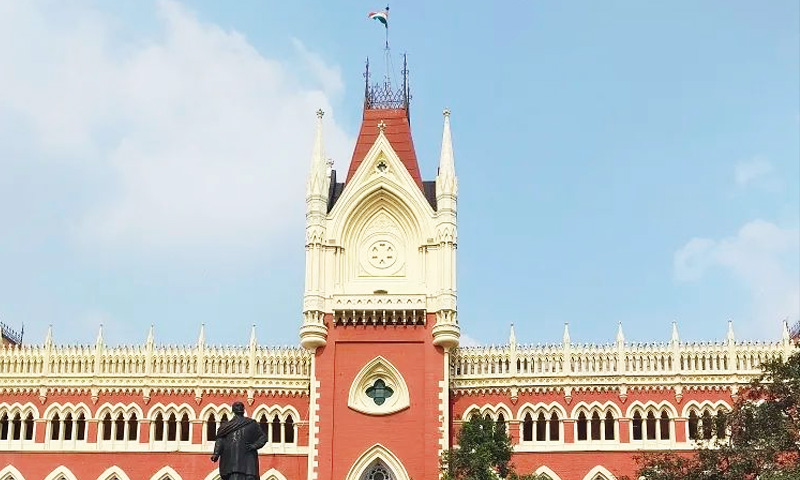
Calcutta High Court

S.138 NI Act Case Cannot Fail For Non-Examination Of Authorised Representative: Calcutta High Court
The Calcutta High Court on 20 May held that a complaint under Section 138 of the Negotiable Instruments Act, 1881 cannot be rejected solely on the ground that the complainant's original authorised representative was not examined, where the court could have exercised powers under Section 311 CrPC to summon the witness and ensure a just decision. Justice Ajoy Kumar Mukherjee allowed the appeal filed by Shriram Transport Finance Co. Ltd. and set aside the judgment dated 27 August 2021 passed by...
Polypropylene Leno Bags Are Plastic, Not Textile Products For GST Classification: Calcutta High Court
The Calcutta High Court has recently dismissed Mega Flex Plastics Limited's challenge to a GST ruling that treated its polypropylene leno bags as plastic products rather than textile products. A Division Bench of Justice Debangsu Basak and Justice Md. Shabbar Rashidi upheld the order of the Appellate Authority for Advance Ruling (AAAR) and a Single Judge's decision refusing to interfere with it. At the heart of the case was the classification of polypropylene leno bags made by weaving...

Courts Cannot Touch Merits In Contempt Proceedings: Calcutta High Court Sets Aside NCLT Interim Order
The Calcutta High Court has recently reiterated that a court exercising contempt jurisdiction cannot travel beyond the four corners of the order alleged to have been violated or venture into the merits of the underlying dispute while setting aside part of a National Company Law Tribunal order that had allowed a liquidator to complete the sale of a company's assets. Justice Om Narayan Rai held that while exercising contempt jurisdiction, “the Court must confine itself to the four corners of the...
Calcutta High Court Denies Relief To SARFAESI Auctions Buyer After DRT Bars SBI From Issuing Sale Certificate
The Calcutta High Court has held that State Bank of India cannot be faulted for withholding a sale certificate to a successful auction purchaser when it is restrained from doing so by a subsisting Debts Recovery Tribunal order. The Court refused to direct the bank to either complete the sale or refund ₹11.41 crore paid by the purchaser. Justice Ravi Krishan Kapur held: “This is not a case where the respondent bank has failed to issue the sale certificate on its own volition. There is no...

Calcutta High Court Refuses Wife Relief Against Bank's SARFAESI Action Despite DV Act Protection Order
The Calcutta High Court has refused to interfere with HDFC Bank's SARFAESI action against a property despite a wife having secured a domestic violence protection Act order over the same premises. The Court noted that her challenge to the bank's possession notice is already pending before the Debts Recovery Tribunal. A Division Bench of Chief Justice Sujoy Paul and Justice Partha Sarathi Sen observed,“In view of availing of such alternative remedy, we are of the considered view that the learned...

Calcutta HC Sets Aside Injunction, Says Market Value, Not Plaint Valuation, Determines Commercial Suit Threshold
The Calcutta High Court has held that where a dispute relates to immovable property used for trade, the market value of the property, not the valuation stated in the plaint (for determining specified value under the Commercial Courts Act), must govern, while setting aside interim injunction orders in a tenancy dispute. A Division Bench of Justice Sabyasachi Bhattacharyya and Justice Biswaroop Chowdhury observed: “Thus, whatever might have been attributed as valuation in the plaint by the...
Dissent Must Be an “Informed Decision,” Not “Post Facto”: Calcutta High Court Sets Aside Majority Arbitral Award
The Calcutta High Court has set aside an arbitral award in favour of Neo Metaliks Limited, holding that a dissenting arbitrator cannot be excluded from deliberations and given the majority award only after it has been finalised. Justice Sabyasachi Bhattacharyya passed the ruling while allowing Kessels Engineering Works Pvt Ltd's challenge to the award and staying operation of the judgment for 30 days. Justice Bhattacharyya observed, “Deliberation between the co-arbitrators in a multi-member...
Commercial Courts Must Explain Refusal To Impose Safeguards While Denying Summary Judgments In Lease Disputes: Calcutta HC
The Calcutta High Court has recently held that when a tenant continues to occupy a property by relying on a lease agreement, a Commercial Court hearing a plea for summary judgment must explain why it is not requiring safeguards such as payment or security instead of simply sending the dispute to a full trial. Justice Hiranmay Bhattacharyya set aside a February 17, 2025 order of the Commercial Court at Rajarhat, which had rejected a summary judgment application filed by Flowers Valley...

Pending Company Winding-Up Cases Before HC Transferable To NCLT Unless At Irreversible Stage: Calcutta HC
The Calcutta High Court has held that pending company winding-up petitions before High Courts can be transferred to the National Company Law Tribunal even after admission, a winding-up order, and appointment of an Official Liquidator, so long as the proceedings have not reached an irreversible stage.Relying on Supreme Court rulings on transfer of winding-up proceedings, a Division Bench of Justice Debangsu Basak and Justice Shabbar Rashidi observed: “Post admission of a winding up petition,...

Calcutta High Court Quashes PMLA Case Against Louis Dreyfus India In ₹234 Crore Bank Fraud Case
The Calcutta High Court on Friday (May 22) quashed money laundering proceedings initiated by the Enforcement Directorate (ED) against Louis Dreyfus Company India Private Limited, the Indian subsidiary of Dutch-French commodities giant Louis Dreyfus Company. The case arose out of an alleged bank fraud of about ₹234.57 crore investigated by the CBI. The ED had alleged that the company was involved in circular trading transactions linked to three Letters of Credit (LCs) and had unlawfully received...

Is ChatGPT An Intermediary Under IT Act? Calcutta High Court Prima Facie Says No
The Calcutta High Court has, in a case examining how generative AI platforms fit within the Information Technology Act, prima facie held that ChatGPT ought to be treated as an “originator” rather than an “intermediary.” The observations came in IndiaMart InterMesh Ltd's suit against OpenAI, where the classification of ChatGPT became central after the B2B platform argued that the AI tool was omitting links to IndiaMart in response to certain user queries while allegedly providing links for rival...

Delay In Challenging Arbitral Award Not Condoned When Party Lacks Due Diligence: Calcutta High Court
The Calcutta High Court on 20 May held that a party cannot invoke Section 14 of the Limitation Act, 1963 to save a delayed challenge to an arbitral award after pursuing proceedings before the wrong forum without due diligence and bona fide conduct. A Division Bench of Justices Debangsu Basak and Md. Shabbar Rashidi also held that once the High Court entertains an application under Section 29A of the Arbitration and Conciliation Act, 1996, exclusive jurisdiction thereafter vests in it for all...