
Kerala HC Stays NH 66 Compensation Arbitration, Prima Facie Questions District Collector's Eligibility As Arbitrator
Anamika MJ
16 Jun 2026 11:24 AM IST
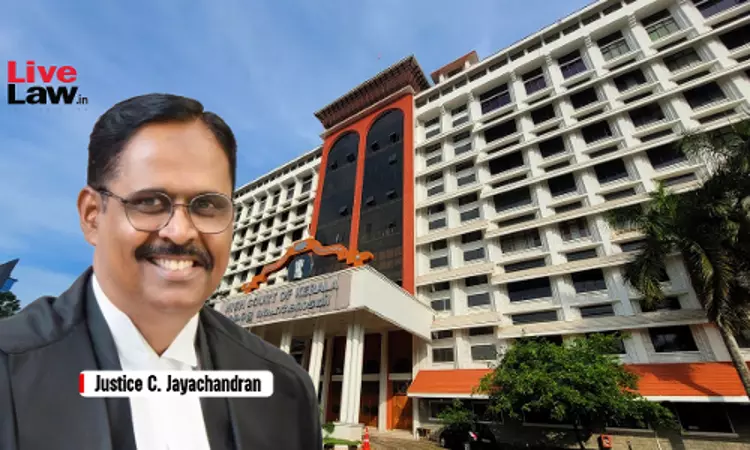
The Kerala High Court has recently stayed an order of the Ernakulam District Collector and directed that arbitration proceedings concerning compensation for land acquired for the widening of National Highway 66 remain in abeyance.
The court found that the landowner had made out a strong prima facie case in challenging the Collector's continuation as arbitrator in the dispute.
Justice C. Jayachandran passed the interim order while considering a writ petition filed by a landowner whose compensation claim had been referred to arbitration after the acquisition of property for the National Highway project.
“Inasmuch as the petitioner has got a strong prima facie case, coupled with the principles of balance of convenience, this Court is of the opinion that Ext.P4 Order is liable to be stayed,” the Court held.
The challenge was directed against an order issued by the District Collector acting as arbitrator. Through that order, the Collector had rejected objections raised by the landowner regarding his authority to continue with the arbitration proceedings.
Counsel appearing for the landowner attacked two findings contained in the Collector's order. The first concerned the applicability of the disqualification provisions under the Arbitration and Conciliation Act. The second related to the Collector's status as an employee of the State Government, which contributes 25 per cent of the expenditure for the road project.
According to the landowner, the Collector could not continue as arbitrator because the State Government had a stake in the project by bearing 25 per cent of the total expenditure. Since the Collector was a State Government employee, it was argued that the statutory disqualification provisions were attracted.
The Collector had rejected that contention. The Collector took the view that the disqualification provisions applied only to arbitrators appointed through agreements between parties and not to arbitrators appointed under the National Highways Act.
The Union Government opposed interim relief. It relied on an earlier Division Bench interim order of the High Court whose operation had subsequently been stayed by the Supreme Court.
Justice Jayachandran was not persuaded by that submission. The Court observed that the issue involved in the earlier proceedings was different. It noted that the earlier order had not dealt with the specific question raised in the present case regarding the applicability of the disqualification provisions.
The Union Government also argued that the landowner was barred by the principles of constructive res judicata and sub judice. The Court declined to accept those objections at the interim stage.
The Court observed that the question whether the landowner was hit by constructive res judicata could be examined at the stage of final disposal of the writ petition. As for the plea of sub judice, the Court found that the issues pending before the Supreme Court were distinct from those raised in the present challenge.
Turning to the merits of the challenge, the Court noted that the National Highways Act makes the provisions of the Arbitration and Conciliation Act applicable to arbitrations conducted under the statute.
“No provision has been pointed out by the learned Central Government Counsel for respondents 1 to 5 in the National Highways Act, which would impair the effect of Sub Section (6) of Section 3G of the National Highways Act. If the provisions of the Arbitration Act apply to every arbitration under the National Highways Act, this Court could not prima facie find any reason as to why Section 12(5), read with Schedule VII, could not apply to an arbitrator appointed in terms of Section 3G(5) of the National Highways Act,” the Court observed.
The court further noted that Part I of the Arbitration and Conciliation Act applies to arbitrations arising under other enactments as though they were conducted pursuant to an arbitration agreement.
“Prima facie, the argument based on Section 2(4) is also convincing to the effect that Section 12(5) of the Arbitration Act, read with Schedule VII, applies to the instant arbitration under Section 3G(5) of the National Highways Act. This Court is therefore prima facie of the opinion that the first conclusion arrived at by the Arbitrator in the impugned Ext.P4 Order can hardly be sustained,” the Court held.
The court then examined the Collector's finding that he was not connected with land acquisition activities carried out under a Central Government-controlled enactment. Even assuming that premise to be correct, the Court observed that the statutory disqualification provision extends to an arbitrator's relationship with a party to the dispute.
The order records that it was not disputed before the Court that the State Government bears 25 per cent of the total expenditure for the formation of the road.
“At least to that extent, State Government is an interested party and District Collector, being an employee, appears to be prima facie hit by the disqualification contained in Section 12(5), read with Schedule VII, of the Arbitration Act. This Court is therefore constrained to prima facie find that the second premise on which the District Collector trekked is also erroneous,” the Court observed.
Having found prima facie merit in both grounds raised by the landowner, the Court concluded that interim protection was warranted.
“As otherwise, the District Collector will proceed with the arbitration proceedings, which will lead to a precarious situation, if this Court ultimately allows this Writ Petition, finding merits on the grounds canvassed by the petitioner,” the court held.
The court stayed the Collector's order and directed the District Collector to keep the arbitration reference in abeyance until further orders.
The matter has been posted for further consideration on July 6, 2026.
For Petitioner: Advocates P. Sathisan, Shinbu B.S, Razak M, Biju P. Paul, Alvin Jewel S.S, Vidhya T.U, Abhirami .S, Leena Varghese, Daniel A.J, Sreekarthik S. Menon
For Respondents: Advocate Renjish S. Menon