
Arbitration Clause Signed By Only One Party Invalid, Award Unenforceable: Delhi High Court
Mohd Malik Chauhan
6 May 2026 2:15 PM IST
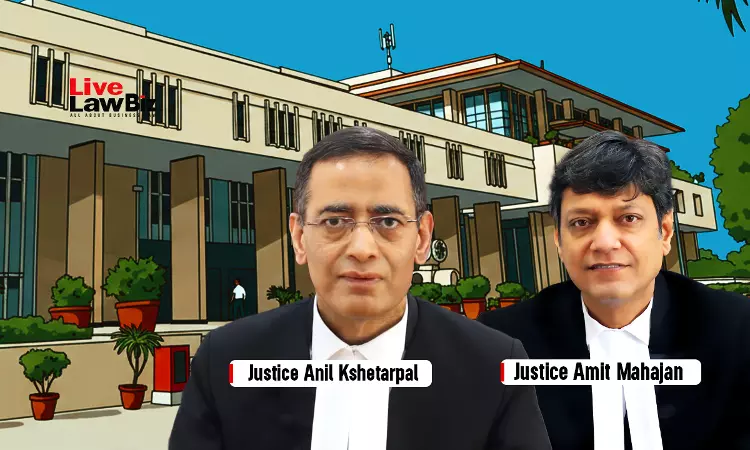
The Delhi High Court on 5 May held that an arbitration clause contained in a document signed by only one party does not constitute a valid arbitration agreement under Section 7 of the Arbitration and Conciliation Act, 1996, in the absence of material demonstrating mutual consent to arbitrate.
A Division Bench of Justices Anil Kshetarpal and Amit Mahajan further held that an arbitral award founded on such a defective agreement is a nullity and incapable of execution and upheld the Executing Court's order refusing enforcement of the award. It held:
“It is not in dispute that the said acknowledgment letter bears the signature of the Respondent but does not bear the signature of the Appellant. Therefore, it does not satisfy the requirement of a 'document signed by the parties' under Section 7(4)(a) of the A&C Act.”
Matsya Fincap Pvt. Ltd. initiated execution proceedings to enforce an ex parte arbitral award dated 22 October 2022 for recovery of Rs. 10 lakhs with interest from Govind Lal, respondent. It relied on a “receipt-cum-acknowledgement” containing an arbitration clause. However, the document bore only Lal's signature and not that of Matsya Fincap.
Lal objected to execution, contending that no valid arbitration agreement existed and, consequently, the arbitral tribunal lacked jurisdiction. The Executing Court accepted the objection and held the award unenforceable. Aggrieved, the Matsya Fincap approached the High Court.
It argued that the acknowledgement letter constituted a valid arbitration agreement and that, even in the absence of its signature, an agreement could be inferred from the parties' conduct or exchange of communications under Section 7(4)(b). It also contended that the respondent ought to have challenged the award under Section 34 and that the Executing Court could not examine the validity of the arbitration agreement under Section 47 CPC.
The Court rejected these submissions. It held that arbitration rests on mutual consent and that Section 7 requires both a written agreement and clear evidence of consensus ad idem. The acknowledgment letter failed to meet Section 7(4)(a) as it was not signed by both parties.
It further found that the appellant produced no emails, letters, or electronic records to establish a mutual agreement to arbitrate under Section 7(4)(b). The award itself did not refer to any such material forming the basis of jurisdiction. It held:
“However, no letters, emails, electronic correspondence or any other material providing a record of mutual agreement to arbitrate have been placed on record. The Award itself does not refer to any such exchange forming the basis of jurisdiction.”
The Bench noted that the arbitral tribunal wrongly assumed that the acknowledgment letter had been signed by both parties. It held that such a basic error goes to the root of jurisdiction and renders the proceedings unsustainable. It observed that jurisdiction based on a mistaken belief about the existence of a valid arbitration agreement cannot be upheld.
Relying on the Supreme Court's decision in Dhurandhar Prasad Singh v. Jai Prakash University, the Court held that although an Executing Court cannot revisit the merits of a decree, it can examine whether the decree or award is a nullity for want of inherent jurisdiction. Since a valid arbitration agreement was not established, the tribunal lacked such jurisdiction.
It further clarified that the Executing Court's conclusion that the award suffered from a fundamental jurisdictional defect fell within the limited scope of inquiry permitted under Section 47 of the CPC.
The Court also noted that the appellant had repeatedly appointed the same arbitrator across disputes with different borrowers. It observed that although party autonomy governs arbitration, such repeated unilateral appointments—especially where the arbitration agreement itself is disputed—raise concerns about neutrality and fairness. It held:
“Nonetheless, the pattern of repeated appointments, when read in conjunction with the absence of a valid arbitration agreement and the unilateral invocation of the clause by the Appellant, lends further support to the conclusion that the constitution of the arbitral tribunal lacked the necessary indicia of independence and neutrality.”
Accordingly, the Court upheld the impugned order and concluded that the award was a nullity in the absence of a valid arbitration agreement and was incapable of execution.
For Respondent: Mr. Pramod Kumar and Mr. Gaurav, Advs.