
ARBITRATION

Calcutta High Court Upholds Arbitral Award Against Neo Metaliks In Lam Coke Supply Contract Dispute
The Calcutta High Court has upheld an arbitral award in favour of Orissa Metaliks Pvt Ltd, dismissing Neo Metaliks Ltd's appeal arising from a dispute over a Lam Coke supply contract. The court found no perversity or patent illegality in either the arbitral award or the earlier judgment refusing to set it aside. A Division Bench of Justices Debangsu Basak and Md. Shabbar Rashidi upheld the arbitral award and affirmed the Single Judge's judgment of January 6, 2025. The Court said that the...

'Deemed Service' Cannot Cure Defect In Service Of Arbitration Notices: Bombay High Court
The Bombay High Court has recently held that the legal presumption that arbitration notices have been served cannot be mechanically invoked where there is no proof that the notices actually reached the parties. Setting aside an arbitral award, the court observed: Justice Arif S. Doctor also quashed an April 4, 2025 judgment of the District Judge, Pune. The District Judge had dismissed the borrowers' challenge to an arbitral award passed in favour of Abhyudaya Co-operative Bank Ltd. in a loan...
Calcutta High Court Upholds ₹2.05 Crore Arbitral Award Against SAIL Over Wrongful Iron Ore Contract Termination
The Calcutta High Court has upheld an arbitral award directing Steel Authority of India Limited (IISCO Steel Plant) to pay more than ₹2.05 crore to Balaji Industrial Products Limited. The court found no ground to interfere with the arbitrator's conclusion that SAIL had wrongfully terminated a contract for the supply of 60,000 metric tonnes of iron ore. A division bench of Justices Debangsu Basak and Md. Shabbar Rashidi held that the arbitrator's findings represented a plausible view of the...

Bombay HC Says Confidentiality Claims Need Evidence, Refuses Injunction Against Tata Retail Arm Trent
On 7 July, the Bombay High Court held that allegations of misuse of confidential information, proprietary business methods and protected employees cannot, at the interim stage, justify a blanket injunction against a party's business activities and require adjudication before the arbitral tribunal on the basis of evidence. Justice Amit Borkar partly allowed a Section 9 petition filed by The Packshot (India) Pvt Ltd and directed Trent Ltd, Tata's retail arm, to preserve records relating to...

Bombay HC Holds Mumbai Was Arbitration Seat In Siemens' ₹7.38 Cr Loan Dispute, Appoints Arbitrator
The Bombay High Court on 2 July, appointed Justice Dhiraj Singh Thakur (Retd.), former Chief Justice of the Andhra Pradesh High Court, as the sole arbitrator to adjudicate disputes arising from a Rs. 7.38 crore loan facility extended by Siemens Financial Services Pvt Ltd to Saroj Diagnostic Laboratory LLP. Justice Gautam A. Ankhad held that where an arbitration agreement specifies a place of arbitration and also grants jurisdiction to courts at that place, such provisions can indicate that the...

Registered Mortgage Does Not Bar Arbitration In Simple Money Recovery Claims: Madras High Court
The Madras High Court on 1 July held that a simple money recovery claim is arbitrable even if the underlying loan transaction is secured by a registered mortgage deed, provided the lender does not seek enforcement, foreclosure or sale of the mortgaged property. Justice S. Sounthar dismissed an appeal filed by borrowers Marsalin and Mary Rani Subi, upheld an arbitral award directing them to pay Rs. 15,70,637 to Shriram City Union Finance Limited, and affirmed the Principal District Judge,...
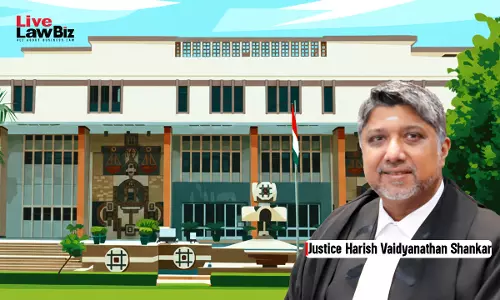
Fresh Copy Of Arbitral Award Cannot Restart Limitation To Challenge Award: Delhi High Court
The Delhi High Court has dismissed two petitions filed by the Union of India challenging an arbitral award. It held that a party cannot allow the statutory period for challenging an award to expire and later attempt to restart the limitation by obtaining another copy of the award. Justice Harish Vaidyanathan Shankar delivered the judgment. The court observed, "A party, despite having knowledge of an Award and despite its authorised representative having received the signed copy, could...
WhatsApp Acknowledgment Of Arbitral Award Shows Acceptance, Bars Delayed Challenge: Delhi High Court
The Delhi High Court has dismissed a challenge to an interim arbitral award after finding that the party seeking to set it aside had acknowledged receiving it on WhatsApp, participated in discussions on its implementation, and acted upon it before questioning the award only after execution proceedings were initiated. The court held that the challenge to the interim arbitral award, raised more than two years after the petitioner admittedly acquired knowledge of it was barred by...

'Duly Certified Copy' Under HC Arbitration Scheme Can Include Party Or Counsel Attestation: Kerala High Court
The Kerala High Court has recently held that, for the purpose of arbitration requests filed under the Kerala High Court Scheme for Appointment of Arbitrators, 1996, a "duly certified copy" of a private arbitration agreement does not have to be certified by a public authority. It held that the requirement is satisfied where the party files an affidavit certifying the copy as a true copy of the original, explains why the original has not been produced, and submits a copy attested to by the party...
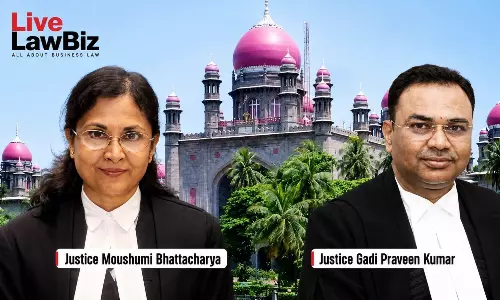
'Enforced' Is Not The Same As 'Enforceable' For Post-Arbitral Award Interim Relief: Telangana High Court
The Telangana High Court has recently held that an award-holder can invoke Section 9 of the Arbitration and Conciliation Act to seek interim protection until an arbitral award is actually enforced. The remedy remains available even after the award becomes enforceable. A Division Bench of Justices Moushumi Bhattacharya and Gadi Praveen Kumar ruled that the expression "before it is enforced" in Section 9 refers to the completion of enforcement proceedings. It cannot be equated with the stage when...
Procedural Irregularity Without Prejudice Not Ground To Set Aside Arbitral Award: Delhi High Court
The Delhi High Court on 6 July held that a party challenging the constitution of an arbitral tribunal must establish actual prejudice caused by the alleged procedural irregularity, and that mere dissatisfaction with the appointment process cannot be a ground to set aside an arbitral award. Justice Harish Vaidyanathan Shankar dismissed a petition filed by Shriram Pistons & Rings Limited challenging an arbitral award passed in favour of Usha International Limited. He observed: “It is also...
Confidential Material From Separate Arbitration Cannot Be Relied Upon Merely Because ICC Rules Don't Bar It: Delhi HC
The Delhi High Court has held that confidential material from a separate arbitration cannot be relied upon in another arbitral proceeding merely because the International Chamber of Commerce (ICC) Rules do not expressly prohibit its use. It upheld an arbitral award in favour of Alstom Transport India Limited after finding that the arbitral tribunal was justified in refusing to admit such material. Justice Harish Vaidyanathan Shankar observed, "A statutory mandate enacted by Parliament...