
Supreme Court Says Article 142 Cannot Be Invoked To Cure Illegalities In Jaipur Udyog Rehabilitation Efforts
Kirit Singhania
15 April 2026 7:15 PM IST
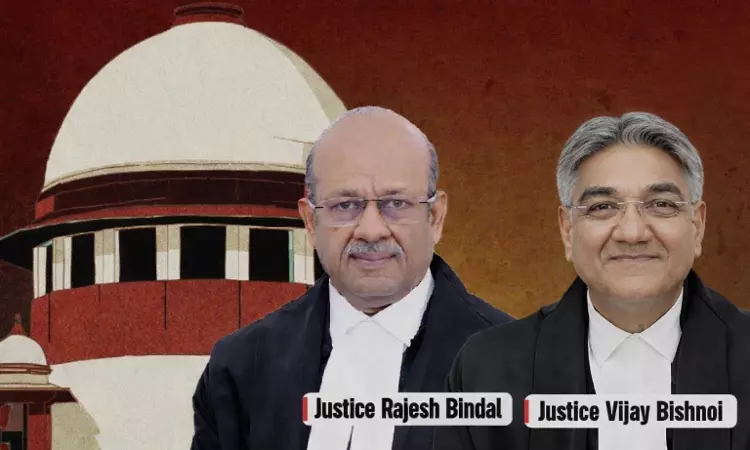
The Supreme Court on Wednesday refused to invoke its powers under Article 142 of the Constitution, which allows it to pass orders to do complete justice, to condone illegalities in a long-running dispute involving defunct Jaipur Udyog Ltd. (JUL), directing disbursal of workers' dues estimated at over Rs. 100 crore and appointment of an administrator to oversee the process.
Separately, the court directed the deposit of Rs 51 crore realised from the sale of the Kanpur unit for utilisation towards workers' dues.
The top court said such powers cannot be used to cure lapses where statutory requirements were not followed, particularly after proceedings under the earlier industrial sickness law stood abated and no fresh insolvency proceedings were initiated under the current bankruptcy regime.
A Bench of Justices Rajesh Bindal and Vijay Bishnoi held that after the repeal of the Sick Industrial Companies Act (SICA) on December 1, 2016, no proceedings were initiated before the National Company Law Tribunal (NCLT) under the Insolvency and Bankruptcy Code within the prescribed period.
As a result, the appeal pending before the Appellate Authority for Industrial and Financial Reconstruction (AAIFR) stood abated, and the recommendation of the Board of Industrial and Financial Reconstruction (BIFR) for winding up of JUL revived.
Rejecting the plea that the lapses could be cured through Article 142, the Court observed:
“In our view, power under Article 142 of the Constitution of India cannot be invoked to condone the illegalities committed. In fact, after repeal of SICA with effect from 01.12.2016 and no proceedings having been initiated before NCLT in terms of provisions of IBC within the time permitted, the appeal filed by GDCL/ JUL before the AAIFR stood abated. Thus, the recommendation made by the BIFR for winding up of JUL revived.”
The court said that in the absence of any subsisting rehabilitation framework, Gannon Dunkerley & Co Ltd (GDCL) could not justify its actions in dealing with the assets of JUL and its subsidiary, including sale of properties such as the Kanpur Jute Mill and disposal of assets without prior approval during the pendency of proceedings.
The dispute arose from a writ petition seeking payment of workers' dues and implementation of an arbitral award dated December 5, 2008 passed by Justice N.N. Mathur (Retd.). JUL had been declared sick in 1987, and although GDCL's rehabilitation scheme was approved in 1992, it failed, leading to a winding-up recommendation in November 2000.
Examining GDCL's conduct, the court noted that assets including the Kanpur Jute Mill and properties of Jai Agro Industries Ltd (JAIL) were sold without prior approval. It also recorded that scrap from the Sawai Madhopur unit had been disposed of and that such steps were taken during the pendency of proceedings.
The court further found that no effective rehabilitation plan was implemented despite opportunities granted earlier and that revival of the unit was no longer feasible. It observed:
“The fact remains that neither any rehabilitation scheme was submitted by GDCL in terms of liberty granted by this Court years back in 2008 nor can the Unit be revived because of subsequent developments. It will be too late now to permit GDCL to submit any rehabilitation scheme. Firstly, the Unit cannot be revived, for which details have already been noticed in the previous paragraphs. And further none of the employees who may be working in the JUL may be up to the age, who can be reengaged for employment. It is only their children who also may or may not be interested. Furthermore, they also do not have any right to claim employment merely because their predecessors were working in any unit, which is closed. They only have a right to receive unpaid wages..”
Rejecting the contention that the lapses were merely technical, the court held that GDCL, being a professionally managed corporate entity, acted for its own convenience and could not seek equitable relief after such conduct. The court said:
“At this stage we are unable to accept the argument raised by learned counsel for GDCL that it was merely a lapse, and this court can iron out the creases instead of going into technicalities. GDCL is a big corporate, which is managed by professionals. In fact, actions were being taken by GDCL from the very beginning as per its convenience.”
At the same time, the court directed structured disbursement of workers' dues, including wages and other benefits, based on verified claims. It also ensured that amounts realised from asset sales, including Rs. 51 crore from the Kanpur unit, were deposited and utilised under supervision.
The court appointed former Chief Justice of the Madras High Court, Justice Manindra Mohan Shrivastava, as Administrator to oversee disbursal of dues and management of the remaining assets.
For Petitioner: Senior Advocates Gopal Sankaranayanan, Krishna Venu Gopal, Colin Gonsalves with Nikhil Goel, Rameshwar Prasad Goyal, Satya Mitra, Megha Karnwal, Advocates on Record
For Respondent: Senior Advocates Dr. Abhishek Manu Singhvi, Dhruv Mehta, Balbir Singh, Arun Kathpalia, Manish Singhvi, Vikas Singh, Ardhendumauli Kumar Prasad, with Arun K. Sinha, Ansar Ahmad Chaudhary, Tulika Mukherjee, Anuvrat Sharma, Nidhi Jaswal, Chitrangda Rastravara, Rameshwar Prasad Goyal, Snehasish Mukherjee, Abhijnan Jha, Shashwat Parihar, Abhay Pratap Singh, Prashant Rawat, Shashwat Anand, Abdul Qadir Abbasi, Sumeer Sodhi, Karanjwala & Co., Advocates on Record