
Supreme Court Likens AI Hallucinations To Gas Behind Bhopal Gas Tragedy, Sets Aside CIRP Orders Over Fake Case Law
Kirit Singhania
2 July 2026 10:54 AM IST
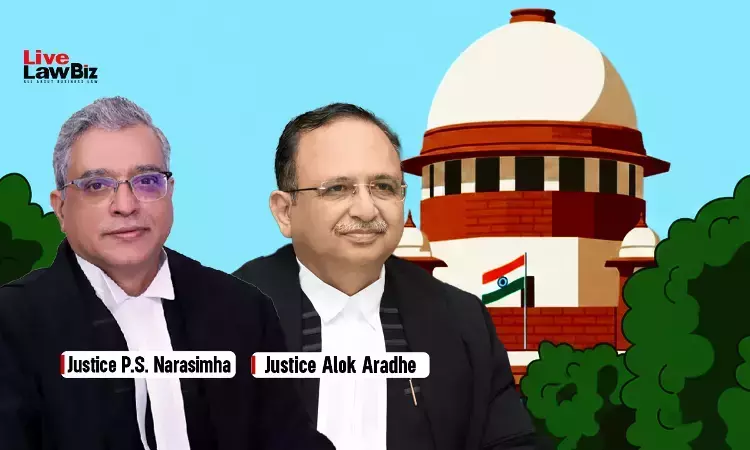
The top court also directed the Bar Council of India to constitute a committee to examine issues arising from the use of artificial intelligence in legal practice and adjudication.
Comparing fake AI-generated legal material to the release of methyl isocyanate (the gas behind the Bhopal gas tragedy), the Supreme Court on Thursday warned that artificial intelligence could become "invisible, insidious, catastrophic" if used without safeguards.
The court set aside insolvency orders against Essel Infraprojects Ltd after finding that the National Company Law Tribunal and the National Company Law Appellate Tribunal had relied on non-existent, hallucinated case law.
A bench of Justices P.S. Narasimha and Alok Aradhe held that the integrity of the adjudicatory process had been compromised. It remitted the insolvency proceedings for fresh consideration.
The court also directed the Bar Council of India to constitute a committee to examine issues arising from the use of artificial intelligence in legal practice and adjudication.
While affirming that AI can assist judicial work, the bench stressed that adjudication must remain under "total and absolute control" of human decision-makers at every stage.
Setting aside the tribunal orders, the court observed, "The tribunals relied on non-existing, fake and hallucinated material generated through artificial intelligence, as if they were precedents in support of its judgment. For the reasons to follow, we have set aside the judgment of the NCLT, as well as the judgment in appeal, to affirm and maintain the integrity of the adjudication and its processes."
The bench clarified that it was not rejecting the use of AI in the justice delivery system. Instead, it emphasised that AI should function only as an aid to adjudication and never replace human reasoning.
"We resolve to adopt artificial intelligence technology in aid of adjudication, while at the same time asserting and declaring total and absolute control over adjudication, with a human in the loop, at every stage."
Warning against the dangers of unregulated AI, the Court made a striking comparison,
"The production of fake, non-existing and hallucinated material... is like release of methyl isocyanate in the province of law and justice. Invisible, insidious, catastrophic."
The bench observed that although regulation of AI would primarily be a matter of public policy, its successful implementation would depend equally on the Bar and the Bench exercising care and caution while using the technology.
Background
The insolvency dispute arose after Jammu and Kashmir Bank Ltd initiated proceedings against Essel Infraprojects Ltd as a corporate guarantor for loans granted to Pan India Utilities Distribution Company Ltd. The bank claimed a default of more than ₹87.43 crore under a ₹200 crore credit facility sanctioned in December 2013.
The facility was secured through a corporate guarantee and a mortgage over land at Gorai in Mumbai. On August 28, 2024, the NCLT Mumbai admitted the insolvency plea, holding that the corporate guarantee continued despite restructuring of the borrowing entity.
On appeal by Pooja Ramesh Singh, the NCLAT on September 11, 2025 upheld that order, holding that Clause 8 of the guarantee deed expressly stated that the guarantee would not be prejudiced by amalgamation or absorption of the guarantor company. It also found no evidence to show that the bank had discharged the guarantee.
Notably, a controversy surfaced during the Supreme Court hearing on May 5, when Singh informed the Court that the NCLT Mumbai had relied on what were described as “hallucinated” citations while admitting Essel Infraprojects Ltd into insolvency.
In an affidavit filed on May 11, Singh alleged that the NCLT and NCLAT relied on “non-existent” and “untraceable” judgments, including State Bank of India v. Shree Ram Urban Infrastructure Ltd., Everest Kento Cylinders Ltd. v. Union of India, ICICI Bank Ltd. v. Urban Infrastructure Real Estate Ltd., V.S. Dempo & Co. Ltd. v. Reliance Communications Ltd., Canara Bank v. N.G. Subbaraya Setty & Anr., and Sarbjit Singh v. Union Bank of India. According to the affidavit, the cited propositions could not be traced on recognised legal databases.
The Supreme Court on May 19 had informed the parties that allegations that the NCLT and NCLAT relied on allegedly fake citations in insolvency proceedings against Essel Infraprojects Ltd were already under administrative examination and had been referred to a committee.