
RBI Can Supersede Multi-State Co-Operative Bank Board For Up To Five Years In Public Interest: Supreme Court
Kirit Singhania
4 Sept 2026 10:43 AM IST
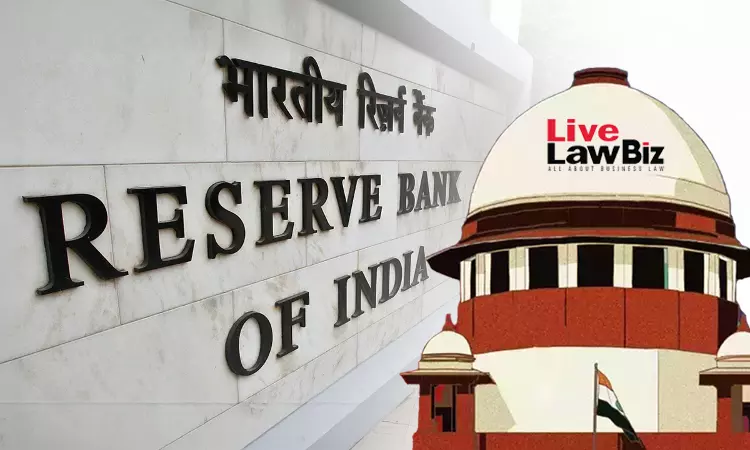
The Supreme Court has ruled that the Reserve Bank of India can supersede the Board of Directors of a multi-State co-operative bank and extend the period of supersession from time to time, subject to an overall limit of five years.
This power can be exercised in public interest, to protect depositors and the bank from harmful management, or to ensure proper management of the bank.
"Thus, for reasons to be recorded, the power of supersession of a multi-State co-operative bank, can be exercised by RBI, in public interest or for preventing the affairs of a co-operative bank being conducted in a manner detrimental to the interest of the depositors or of the co-operative bank or for securing the proper management of such bank, from time to time, for a period not exceeding five years," the court observed.
A Bench of Justices Pamidighantam Sri Narasimha and Alok Aradhe dismissed the appeals against the Bombay High Court's November 18, 2024 judgment.
The High Court had upheld the Reserve Bank's decision to supersede the Board of Abhyudaya Co-operative Bank and appoint an Administrator to manage its affairs.
The Board members had been elected in May 2019 for a statutory term of five years. On November 24, 2023, the Reserve Bank superseded the Board for one year and appointed an Administrator.
The Reserve Bank cited the bank's deteriorating financial health. It found that supersession was necessary to protect depositors, prevent the bank from collapsing, and bring in expert management to restore its financial health.
The Board members challenged the action before the Bombay High Court. Their five-year term expired on May 24, 2024 while the challenge was pending.
On November 18, 2024, the High Court upheld the Reserve Bank's action. The Reserve Bank extended the supersession for another year from November 24, 2024. It was extended again from November 24, 2025 while the matter was pending before the Supreme Court.
Before the Supreme Court, the former Board members argued that the Constitution generally does not allow a co-operative society's Board to remain under supersession for more than six months. They contended that the Reserve Bank could not use its powers under the Banking Regulation Act to go beyond this limit. They also argued that the supersession could not continue after the elected Board's five-year term had ended.
The Reserve Bank relied on the Banking Regulation Act, which governs banking. Under the Act, the Reserve Bank can supersede the Board of a co-operative bank where it is necessary in public interest, to prevent the bank's affairs from being run in a manner harmful to depositors or the bank, or to secure proper management. The period can be extended from time to time, but the total period cannot exceed five years.
The court examined the constitutional provision dealing with the supersession of co-operative societies' Boards. While the provision generally fixes a six-month limit, it also states that the Banking Regulation Act “shall also apply” to co-operative societies carrying on banking business.
The court observed that the words “shall also apply” were used in an additive and non-restrictive sense. It held that the Banking Regulation Act is incorporated into the constitutional framework governing multi-State co-operative banks.
"Tested on the analogy of the aforesaid well-settled legal principles, it is evident that the third proviso to Article 243ZL(1) employs the expression “shall also apply”. The said expression has been used in an additive and non-restrictive sense. Therefore, it is evident that the same incorporates BR Act into Part IXB of the Constitution insofar as it pertains to multi-State co-operative bank.", it ruled.
Another part of the same constitutional provision extends the usual six-month limit to one year for certain co-operative societies carrying on banking business, but specifically excludes multi-State co-operative societies from that extension.
The court observed that this express exclusion showed that multi-State co-operative banks were otherwise within the scope of the provision. It held that the Constitution preserved the application of the Banking Regulation Act to such banks.
The court noted that banking involves public interest because banks hold and manage depositors' savings. The Banking Regulation Act gives the Reserve Bank specialised regulatory powers to protect depositors and maintain the stability and discipline of the banking system.
"To read the third proviso to Article 243ZL(1) as excluding multi-State co-operative banks from the reach of the BR Act and thereby confining the RBI's regulatory hand to a rigid six-month period, ill-suited to the time genuinely required to nurse a distressed bank back to health, would be to subordinate the protection of depositors and the discipline of the banking system to a truncated and overly technical reading of a constitutional proviso," the court observed.
It consequently ruled that the Constitution's six-month limit does not restrict the Reserve Bank's power under the Banking Regulation Act to supersede the Board of a multi-State co-operative bank.
The court then considered whether the supersession could continue after the elected Board's original term had expired. It noted that once a Board is superseded, its powers vest in the Administrator appointed by the Reserve Bank.
The law requires the Administrator to call a general meeting for the election of new directors on or before the expiry of the period of supersession specified by the Reserve Bank.
The court ruled that the tenure of the erstwhile Board does not limit the Reserve Bank's power to continue the supersession. The five-year maximum period ensures that elections cannot be postponed indefinitely.
Since the Reserve Bank had first superseded the Board while its elected term was still in force and the later extensions remained within the overall five-year limit, the court upheld the action and dismissed the appeals.
For Appellant: Devadatt Kamat, Sr. Advocate, Anandh Kannan N., AOR, Advocates C.subash, Revanta Solanki, Hruday Bajentri
For Respondent: Jaideep Gupta, Ramesh Babu, Sr. Advocates, Advocates Nisha Sharma, Tanya Chowdhary, Mukti Chowdhary, AOR, Ninad Laud, Zubin Dash, Guruprasad Naik, Deb Ganapathy, Dcosta Ivo Manuel Simon, AOR, Shrirang B. Varma, Siddharth Dharmadhikari, Aaditya Aniruddha Pande, AOR, Anandh Kannan N., AOR