
Limitation To Challenge Arbitral Award Begins Only After Tribunal Disposes Of Post-Award Pleas: Supreme Court
Kirit Singhania
2 Jun 2026 6:42 PM IST
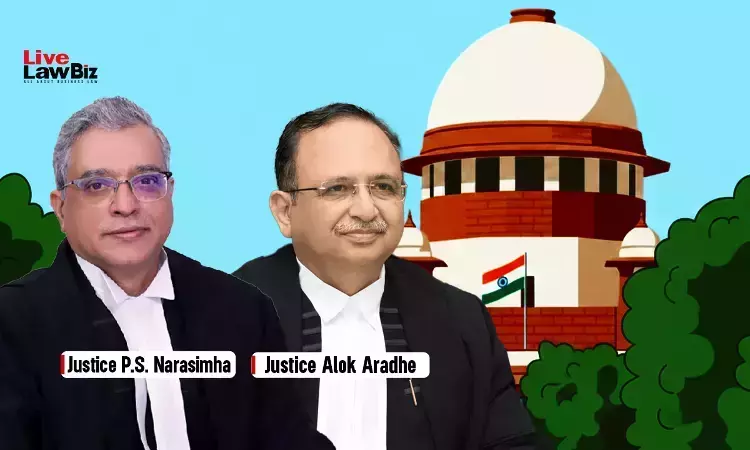
The Supreme Court on Tuesday held that when parties invoke post-award proceedings before an arbitral tribunal seeking correction, interpretation, or an additional award, the limitation period for challenging the arbitral award begins only after those proceedings are disposed of.
The court observed that parties cannot be compelled to challenge an award while such proceedings remain pending before the tribunal.
A bench of Justices Pamidighantam Sri Narasimha and Alok Aradhe allowed an appeal filed by the National Highway Authority of India (NHAI) and set aside a January 22, 2024 judgment of the Karnataka High Court.
It restored an August 5, 2023 order of the Principal District and Sessions Judge, Ballari, which had condoned the delay in filing NHAI's challenge to an arbitral award.
The bench ruled, “Once proceedings under Section 33 are initiated and entertained by the Arbitral Tribunal, the award remains subject to the limited jurisdiction of the tribunal for correction, interpretation, or supplementation as contemplated under the provision. So long as such proceedings remain pending, the parties cannot be compelled to institute proceedings under Section 34 merely as a matter of abundant caution. The parties can effectively pursue their remedy under Section 34 only upon conclusion of the proceedings under Section 33. Consequently, the limitation prescribed under Section 34(3) can start only from the date on which the proceedings under Section 33 are disposed of.”
The dispute arose from the acquisition of land belonging to T. Younis in Ballari district for a national highway project. A notification issued in December 2009 included Younis's land in the acquisition proceedings and compensation was determined in December 2011. NHAI subsequently invoked arbitration, following which the Deputy Commissioner-cum-Arbitrator passed an award in February 2013 redetermining compensation.
The Karnataka High Court later set aside that award and remitted the matter for fresh consideration.
The arbitrator then passed a fresh award on February 3, 2022, granting the landowner benefits under the Land Acquisition Act, 1894.
NHAI then sought correction of the award, arguing that the grant of additional market value and interest was legally unsustainable. Younis, in turn, sought an additional award, claiming that one of his claims had been left out. The arbitrator rejected both pleas through a common order dated July 4, 2022.
NHAI thereafter filed applications challenging the award along with applications seeking condonation of delay. Younis opposed the applications, arguing that they had been filed beyond the maximum period permissible under law. On August 5, 2023, the Principal District and Sessions Judge, Ballari, condoned the delay.
However, the Karnataka High Court later set aside that order after holding that NHAI's application did not fall within the scope of Section 33(1)(a) of the Arbitration and Conciliation Act, 1996 and therefore could not extend the limitation period.
Reversing the High Court, the Supreme Court held that the limitation provision does not distinguish between applications that are ultimately allowed and those that are dismissed. It also held that the provision does not indicate that only an application found to be maintainable can defer the commencement of limitation.
Rejecting the High Court's reasoning, the bench held:
“The said provision does not distinguish between the applications which are ultimately allowed or dismissed. The said provision also does not indicate that only an application which is maintainable under Section 33 of the Act would defer the commencement of litigation under Section 34(3) of the Act. Had the legislature intended to restrict the benefit only to the applications which were ultimately allowed or which were held to be maintainable, it would have expressly provided so. The Court cannot read into the provision a restriction which the legislature itself has not consciously incorporated.”
The Court also rejected the respondent's contention that only a maintainable application could postpone the commencement of limitation. It held that the outcome of such an application is not determinative for limitation purposes and that the relevant consideration is whether the arbitral tribunal's jurisdiction had been formally invoked.
Rejecting the respondent's contention, the Court observed:
“Whether the application under Section 33 ultimately succeeds or fails, or whether the Arbitral Tribunal eventually finds that no correction or modification of the award is warranted, is not determinative for the purpose of Section 34(3). What is relevant is that whether the jurisdiction of the Arbitral Tribunal under Section 33 had been formally invoked and that such proceedings remained pending consideration before the tribunal.”
The Court further held that the High Court's interpretation would defeat the scheme and object of the legislation by forcing parties to institute challenge proceedings while post-award proceedings remained pending before the tribunal.
On the consequences of the High Court's interpretation, the Bench observed:
“We are also of the view that the interpretation adopted by the High Court would defeat the scheme and object of the Act. If parties are compelled to institute proceedings under Section 34 during the pendency of proceedings, under Section 33 merely as a matter of abundant caution, it would result in multiplicity of proceedings and procedural uncertainty.”
The Bench, however, clarified that where applications are found to be sham, frivolous, mala fide, or filed solely to defeat limitation, courts would be justified in imposing exemplary and punitive costs.
The Court also rejected reliance placed by the respondent on State of Arunachal Pradesh v. Damani Construction Co., holding that the decision arose in a different factual context where there was no formal application under Section 33 invoking the arbitral tribunal's jurisdiction.
In the present case, the court noted both parties had admittedly filed formal applications under Section 33 within the statutory period and those applications had been entertained and disposed of by the arbitrator.
Noting that NHAI received the certified copy of the common order disposing of the applications on September 15, 2022, and filed its challenge on November 7, 2022, the court held that the challenge had been instituted within the period contemplated by law when limitation was reckoned from the disposal of those applications.
Accordingly, the court allowed NHAI's appeal, restored the order condoning delay and directed that NHAI's challenge to the arbitral award be decided on its own merits in accordance with law.
For Petitioner: Senior Advocate Pinky Anand, Advocates Tarun Dua, Sumit Gupta, Saudamini Sharma, Akshay Kumar Tiwari, Tanya Shrotriya, Venkita Subramoniam T.r, AOR
For Respondent: Senior Advocate Sushil Kumar Jain, Advocates Anandakumar A Magadum, Darpan Km, Amrita Sharma, Rajat Jonathan Shaw, Ajay Magadum, Easha Chandhok, Prashant Upadhyay, Mahima Sadawat, Sidharth Jain, Rashi Bansal, AOR