
IBC Moratorium Applies Only To Corporate Debtor, Not Directors Or Promoters: Supreme Court
Kirit Singhania
27 July 2026 8:15 PM IST
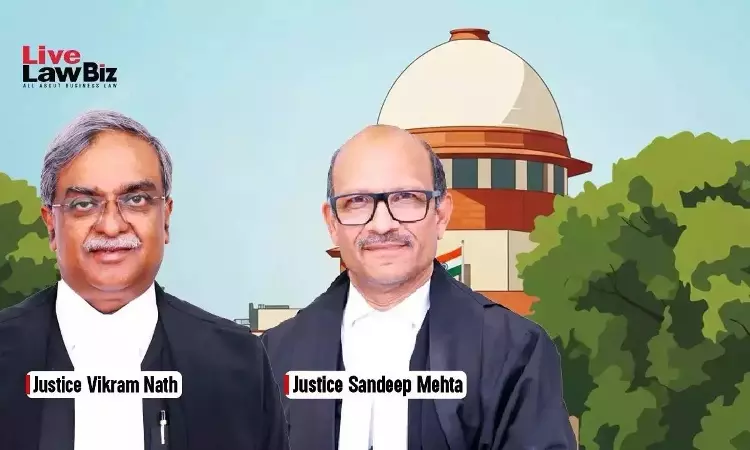
The Supreme Court on Monday held that the moratorium under Section 14 of the Insolvency and Bankruptcy Code, 2016, operates only against the corporate debtor.
It ruled that courts or adjudicating authorities cannot enlarge its scope to cover directors, promoters, subsidiary companies, personal guarantors or any other persons unless the statute expressly provides so.
The court observed that the scope of the moratorium is statutory and must remain confined to what Section 14 contemplates.
A bench of Justices Vikram Nath and Sandeep Mehta allowed appeals filed by homebuyers of the Mantri Manyata Energia project and set aside the NCDRC's order of 20 January 2025 refusing to proceed with the consumer complaint against respondents other than the corporate debtor on account of the Section 14 IBC moratorium.
"The scope of the moratorium is statutory. It is not open either to the adjudicating authority or the Court to enlarge its ambit beyond what the statute contemplates. A plain reading of the provision makes it clear that the moratorium operates against the corporate debtor alone. No other category, whether it be any subsidiary company, any managers/ directors, personal guarantors etc. can be added to it unless specifically provided.", the Court said.
The homebuyers in the Mantri Manyata Energia project filed a consumer complaint in 2023 against the developer, its associated company, directors and landowners alleging delay in handing over possession promised by 31 December 2018. During the pendency of the complaint, the NCLT, Bengaluru admitted an insolvency petition against the developer on 23 August 2024, triggering Section 14 IBC moratorium.
The homebuyers sought continuation of proceedings against the remaining respondents but the NCDRC rejected the plea and adjourned the complaint sine die.
Referring to the judgment in Ansal Crown Heights Flat Buyers Association v. Ansal Crown Infrabuild Pvt. Ltd., the Court reiterated that a moratorium against the corporate debtor does not extend protection to its promoters or directors and proceedings can continue against them.
The homebuyers argued that the moratorium applied only to the corporate debtor and did not bar proceedings against the remaining respondents. Accepting the contention, the Court held that the respondent company alone was undergoing CIRP and no independent moratorium protected other respondents.
"In our view, this approach is erroneous. In the present case, Respondent No.1 alone is the corporate debtor against whom the CIRP has been initiated. No independent moratorium or independent protection operates in favour of Respondent Nos. 2 to 7. In the absence of any legal bar against continuation of proceedings qua the said respondents, the NCDRC was not justified in rejecting appellants' prayer to proceed with the complaint against the rest of the respondents.", the court noted.
The Court observed that the Commission prematurely concluded that the alleged deficiency in service was attributable only to the corporate debtor, even while acknowledging that liability had yet to be adjudicated. By doing so, it effectively decided the merits at the interlocutory stage.
Explaining why the NCDRC's approach was unsustainable, the Court said, "Having itself observed that the liability arising from deficiency in service are yet to be determined, it could not have simultaneously concluded that the alleged deficiency was attributable only to Respondent No. 1 and therefore no complaint could proceed against the rest."
Accordingly, the Court restored the interlocutory applications and directed the NCDRC to proceed with the consumer complaint against the remaining respondents while clarifying that proceedings against the corporate debtor would continue to remain stayed under the Section 14 IBC moratorium.
For Appellants: Chandrachur Bhattacharyya, Advocate, Sahil Tagotra, AOR, Shreya Kasera
For Respondents: Sajan Poovayya, Sr. Adv, Pratibhanu Singh Kharola, Chandrashekhar Chaklabi, Sriharikiran Gottipati, Palash Maheshwari, Dharmaprabhas Law Associates, AOR, Devasa & Co., AOR, Ashutosh Dubey, AOR, Rajshri, Abhishek Chauhan, Amit P Shahi, Anirban Tripathi, Rekha Chaudhary, Anjan Datta, Rahul Sethi, Abhishek Puri, Govind Kashyap