
Top Stories

LiveLawBiz: Corporate Legal News Daily Round-Up: August 25, 2026
IBC Supreme Court Upholds NCLAT Refusal To Entertain Allottee's Plea Seeking Refund Of Around ₹4 Lakh In Jaiprakash Associates CIRPPersonal Guarantor Cannot Extend Limitation Through Own OTS Proposals: NCLAT New DelhiIPR Delhi High Court Refers Territorial Jurisdiction Question In HUL's Disparagement Suit Against Kwick Living To Larger BenchDelhi High Court Restrains Healing Pharma From Using Trade Dress Similar To Himalaya ProductsDelhi High Court Temporarily Restrains Sale Of Counterfeits With...
SEBI Moves Supreme Court Against Kerala HC Ruling Dismissing Its Appeal Over Ramachandran Escrow Funds
On 22 August, the Securities and Exchange Board of India (SEBI) filed a special leave petition (SLP) before the Supreme Court challenging a Kerala High Court judgment which dismissed its appeal over funds lying in an escrow account linked to late filmmaker and jeweller M.M. Ramachandran and Atlas Jewellery. A Division Bench of the Kerala High Court had held that SEBI, which was not the original writ petitioner, could not challenge the judgment in proceedings initiated by Axis Bank. It had...

Supreme Court Upholds NCLAT Refusal To Entertain Allottee's Plea Seeking Refund Of Around ₹4 Lakh In Jaiprakash Associates CIRP
The Supreme Court on Tuesday upheld the National Company Law Appellate Tribunal's refusal to grant relief to an allottee of a Jaiprakash Associates Ltd. project, who had sought refund of around ₹4 lakh demanded from him towards common area charges after he had taken possession of his unit.A Bench comprising Chief Justice of India Surya Kant and Justices Joymalya Bagchi and V. Mohana after hearing the case, refused to interfere with the NCLAT order dated May 14, 2026.Counsel appearing for...
Ilaiyaraaja Moves Top Court Against Delhi HC's Review Dismissal In 'En Iniya Pon Nilave' Copyright Dispute
Music composer Ilaiyaraaja has moved the Supreme Court through a Special Leave Petition (SLP) challenging the Delhi High Court's dismissal of his review petition in a copyright dispute concerning the sound recording of “En Iniya Pon Nilave” from the Tamil film Moodu Pani. The dispute arose after Saregama India Ltd. initiated proceedings against Vels Film International Ltd. (VFIL) over its proposed use of a recreated version of “En Iniya Pon Nilave” in Aghathiyaa. VFIL relied on an agreement...
LiveLawBiz: Corporate Legal News Daily Round-Up: August 24, 2026
IBC NCLAT New Delhi Clarifies Property Inspection For Liquidation Does Not Affect Possessory RightsNCLT Bengaluru Dissolves Infotech HAL After Completion Of Liquidation ProcessNCLT Chennai Admits Gangotri Textiles' CIRP Plea, Holds Pending DRT Proceedings No BarNCLT Indore Holds Mere Shareholding Overlap Can't Establish Collusion, Admits Plea Against Organic World'Other Creditor' Status Does Not Confer Unrestricted Right To Challenge Resolution Plan: NCLT ChandigarhNCLAT New Delhi Upholds Jet...
Supreme Court Asks Bombay High Court To Expedite Pending Applications In Ex-Lilavati Trustee's Suit
On 20 August, the Supreme Court requested the Bombay High Court to take up and dispose of pending applications in a suit filed by Rajesh Mehta, former Permanent Trustee of the Lilavati Kirtilal Mehta Medical Trust, challenging his removal from the post. A Bench comprising Chief Justice of India Surya Kant with Justices Joymalya Bagchi and V. Mohana declined to interfere with the Bombay High Court's interim order dated 7 August, as the matter remained pending before it, but requested the High...
Vivo Executive Moves Supreme Court After Delhi HC Denies Travel To China Over ₹20,000 Cr. PMLA Case
On 17 August, Guangwen Kuang, a executive of Vivo Mobile Communications filed a Special Leave Petition (SLP) before the Supreme Court challenging the Delhi High Court's refusal to permit him to travel to Guangzhou, China, where his 82-year-old father is ill.The Delhi High Court's order dated 9 July 2026 refused permission citing the alleged proceeds of crime, his status as a Chinese national and the absence of an extradition treaty or Mutual Legal Assistance Treaty between India and China....

LiveLawBiz IBC Weekly Digest: August 17 - August 22, 2026
SUPREME COURT 'Judicial Discipline' Requires HC To Refrain From Entertaining Writ Against Appealable NCLT Order: Supreme CourtCase Title : DAVIS KOOTTALA VARKEY & ORS. VERSUS SAMSON T. GEORGE & ORS. Case Number : SPECIAL LEAVE PETITION No.18523/2026 CITATION : 2026 LLBiz SC 278The Supreme Court has set aside a Kerala High Court order that entertained a writ petition challenging an NCLT order passed during liquidation proceedings. Supreme Court To Examine If Winding-Up Petitions...
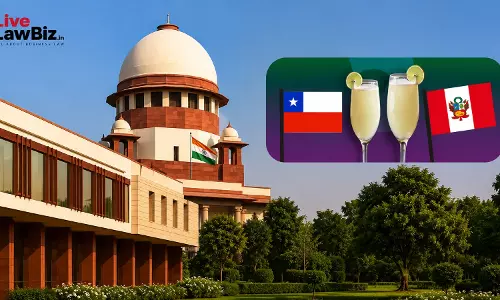
Supreme Court Issues Notice In Embassy Of Peru's Plea Against Delhi HC Ruling On 'PISCO' GI
The Supreme Court on Monday issued notice on the Embassy of Peru's special leave petition challenging the Delhi High Court judgment which declined Peru an exclusive standalone geographical indication (GI) for “PISCO” in India.The High Court held that the term has historically been associated with alcoholic beverages originating from both Peru and Chile, making exclusive protection likely to confuse consumers.The Supreme Court was hearing the Embassy of Peru's special leave petition challenging...
NCLAT New Delhi Upholds Jet Airways Aircraft Sale, Dismisses Ex-Employees' Challenge
On 21 August, the New Delhi Bench of the National Company Law Appellate Tribunal (NCLAT) dismissed an appeal filed by former employees of Jet Airways (India) Limited challenging the sale of the airline's aircraft assets during liquidation. Judicial Member Justice Mohd Faiz Alam Khan and Technical Member Arun Baroka held that the former employees, whose dues would be paid under the waterfall mechanism under Section 53 of the Insolvency and Bankruptcy Code (IBC), had no basis to challenge the...

LiveLawBiz: Corporate Legal News Daily Round-Up: August 21, 2026
IBC NCLT Indore Dismisses Union Bank's Plea To Include Four Belated EOIs In JSM Devcons CIRPNCLT Chandigarh Sets Aside Canara Bank's SARFAESI Sale Of Mohan Rail Components' AssetsNCLT Delhi Permits Withdrawal Of Aviator ML 29641 Insolvency Plea Against SpiceJet, Imposes ₹15 Lakh CostsNCLAT New Delhi Holds Reasonable Time Must Be Granted After PIRP Plan Approval, Sets Aside NCLT OrderBombay High Court Upholds IBBI's Power To Levy 0.25% Fee On Successful Resolution PlansIBC Amendment Excluding...
NCLT Delhi Permits Withdrawal Of Aviator ML 29641 Insolvency Plea Against SpiceJet, Imposes ₹15 Lakh Costs
The National Company Law Tribunal (NCLT), New Delhi, on 19 August allowed Aviator ML 29641 to withdraw its insolvency petition against SpiceJet Limited under Section 9 of the Insolvency and Bankruptcy Code, 2016, but imposed costs of Rs. 15 lakh on both parties for seeking withdrawal after the matter had been reserved for orders. A Bench of Judicial Member Mahendra Khandelwal and Technical Member Anu Jagmohan Singh allowed the withdrawal under Rule 8 of the Insolvency and Bankruptcy...