
Tax

Rajasthan High Court Orders Release Of ₹47.45 Lakh Cash Seized Over Alleged Unaccounted Sales
The Rajasthan High Court on 14 September directed the GST department to release Rs. 47.45 lakh seized during a search of residential premises, along with applicable interest. A Division Bench comprising Justices Arun Monga and Ashutosh Kumar held that Section 67(2) of the Central Goods and Services Tax (CGST) Act does not authorise the seizure of cash merely on suspicion that it represents proceeds from unaccounted sales. It observed: “...the jurisdictional condition of 'reasons to believe'...

Calcutta High Court Allows Birla Corporation's Cross-Objections In Income Tax Appeal Under CPC
On 14 October, the Calcutta High Court allowed Birla Corporation Limited to maintain cross-objections in the Income Tax Department's appeal, subject to the requirement that they raise substantial questions of law. A Division Bench comprising Justices Rajarshi Bharadwaj and Sudip Deb held that Section 260A(7) of the Income Tax Act, 1961, incorporates the relevant provisions of the Code of Civil Procedure, 1908 (CPC), including the right to file cross-objections. The judges observed: “We are of...
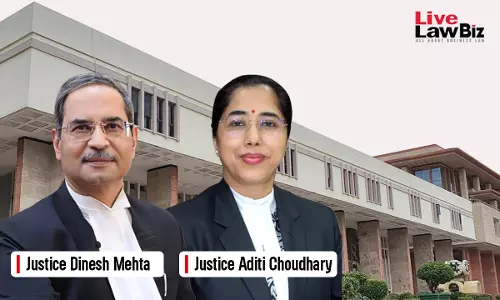
PAN Misuse | Delhi High Court Quashes ₹3.91 Crore Income Tax Demand Against Security Guard
The Delhi High Court has quashed an income tax assessment order raising a demand of approximately ₹3.91 crore against a contractual security guard, observing that the assessment was based solely on portal data without any independent inquiry to establish his connection with the alleged transactions.The Division Bench of Justices Dinesh Mehta and Aditi Choudhary held that the assessment violated the principles of natural justice, as the Assessing Officer failed to provide the material relied upon...
Delhi High Court Refuses To Quash ₹8.12 Crore Income Tax Reassessment Notice Against Pernod Ricard
The Delhi High Court has refused to quash an income tax reassessment notice issued to Pernod Ricard India Private Limited, the maker of popular liquor brands Royal Stag and Blenders Pride, over an alleged discrepancy of more than ₹8 crore between its turnover declared in Value Added Tax (VAT) returns and its income tax records for the assessment year 2013-14.The Division Bench of Justices Dinesh Mehta and Aditi Choudhary dismissed the company's writ petition challenging the notice issued under...

CKD Electric Two-Wheelers Without Battery, Charger Not Eligible For Customs Duty Exemption: CESTAT Delhi
The Customs, Excise and Service Tax Appellate tribunal (CESTAT), New Delhi, has denied concessional customs duty to an importer of electric two-wheelers in completely knocked down (CKD) condition because the kits lacked components required under the applicable exemption notification.A Bench of Officiating President Dr. Rachna Gupta and Technical Member Hemambika R. Priya, however, upheld their classification as complete electric two-wheelers under Rule 2(a) of the General Rules for...
Airline Cancellation Charges Are Compensation For Breach Of Contract, Not Taxable Service: CESTAT Delhi
The Customs, Excise and Service Tax Appellate Tribunal (CESTAT), New Delhi, has ruled that cancellation fees collected by Lufthansa German Airlines as compensation for passengers failing to honour their travel commitments are not taxable as consideration for a separate service under Section 66E(e) of the Finance Act, 1994.“In short, the cancellation charges are in the form of a compensation for failure of a contract entered into that the passenger would fly and the airlines would carry him to...

VAT Payment Doesn't Exempt Fit-Out Charges From Service Tax, CENVAT Credit Allowed: Madras High Court
The Madras High Court on 12 October held that payment of Value Added Tax (VAT) on fit-out charges does not automatically exempt the same transaction from service tax. Further, a portion of the consideration for leased office premises must be attributed to fit-outs provided under the lease agreements. A Division Bench comprising Justices Anita Sumanth and C. Kumarappan upheld CENVAT credit claimed by Ascendas IT Park (Chennai) Ltd. on specified input services, while deciding an appeal filed by...

Dupattas Made Of Woven Fabric Exempt From Tax As Fibres Under TNVAT Act: Madras High Court
The Madras High Court on 7 October held that dupattas made of woven fabric fall under the exemption for textile fabrics under the Tamil Nadu Value Added Tax (TNVAT) Act, 2006, and cannot be classified as fibres for taxation. A Division Bench comprising Justices Anita Sumanth and K. Rajasekar allowed three tax case revisions filed by Vedant Fashions Pvt. Ltd., and set aside the 4% tax levy on dupattas for the assessment years 2009-10, 2010-11 and 2011-12. The judges held: “A dupatta cannot, by...
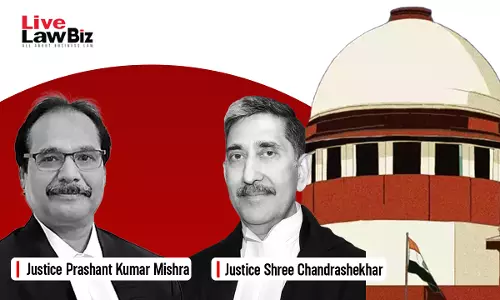
Income Tax | Taxpayers Cannot Raise Fresh Claims Based On New Facts In Revision Proceedings: Supreme Court
The Supreme Court has recently reiterated that taxpayers cannot use revision proceedings to introduce fresh claims based on facts that were never placed before the Assessing Officer, bypassing the deadline for filing a revised income tax return.A bench of Justices Prashant Kumar Mishra and Shree Chandrashekhar held that the revisional authority can entertain a new question of law, but cannot consider a claim that goes beyond the facts available to the Assessing Officer.“In our considered view,...

Charitable Hospital Cannot Be Denied Income Tax Exemption For Charging Patients, Making Surplus: Bombay High Court
The Bombay High Court has ruled that a hospital seeking income tax exemption on philanthropic grounds cannot be denied the benefit merely because it earns a surplus, charges patients for treatment, or collects professional fees on behalf of consultant doctors. The question is whether its actual activities and use of funds establish that it exists solely for philanthropic purposes and not for profit.A division bench of Justice B.P. Colabawalla and Justice Farhan P. Dubash set aside orders passed...
LiveLawBiz Indirect Tax Weekly Round-Up: October 05 - October 11, 2026
SUPREME COURTTax Classification Depends On Form Of Goods At Sale, Not End Use: Supreme CourtCase Title : Additional Commissioner, Commercial Tax & Ors. v. Cadila Health Care Ltd. & Anr. Case Number : Civil Appeal Nos. 9788–9789 of 2013 CITATION : 2026 LLBiz SC 327The Supreme Court has held that a product must be classified for tax purposes in the form in which it is sold, rather than on the basis of what a consumer may later turn it into. “The tax authorities are bound to look at what...
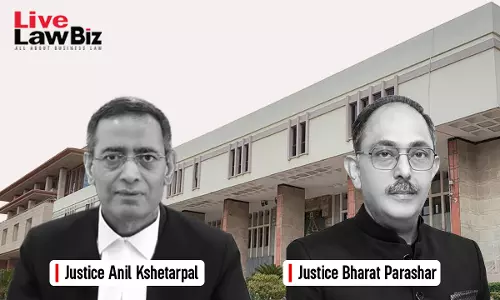
Delhi High Court Allows GST Appeal Without Full Pre-Deposit Over Overlapping Demands
The Delhi High Court has permitted a taxpayer to approach the appellate authority with an application seeking exemption from the statutory pre-deposit requirement, to the extent the GST demand is alleged to overlap with an earlier demand.The division bench of Justices Anil Khetarpal and Bharat Parashar was hearing a plea by M/s Forever Exim India Private Limited seeking restoration of its writ petition challenging a GST order dated August 30, 2024.Petitioner submitted that parallel proceedings...