
Supreme Court
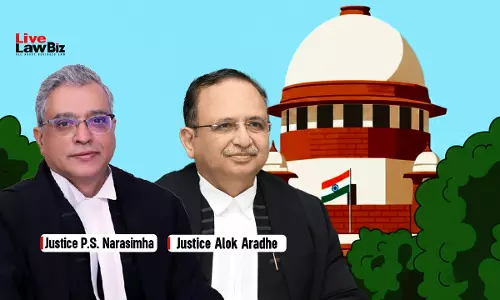
Insolvency Process Has Far-Reaching Consequences, Cannot Be Used To Enforce Money Decrees: Supreme Court
The Supreme Court on Thursday held that insolvency proceedings under the Insolvency and Bankruptcy Code, 2016 cannot be invoked as a substitute for execution of a civil court decree. A Bench of Justices Pamidighantam Sri Narasimha and Alok Aradhe observed that, “The insolvency process is a remedy with far-reaching consequences and must be reserved for cases of genuine insolvency or financial distress, not for the enforcement of money decrees.” The Division Bench allowed an appeal against a...
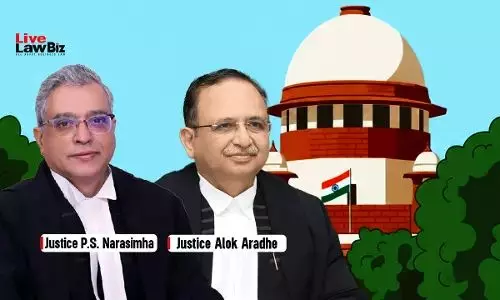
RBI Approval Needed To Enforce Foreign Decree Where FERA Regime Applies: Supreme Court
The Supreme Court of India on Tuesday clarified that enforcement of a foreign decree arising from a transaction governed by India's foreign exchange regulatory regime would require prior approval of the Reserve Bank of India (RBI), where such approval is mandated under the governing statutory framework. A bench of Justices Pamidighantam Sri Narasimha and Alok Aradhe held that while there is no prohibition on the initiation of proceedings or determination of liability based on a foreign decree,...

Supreme Court Declines To Interfere With Calcutta High Court IT Order Favouring Britannia
The Supreme Court on Tuesday refused to interfere with a tax department plea against Britannia Industries Ltd, upholding a Calcutta High Court ruling that had set aside a Income Tax revision order. The dispute concerned the valuation of property acquired by the company and deductions claimed for statutory dues such as taxes.A bench of Justices Pamidighantam Sri Narasimha and Alok Aradhe, while declining to interfere with the High Court's order, kept the interpretation of Section 56(2)(x) of the...
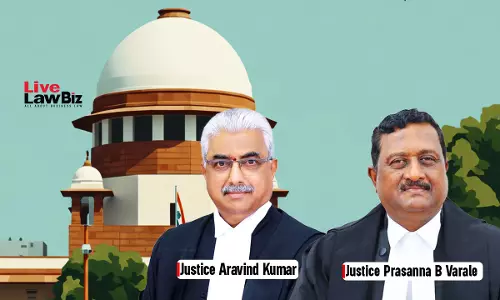
Supreme Court Sets Aside HC Direction Making Customs Dept. Liable For Demurrage In Austin Engineering Dispute
The Supreme Court has recently set aside a Madras High Court ruling that had required the Customs Department to bear demurrage charges in a dispute with Austin Engineering Co. Ltd. These charges are levied by port authorities when imported goods remain in storage beyond the permitted period.The court made it clear that such liability cannot be placed on customs unless there is clear evidence of mala fides or a gross abuse of power. A bench of Justice Aravind Kumar and Justice Prasanna B. Varale...

Legal Representatives Have Right To Challenge Arbitral Awards That Bind Them: Supreme Court
The Supreme Court on Monday held that if an arbitral award can be enforced against the legal representatives of a deceased party, they must also have the right to challenge it under the law, holding that such representatives “step into the shoes” of the deceased for the purposes of arbitral proceedings. A bench of Justices Sanjay Karol and Vipul M. Pancholi observed that the Arbitration and Conciliation Act is a self-contained code and emphasises continuity of arbitral proceedings, particularly...

Supreme Court Stays ₹14.91 Crore Customs Duty Recovery Against HP India, Issues Notice
The Supreme Court has stayed recovery pursuant to a Rs.14.91 crore customs demand against HP India Sales Pvt. Ltd. and issued notice in its appeal against a November 4, 2025 order of the Customs, Excise, and Service Tax Appellate Tribunal (CESTAT).HP India's appeal challenges the CESTAT Mumbai order, which upheld the classification of its imported “HP Latex printers” as inkjet printing machines instead of inkjet printers, leading to the duty demand along with interest and penalty under the...
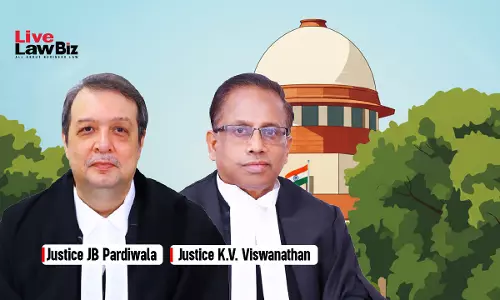
Supreme Court Pulls Up RP, CoC Of Xalta Food For Defaulting On ₹50.55 Lakh Monthly Compensatory Rent
The Supreme Court on Thursday came down heavily on the Resolution Professional (RP) and Committee of Creditors (CoC) of Xalta Food and Beverages Pvt. Ltd. for failing to honour their statement on oath and resolution to pay monthly compensatory rent of about ₹50.55 lakh to the lessor, Prerna Singh, noting that despite such commitment, only partial payment of ₹33.83 lakh was made for April 2026. A Bench of Justices J.B. Pardiwala and K.V. Viswanathan reprimanded the RP and the CoC for failing to...
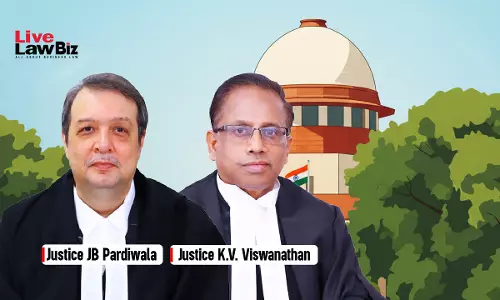
Supreme Court Flags Delay In Resolution Plan Approvals By NCLT, Seeks Data From Principal Bench, IBBI
Flagging delays in approval of resolution plans, the Supreme Court on Thursday sought details from the National Company Law Tribunal's Principal Bench in New Delhi and nationwide data from the Insolvency and Bankruptcy Board of India (IBBI).A Bench of Justice J.B. Pardiwala and Justice K.V. Viswanathan directed the NCLT's Principal Bench to provide the following details: “(i) How many applications for approval of resolution plans are pending? (ii) For how long are such applications pending? ...
'Can' In Arbitration Clause Implies Choice, No Mandatory Arbitration Without Clear Agreement: Supreme Court
The Supreme Court on Friday held that an arbitration clause using the word “can” does not make arbitration mandatory, ruling that parties cannot be compelled to arbitrate unless there is a clear and binding agreement to that effect under Section 7 of the Arbitration and Conciliation Act, 1996.A Division Bench of Justice Sanjay Karol and Justice Nongmeikapam Kotiswar Singh held that the clause in question only indicates a possibility of arbitration and not a binding obligation. “The clause...
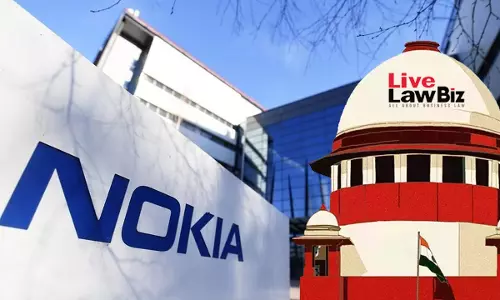
Supreme Court Dismisses Income Tax Appeal Against Nokia Over Gross Delay Of 286 Days
The Supreme Court on Thursday dismissed the Income Tax Department's appeal against Nokia Corporation over a 286-day delay, leaving undisturbed the Delhi High Court's ruling that offshore supply of telecom equipment is not taxable, software payments are not royalty, and no permanent establishment existed in India.A Bench of Justices B.V. Nagarathna and Ujjal Bhuyan found no sufficient and satisfactory reason by the department to condone 286 days 'gross' delay and observed the following:“There is...
Can Delay Beyond Prescribed Time Limit In Service Tax Appeals Be Condoned Under Limitation Act? Supreme Court To Examine
The Supreme Court has agreed to examine whether delay in filing a service tax appeal beyond the 2-month deadline and the additional 1-month extension allowed under the law can be excused under Section 5 of the Limitation Act. Section 5 of the Limitation Act allows courts to accept delayed filings if sufficient cause for the delay is shown. A Bench of Justice J.B. Pardiwala and Justice K.V. Viswanathan issued notice on April 13, 2026 while hearing a petition filed by assessee Morthala Sidda...
Supreme Court Dismisses Paharpur Plea Against Sinnar Thermal Power, Bars Arbitral Award Execution Post CIRP
The Supreme Court on Friday dismissed the special leave petition filed by Paharpur Cooling Towers Ltd. against Sinnar Thermal Power Ltd., effectively affirming the Delhi High Court's order dated February 11, which held that once a resolution plan is approved under the Insolvency and Bankruptcy Code (IBC), claims cannot be pursued through parallel arbitral award execution proceedings.A Bench of Justices Pamidighantam Sri Narasimha and Alok Aradhe, after hearing the parties, dismissed the...