
Supreme Court

RP's Admission Of Claim In CIRP Not Acknowledgment Of Debt, Cannot Extend Limitation: Supreme Court
The Supreme Court on Wednesday held that admission of a claim by a Resolution Professional during insolvency proceedings is merely an administrative act and does not amount to an acknowledgment of liability under Section 18 of the Limitation Act, 1963. The court said such admission is only a recital or entry of debt and cannot extend the limitation period for initiating proceedings. “RP performs its administrative duties under Section 18 of the Code. The admission of a claim by RP is merely an...
IBC Time-Bound Resolution “Impossible To Achieve” Amid NCLT Delays; Supreme Court Takes Suo Motu Cognisance
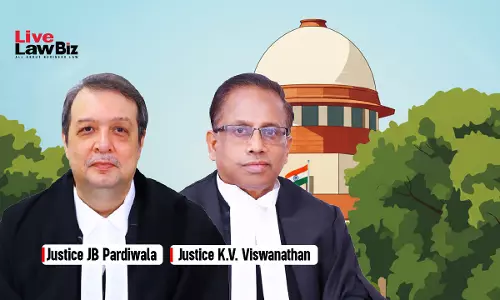
The Supreme Court of India on Wednesday took suo motu cognisance of delays in approval of resolution plans pending before various benches of the National Company Law Tribunal (NCLT), stating that the objective of time-bound resolution under the Insolvency and Bankruptcy Code, 2016 is “impossible to achieve” in the present situation. A bench of Justice J.B. Pardiwala and Justice K.V. Viswanathan was hearing the matter pursuant to its order dated April 16, 2026. By that order, the Court had...
No Immediate Challenge To Arbitrator's Rejection Of Jurisdiction Plea; Must Wait For Final Award: Supreme Court
The Supreme Court has recently held that when a claim is challenged as time-barred to question an arbitrator's jurisdiction, and the arbitrator rejects that objection, the party cannot challenge it midway and must wait until the final award. A Division Bench of Justices Sanjay Kumar and K. Vinod Chandran observed that "In that situation, there is no option for the party aggrieved by the decision of the arbitrator upon the application filed under Section 16 except to wait till the conclusion of...
OYO Moves Supreme Court Against Gujarat HC Ruling On Arbitral Award Execution In Dispute with Meridian Hotels
OYO Hotels and Homes Pvt Ltd has approached the Supreme Court challenging a Gujarat High Court ruling that declined to interfere with execution proceedings enforcing an arbitral award in favour of Meridian Hotels Pvt Ltd in a dispute arising out of a hotel management agreement. The matter is likely to be heard on May 11 by a bench of Justices P.S. Narasimha and Alok Aradhe. The ruling under challenge was delivered on February 19, 2026. The dispute stems from a 2018 Management Services...
SBI Back In Reliance Infratel CoC As Supreme Court Sets Aside NCLAT Order Excluding Consortium Lenders
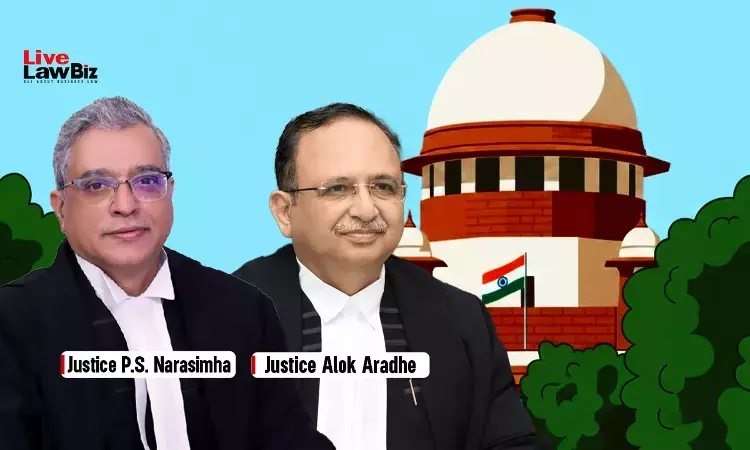
The Supreme Court of India has allowed the appeal filed by the State Bank of India against an October 14, 2022 order of the National Company Law Appellate Tribunal, which had upheld the exclusion of SBI and other lenders from the Committee of Creditors (CoC) in the insolvency of Reliance Infratel Limited.A bench of Justices P.S. Narasimha and Alok Aradhe set aside the NCLAT ruling and restored the status of lenders claiming under corporate guarantees as financial creditors and directed their...
Supreme Court Issues Notice On Plea Against Delhi HC Ruling That Patent Revocation Plea Survives Expiry
The Supreme Court on Monday issued notice on a plea challenging a Delhi High Court ruling that a patent revocation petition remains maintainable and survives even after expiry of the patent and is not barred merely because an invalidity defence is raised in a parallel infringement suit. A Bench of Justices P.S. Narasimha and Alok Aradhe issued notice on the special leave petition filed by by Boehringer Ingelheim Pharma GmbH and listed the matter for final disposal on May 25, 2026 The case...
Supreme Court Stays Arbitration In ₹36.53 Crore AP E-Challan Dispute Involving Digi Yatra Developer
The Supreme Court recently stayed further arbitration proceedings in a Rs. 36.53 crore dispute between the Andhra Pradesh government and Dataevolve Solutions Pvt. Ltd., the developer of the Digi Yatra app, over settlement of accounts under an e-challan software contract. A Bench led by Chief Justice Surya Kant and comprising Justice Joymalya Bagchi and Justice Vipul M. Pancholi issued notice on the State's special leave petition challenging the Andhra Pradesh High Court's order appointing a...
Supreme Court Stays NCLAT Ruling That Set Aside CCI's Clean Chit To Chettinad Coal Terminal
The Supreme Court on Monday stayed the operation of a ruling of the National Company Law Appellate Tribunal that had set aside the Competition Commission of India order clearing Chettinad International Coal Terminal Pvt. Ltd. (CICTPL) of abuse of dominance in the market for provision of common user coal terminal services at Kamarajar Port, while issuing notice in the matter.The top court was hearing a plea filed by CICTPL against the NCLAT's January 21, 2026 judgment, which had overturned the...
Supreme Court Refuses To Interfere With Madras HC Ruling That Contempt Can't Enforce Unquantified Royalty
The Supreme Court on Friday refused to interfere with a Madras High Court ruling that contempt proceedings were not maintainable where royalty claims had not been quantified, holding that non-payment of an unascertained amount cannot amount to willful disobedience. Dismissing the Special Leave Petitions filed by the South India Music Companies Association (SIMCA), a bench of Justices Dipankar Datta and Satish Chandra Sharma said, “We are not inclined to interfere with the impugned judgment(s)...

Unsuccessful Party Can Seek Interim Relief Under Arbitration Act: Supreme Court
The Supreme Court of India on Friday held that any party to an arbitration agreement, including one that has been unsuccessful in arbitral proceedings and has no enforceable award in its favour, is entitled to seek interim relief under Section 9 of the Arbitration and Conciliation Act, 1996. It clarified that such relief can be sought at the post-award stage but before enforcement. A Bench of Justice Manmohan and Justice Manoj Misra observed that “Section 9 of the Act commences with the...
Supreme Court Issues Notice In Ideal Jawa Liquidator's Plea Against Classic Legends Over Yezdi Trademark
The Supreme Court on Friday issued notice in a plea by the liquidator of Ideal Jawa (India) Ltd. challenging a Karnataka High Court ruling that allowed Classic Legends Pvt. Ltd. and its founder Boman R. Irani to use the 'Yezdi' trademark after holding that the company no longer retained rights over it.The high court had found that the trademark had lapsed and that goodwill could not survive once the underlying business had ceased operations.A bench of Chief Justice Surya Kant and Justices...
Supreme Court Dismisses Customs Challenge Against ITC Ltd Over Quicklime Classification
The Supreme Court on Friday dismissed the Customs Department's challenge against ITC Ltd, upholding a ruling that treated imported “quicklime” as an industrial form of lime rather than a chemically pure compound. The classification turned on whether the product, containing about 92% calcium oxide, could be considered a high-purity chemical.A bench of Justices Manoj Misra and Manmohan found no grounds to interfere with the CESTAT Kolkata Bench order dated June 20, 2025, which had held in favour...