
Allahabad High Court Upholds Ghaziabad Property Tax Revision Based On Minimum Monthly Rent Rate
Upasna Agrawal
18 April 2026 6:02 PM IST
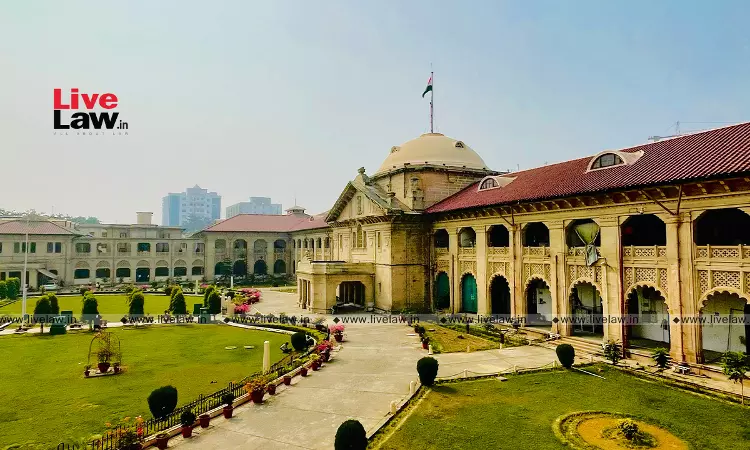
The Allahabad High Court has upheld the Ghaziabad Municipal Corporation's revision of property tax based on minimum monthly rent rates (MMRR) under the U.P. Municipal Corporations Act, 1959.
In a PIL challenging the revision of property tax and its enhancement based on MMRR, the bench of Chief Justice Arun Bhansali and Justice Kshitij Shailendra held:
“we neither find any error in determination of 'MMRR' based upon categorization/classification of the properties nor any illegality in the impugned decision of the respondents to revise/enhance the property taxes based upon 'MMRR'. The exercise undertaken by the respondents is found to be fully in consonance with the statutory provisions requiring no interference by this Court.”
Petitioners, being ex/present corporators in the Municipal Corporation, Ghaziabad, filed a public interest litigation challenging the order dated May 3, 2025, notice dated January 9, 2024, and Resolution No. 139 dated March 7, 2025 issued by the Corporation, whereby a revision in property taxes was approved.
Petitioners also sought extension of rebate benefits on property tax as provided under the Act.
It was pleaded that though in the Board meeting of the Municipal Corporation, Ghaziabad on June 7, 2022, a resolution was passed to discuss increase in property tax in accordance with circle rates in the next meeting, the proposal was instead forwarded to the State Government.
In a subsequent meeting on January 7, 2023, the Board suo motu increased property taxes by 10%. Thereafter, a notice dated January 9, 2024 was published inviting objections to further enhancement.
Further, a meeting of Zonal Incharges and Tax Superintendents was held for determination of property taxes for the financial year 2025–26 in accordance with newly prescribed rates, wherein it was decided that property taxes for residential buildings would be based on carpet area and for non-residential buildings on covered area. These rates were made applicable from April 1, 2025.
The Board's resolution providing that road width for calculating rental value would include parking, green belt, drains and similar components was also approved by the State Government.
Petitioners contended that while property tax had earlier been increased periodically by around 10% every two years, the present revision resulted in an approximate 300% increase from April 1, 2025, which was arbitrary and violative of Article 14.
The court noted that although procedural defects were pleaded, no arguments were advanced on that aspect, and therefore confined the issue to whether determination of MMRR was in accordance with statutory provisions.
“A perusal of the record indicates that the Municipal Commissioner, after dividing the entire city into 100 wards, each ward comprising of different colonies and localities and also based upon the width of the road, area of the building, monthly rent and its calculation on per square foot of carpet area, classified and categorised the localities situated within the entire municipal limits of Ghaziabad in the following three categories:-
(A) Developed areas;
(B) Normally developed areas; and
(C) Backward/slum areas.”
The court held that the Municipal Commissioner had exercised powers in accordance with Section 174(1)(b) of the Act and the Rules, noting that objections were invited, heard, and decided, and therefore the exercise could not be termed arbitrary.
“Further, the petitioners have not been able to come out with any specific submission or suggestion as to what better methodology or concrete formula could have been adopted or exercise undertaken by the Municipal Commissioner for such determination. Therefore, we are of the view that the determination of 'MMRR' cannot be said to be excessive, rather in accordance with the categorization/classification of the properties, as provided under the Rules.”
The court also noted that earlier increases in rental values had been made periodically over the years and were not based on a statutory exercise under Section 174 read with the Rules and that the present determination was undertaken after more than two decades in accordance with the Act and Rules.
It further held that reference to the State Government under Section 116 was valid and the decision taken thereafter was in accordance with law.
Holding that the challenge lacked merit, the court dismissed the writ petition.
For petitioners: Senior Advocate Samir Sharma with Advocate Himanshu Agrawal
For Respondents: AAG Manish Goyal, A.C.S.C. A.K. Goyal, Senior Advocate Shashi Nandan with Advocates Shreya Gupta, Raghuvansh Misra, Sunil Dutt Kautilya, Satyavrat Sahai