
Jammu & Kashmir and Ladakh High Court Dismisses MSME Supplier's Writ, Cites MSMED Act Remedy
LiveLawBiz News Desk
4 Aug 2026 3:07 PM IST
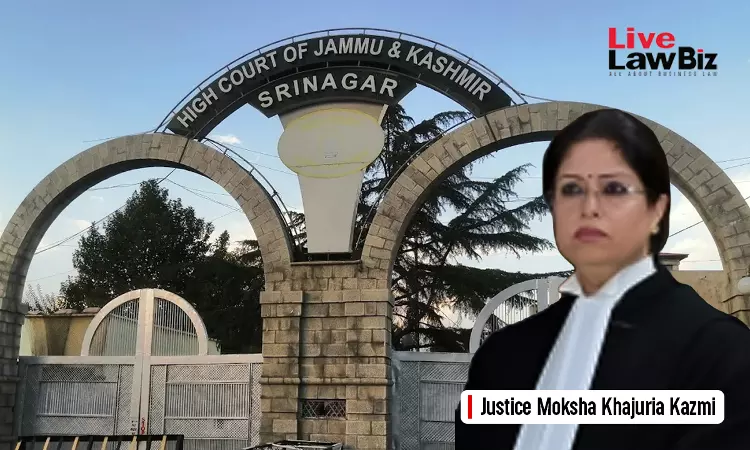
The Jammu & Kashmir and Ladakh High Court has ruled that it would ordinarily not exercise its writ jurisdiction under Article 226 where an MSME supplier has an equally efficacious statutory remedy under the Micro, Small, and Medium Enterprises Development Act, 2006 (MSMED Act).
Dismissing a petition filed by a registered micro enterprise seeking recovery of alleged outstanding dues, the court held that no exceptional circumstances had been made out to justify bypassing the statutory mechanism.
Justice Moksha Khajuria Kazmi observed:
"It is no more res-integra that under Article 226 of the Constitution of India, the High Court having regard to the facts of the case has a discretion to entertain or not to entertain a petition, but the High Court has imposed upon certain restrictions, one of which is that, if an equally efficacious alternative remedy is available, the High Court would not normally exercise its jurisdiction. Petitioner in this case is seeking a remedy which is available to him in terms of the Act of 2006, the grounds projected in the petitioner do not carve out a case to invoke extraordinary jurisdiction in view of the availability of an alternative remedy available to the petitioner."
The ruling came on a petition filed by Mashad Steel Industries, a registered micro enterprise, seeking release of ₹5,93,137 allegedly payable for fabrication work executed under the 13th Finance Commission Scheme, along with compound interest under Sections 15 and 16 of the MSMED Act.
The petitioner claimed it executed work between 2011 and 2017 for constructing steel roof trusses for Panchayat Ghars across Kashmir. It also alleged that departmental engineers orally instructed it to carry out additional work, including installation of eaves boards and soffits, which increased the contract value.
According to the petitioner, while substantial payments had been released, ₹5.93 lakh remained unpaid despite repeated requests.
The court questioned why the petitioner had approached it directly instead of invoking the remedy under Section 18 of the MSMED Act. The petitioner argued that the existence of an alternative remedy did not bar the High Court from exercising its writ jurisdiction and relied on earlier decisions.
Examining the MSMED Act, the court observed that disputes over delayed payments must ordinarily be resolved through the Micro and Small Enterprises Facilitation Council.
Relying on the Supreme Court's decision in Gujarat State Civil Supplies Corporation Ltd. v. Mahakali Foods Pvt. Ltd., it held that allowing suppliers to bypass this mechanism would defeat the object of the legislation.
The court also noted that the authorities had not admitted liability for the amount claimed.
Referring to Godrej Sara Lee Ltd. v. Excise and Taxation Officer-cum-Assessing Authority, it reiterated that although an alternative remedy does not bar a writ petition, high courts ordinarily do not exercise their writ jurisdiction where an effective statutory remedy exists unless exceptional circumstances are shown. Finding none, the court dismissed the petition while leaving it open to the petitioner to pursue the remedy under the MSMED Act