
High Courts

Assessing Officer Not Deemed to Have Noticed Facts Disclosed in Wealth Tax Return: Gujarat High Court
The Gujarat High Court has recently held that an Assessing Officer is not deemed to have noticed facts disclosed in a wealth tax return while examining an income tax return. It refused to interfere with reassessment proceedings initiated against a Hindu Undivided Family (HUF) over an unexplained cash payment of more than ₹1.02 crore towards the purchase of immovable property. A Division Bench of Justice A.S. Supehia and Justice Vaibhavi D. Nanavati dismissed the writ petition filed by...

Gujarat High Court Bars Vimal Oil Reassessment Over Past Tax Liability, Cites IBC Clean Slate Principle
The Gujarat High Court on 30 June quashed reassessment proceedings against Vimal Oil and Foods Ltd., holding that the Assessing Officer cannot reopen an assessment of a company sold as a going concern under the Insolvency and Bankruptcy Code (IBC) on mere assumptions without verifying whether any income had actually escaped assessment. A Division Bench of Justices A.S. Supehia and Vaibhavi D. Nanavati allowed the batch of writ petitions filed by the company and quashed the notice issued under...
Delhi HC Allows SC, HC Judges To Show Allowances As 'Receipts Not In Nature Of Income' Under New Tax Regime
The Delhi High Court, by way of an interim direction, has allowed Supreme Court and High Court judges to file their income tax returns by showing prescribed judicial allowances as “receipts not in the nature of income”, even while opting for the new tax regime.The order came in a petition filed by the Delhi Tax Bar Association challenging a September 12, 2025, Office Memorandum issued by the CBDT, which, according to the petitioner, denied judges opting for the new tax regime the benefit of...

Telangana High Court Restores Relief To Radiant Digital Solutions, Says Bona Fide Lapse Can't Deny Benefit
The Telangana High Court on 2 July held that a company cannot be denied the benefit of the concessional corporate tax regime under Section 115BAA of the Income Tax Act due to a bona fide delay in filing Form 10-IC, where it has substantially complied with the statutory requirements. A Division Bench of Justices P. Sam Koshy and Narsing Rao Nandikonda allowed the writ petition filed by Radiant Digital Solutions Pvt. Ltd. and set aside the Income Tax Department's order rejecting the company's...

Telangana High Court Holds Deferred Sales Tax Benefit Cannot Be Denied, Remands Krebs Biochemicals Case
The Telangana High Court on 19 June held that tax authorities cannot deny a taxpayer the benefit of a sales tax deferment scheme merely because statutory adjustment orders supporting the claim were not available during the original assessment proceedings, and directed the Assessing Officer to reconsider the claim after examining the subsequent orders. A Division Bench of Justices P. Sam Koshy and Suddala Chalapathi Rao partly allowed the appeals filed by Krebs Biochemicals & Industries...

Revised Return Filed After Income Tax Inspection Cannot Shield Dealer From Sales Tax Penalty: Madras High Court
The Madras High Court has upheld Income tax additions and penalty against a dealer, holding that a revised return filed after an Income Tax inspection cannot protect a taxpayer from the consequences of suppressed turnover.It observed that a revised return filed after detection does not automatically establish bona fide conduct or protect a taxpayer from penalty."The revised return filed subsequent to Income Tax inspection cannot be a protection blanket for the tax evaders. Even if the Trader...
Karnataka High Court Upholds Deletion Of Tax Addition On Advances Received By Businessman Procuring Land
The Karnataka High Court has upheld the deletion of a ₹21.11 crore tax addition made against a Bengaluru-based businessman engaged in identifying and procuring land for real estate projects. The court held that advances received in the course of that business cannot be taxed merely because they remained outstanding for several years.The court observed that the mere passage of time does not amount to forfeiture, and such advances cannot be treated as taxable income in the absence of material...

Telangana High Court Upholds Capital Gains Tax Exemption Despite Delay In Villa Registration
The Telangana High Court has held that a taxpayer who invested capital gains in a residential villa under a joint development agreement cannot be denied tax exemption merely because the developer delayed construction and execution of the sale deed. The court observed that delays beyond the assessee's control cannot defeat the benefit intended under the law. A Division Bench of Justice P. Sam Koshy and Justice Narsing Rao Nandikonda allowed the appeal filed by non-resident Indian Sudhakar...
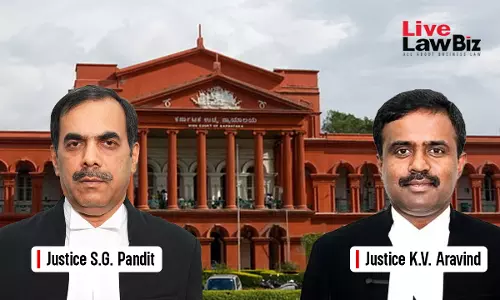
Karnataka High Court Holds S. 271DA , IT Act Penalty Begins Only With S. 274 Notice, Reads In Six-Month Limit
The Karnataka High Court on 7 July held that penalty proceedings under Section 271DA of the Income Tax Act commence only when the Joint Commissioner issues a show cause notice under Section 274, and not when the Assessing Officer merely forwards a proposal for initiating penalty. A Division Bench of Justices S.G. Pandit and K.V. Aravind partly allowed a batch of ten Revenue appeals, clarifying that, although the Act does not prescribe a time limit for issuing a notice under Section 274, the...
Income Tax Order Not Invalid If DIN Is Communicated Later Through Separate Intimation: Karnataka High Court
The Karnataka High Court has held that an income tax order initially communicated without a Document Identification Number (DIN) does not become invalid merely because the DIN is communicated later through a separate authenticated intimation letter. The court held that the procedure substantially complied with CBDT Circular No. 19/2019 as it maintained the audit trail and authenticity of departmental communications. A Division Bench of Justice S.G. Pandit and Justice K.V. Aravind allowed two...

Madras High Court Grants Stay On ₹101.14 Crore TDS Penalty Recovery Against Cognizant
The Madras High Court on 6 July granted interim relief to Cognizant Technology Solutions India Private Limited by staying recovery proceedings arising from tax deducted at source (TDS) penalty demands exceeding Rs. 101.14 crore. A Bench of Justice Senthilkumar Ramamoorthy found that the company had established a prima facie case, directed it to deposit Rs. 4 crore within two months, and stayed recovery of the balance penalty amount until the Commissioner of Income Tax (Appeals) decides the...