
INCOME TAX
Jet Lite's Defence In FBT Proceedings Cannot Be Treated As Furnishing Inaccurate Particulars: ITAT Delhi
The Delhi Bench of the Income Tax Appellate Tribunal (ITAT) has upheld the deletion of penalties exceeding ₹7.6 crore imposed on Jet Lite (India) Ltd. in a fringe benefit tax (FBT) disputeThe tribunal held that the assessee had sought to justify its case against the fringe benefit assessment and that this could not be treated as furnishing inaccurate particulars. A bench of Judicial Member Satbeer Singh Godara and Accountant Member Manish Agarwal dismissed the Revenue's appeals against orders...

No Relief For Reimbursement Claims Made To Foreign Parent Without Expense Break-Up: Madras High Court
The Madras High Court has recently dismissed appeals filed by Cairn India Limited, now Vedanta Limited, and upheld tax demands over its failure to deduct tax at source (TDS) on payments remitted to its Australian parent company. While dismissing Cairn's plea, the court made it clear that a taxpayer cannot obtain relief merely by describing a lump-sum payment as a reimbursement. If the claim is that the payment represents reimbursement of expenses, the taxpayer must disclose what those expenses...

FIIs, BIS Get Income Tax Exemption On Government Securities Under New Income Tax Ordinance
Foreign Institutional Investors (FIIs) and the Bank for International Settlements (BIS) will be exempt from income tax on interest earned from government securities and capital gains arising from their sale, exchange, or transfer under amendments introduced by the Centre through the Income-tax (Amendment) Ordinance, 2026. The ordinance, published in the Gazette on June 5, amends Schedule IV of the Income-tax Act, 2025 and is deemed to have come into force from April 1, 2026. The exemption is...

60% Tax Rate Under Section 115BBE Cannot Apply To Pre-1 April 2017 Income: Rajasthan High Court
The Rajasthan High Court on 27 May held that the enhanced tax rate of 60% introduced under Section 115BBE of the Income-tax Act through the Taxation Laws (Second Amendment) Act, 2016, cannot be applied retrospectively to income pertaining to Financial Year 2016–17, as the amendment was expressly made effective from 1 April 2017. The Division Bench of Justices Arun Monga and Sunil Beniwal held that the higher rate could operate only prospectively and could not govern income earned prior to its...

Registered Sale Deed Triggers Capital Gains Tax Even If Payment Is Delayed: ITAT Ahmedabad
The Ahmedabad Bench of the Income Tax Appellate Tribunal (ITAT) on 27 June held that execution and registration of a sale deed complete “transfer” for capital gains taxation purposes, and that delayed payment or dishonour of cheques does not postpone taxability unless the transaction itself is cancelled. Vice President Dr. B.R.R. Kumar and Judicial Member T.R. Senthil Kumar passed the order in an appeal filed by Mehboob Jabir Patel. The Bench, however, directed the Assessing Officer to grant...
Transfer Pricing Must Be Benchmarked Using AE Transactions, Not Entity-Level Profits: ITAT Delhi
The Delhi Bench of the Income Tax Appellate Tribunal (ITAT) on 2 June 2026 held that transfer pricing analysis must ordinarily be restricted to international transactions with Associated Enterprises (AEs) where reliable segmental data is available, and cannot be extended to entity-level profitability. Judicial Member Anubhav Sharma and Accountant Member Naveen Chandra partly allowed the appeal filed by Cornell Overseas Pvt. Ltd. for Assessment Year 2007–08 and remanded the transfer pricing...
ITAT Delhi Holds TDS Applicable On CAM Charges As They Are Maintenance Payments, Not Rent
The New Delhi Bench of the Income Tax Appellate Tribunal (ITAT) on 26 May held that Common Area Maintenance (CAM) charges paid by tenants in shopping malls constitute payments for maintenance services and not rent, and therefore attract Tax Deducted at Source (TDS) under Section 194C of the Income Tax Act and not under Section 194-I. Judicial Member Raj Kumar Chauhan and Accountant Member Renu Jauhri dismissed Revenue's appeals against Biba Apparels Pvt. Ltd. for Assessment Years 2013–14,...

ITAT Ahmedabad Deletes ₹3.88 Crore Transfer Pricing Adjustment, Upholds TNMM Consistency
The Ahmedabad Bench of the Income Tax Appellate Tribunal (ITAT) on 27 May held that in the absence of any change in facts or functional profile, tax authorities must consistently follow transfer pricing positions accepted in earlier years, and deleted a transfer pricing adjustment of Rs.3.88 crore in the case of Inductotherm (India) Pvt. Ltd. Vice-President Dr. B.R.R. Kumar and Judicial Member T.R. Senthil Kumar rejected the Revenue's attempt to replace the Transactional Net Margin Method...
Partner Cannot Claim Deduction On Interest Paid For Capital Invested In Firm: Kerala High Court
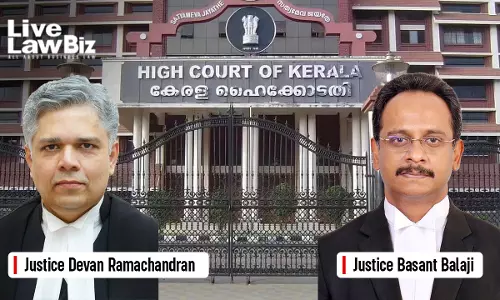
The Kerala High Court on 20 May held that a partner cannot claim deduction under Section 36(1)(iii) of the Income Tax Act for interest paid on funds borrowed and contributed as capital to a partnership firm, since the borrowed capital was not used for the partner's own business. A Division Bench of Justices Devan Ramachandran and Basant Balaji dismissed the appeal filed by Alice Arun Thomas and upheld the order of the Income Tax Appellate Tribunal (ITAT), Cochin Bench. It held: "The provisions...

ALP Of Intra-Group Services Cannot Be Fixed At Nil Once Receipt Of Services Is Proven: ITAT Ahmedabad
The Ahmedabad Bench of the Income Tax Appellate Tribunal (ITAT) on 27 May held that tax authorities cannot determine the arm's length price (ALP) of intra-group services at nil merely on a subjective perception of benefit once the taxpayer proves receipt of services and substantiates them with evidence. Vice-President Dr. B.R.R. Kumar and Judicial Member T.R. Senthil Kumar allowed an appeal by Roquette India Pvt. Ltd. and deleted transfer pricing adjustments for Assessment Years 2017–18 and...

ITAT Ahmedabad Grants Relief To Milacron India, Says CSR Donations May Qualify For Section 80G Deduction
The Ahmedabad Bench of the Income Tax Appellate Tribunal (ITAT) on 27 May held that tax authorities cannot deny a deduction under Section 80G of the Income Tax Act merely because a company made the donation to fulfil its Corporate Social Responsibility (CSR) obligations. Vice-President Dr. B.R.R. Kumar and Judicial Member T.R. Senthil Kumar partly allowed an appeal filed by Milacron India Private Limited for Assessment Year 2020-21 and remanding the matter to the Assessing Officer for fresh...
ITAT Delhi Allows PNB Housing Finance's CSR Deduction Claim, Deletes ₹3.36 Crore Penalty On Cash EMI Repayments
The Delhi Bench of the Income Tax Appellate Tribunal (ITAT) has granted relief to PNB Housing Finance Ltd. by allowing its claim for deduction in respect of eligible CSR-related donations and deleting a ₹3.36 crore penalty imposed for accepting cash EMI repayments from borrowers. A bench of Judicial Member Satbeer Singh Godara and Accountant Member Naveen Chandra passed the order while deciding a batch of appeals filed by the housing finance company for assessment years 2017-18 to 2020-21. The...