
Delhi High Court Upholds Constitutional Validity Of Sec. 19 In 2018 Commercial Courts Amendment Act
Shilpa Soman
2 Oct 2026 3:17 PM IST
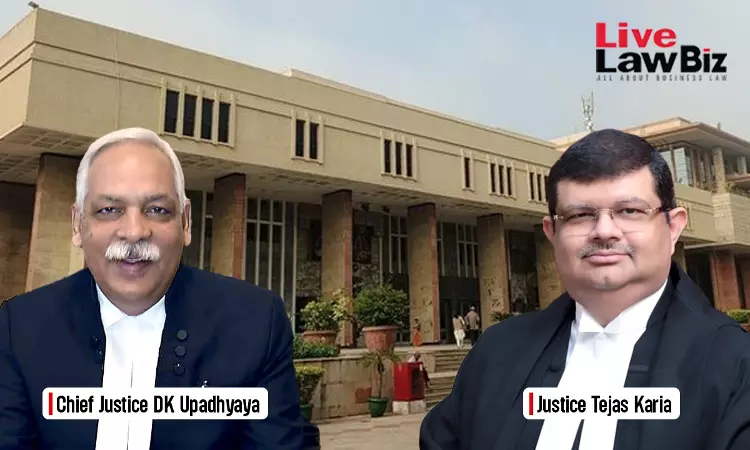
The Delhi High Court on 30 September upheld the constitutional validity of Section 19 of the Commercial Courts, Commercial Division and Commercial Appellate Division of High Courts (Amendment) Act, 2018, holding that applying the amended regime only to commercial disputes instituted on or after 3 May 2018 does not violate Article 14 of the Constitution.
A Bench comprising Chief Justice Devendra Kumar Upadhyaya and Justice Tejas Karia dismissed a petition filed by Alpro Industries and others challenging Section 19 of the Amendment Act. The judges emphasised:
“If every change in legislative policy, limited in its application to transactions or cases arising after the enactment, were to be treated as discriminatory merely because similar transactions or cases arising under the earlier regime remain governed by the previous law, every prospective legislative measure would be vulnerable to challenge under Article 14 of the Constitution on that ground alone.”
In 2016, Indo Alusys Industries Limited filed a suit seeking recovery of Rs. 35.50 lakh with interest from Alpro Industries over unpaid dues for aluminium supplies. At the time, the specified-value threshold under the Commercial Courts Act was Rs. 1 crore, so the suit was filed as an ordinary civil suit.
In 2018, the threshold was reduced to Rs. 3 lakh. In 2025, while the suit was at the evidence stage, Alpro Industries argued that it should be treated as a commercial dispute and transferred to a Commercial Court. It also sought rejection of the plaint under Order VII Rule 11 of the Civil Procedure Code.
The Trial Court rejected the application, holding that the 2018 amendment applied only to suits instituted on or after 3 May 2018.
Alpro Industries then challenged the order before the High Court and questioned the constitutional validity of Section 19 of the 2018 Amendment Act, which makes the amendments applicable only to cases instituted on or after 3 May 2018.
Before the High Court, Alpro Industries argued that Section 19 defeats the object of the Commercial Courts Act by keeping eligible commercial disputes instituted before 3 May 2018 outside the jurisdiction of Commercial Courts, despite Section 15(2) requiring transfer of pending suits meeting the specified-value threshold.
The Union of India, on the other hand, argued that Section 19 merely provides for prospective application of the 2018 amendments, which does not by itself violate Article 14. It submitted that using the date of institution as the basis for classification was reasonable, as it allowed the reduced threshold to be introduced without disrupting ongoing trials.
The Bench examined Section 19 of the Amendment Act and observed:
“When Parliament enacts a law, which is made applicable to certain cases prospectively, it evidently makes a distinction between those cases or cases falling within the ambit of the new law and those which arose or were instituted before the law came into force. The Legislature enjoys a degree of latitude in making such classifications and in formulating legislative policy having regard to economic, administrative, social or other considerations.”
Further, the Court held that Section 19 uses the date of institution as a clear basis for classification, with suits instituted on or after 3 May 2018 governed by the Amendment Act and earlier suits continuing under the pre-amendment regime. On retrospective application, it stated:
“The retrospective application of Section 19 to pending cases, would have resulted in unsettling suits at different stages of trial, including those in which evidence had been recorded in part or in whole, with the attendant consequences for the pleadings, the procedure and the timelines prescribed by the 2015 Act.”
The Bench also relied on its earlier decision in Satyanarain Khandelwal v. Prem Arora, which held that the 2018 amendments apply to commercial disputes instituted on or after 3 May 2018. It further held that the petitioners failed to show that the classification based on the date of institution was arbitrary or lacked a rational nexus with the object of the amendment.
Accordingly, the High Court held that Section 19 was based on an intelligible differentia having a rational nexus with the object of the amendment and did not violate Article 14, and dismissed the petition.
For Petitioners: Senior Advocate Dr. I.M Qudussi and Advocates Jabar Singh and Aishwarya Jha
For Respondents: Advocates Rukhmini Bobde, CGSC, Shubham Goyal, G.P, Jatin Dhamija, Vinayak Aren and Aishwarya Nigam