
100% GST Penalty Challenge Despite 15% Deposit Can Be Examined In Appeal Under CGST Act: Delhi High Court
Kapil Dhyani
12 Oct 2026 4:42 PM IST
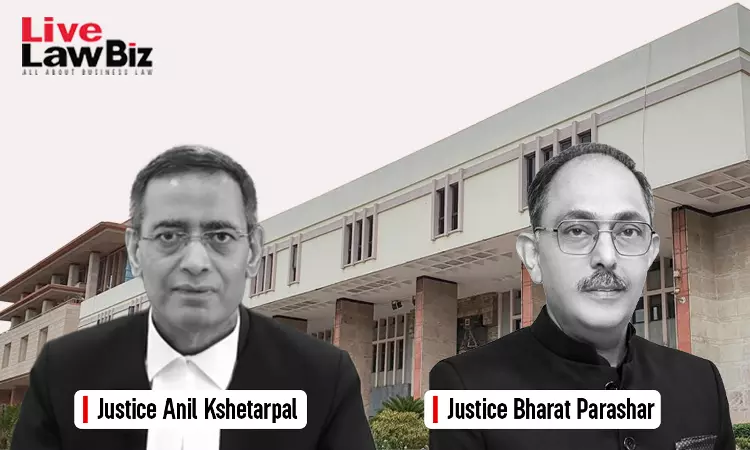
The Delhi High Court on 9 October held that an appellate authority can examine a taxpayer's challenge to a 100% penalty under Section 74(1) of the Central Goods and Services Tax (CGST) Act, despite the taxpayer having already deposited a penalty equivalent to 15% of the tax liability.
A Division Bench of Justices Anil Khetarpal and Bharat Parashar declined to examine Om Shankar Metal's challenge in writ jurisdiction and relegated it to the statutory appellate remedy under Section 107 of the CGST Act. They observed:
“It is trite law that the mere availability of an alternative remedy does not oust the writ jurisdiction of this Court, particularly where there is a breach of natural justice.”
Om Shankar Metal, a sole proprietorship concern, challenged an ex-parte order passed under Section 74 of the CGST Act and the consequential DRC-07. Before the show cause notice, it had deposited Rs. 66,14,525 towards tax, Rs. 1,77,226 towards interest and Rs. 9,92,179 towards penalty, equivalent to 15% of the tax liability. The adjudicating authority subsequently imposed a penalty equivalent to 100% of the tax liability under Section 74(1).
The Court noted that the impugned order did not consider Sections 74(5) to 74(7) or reconcile the appropriation of the 15% penalty with the subsequent imposition of a 100% penalty on the same tax liability. It also found that the order did not record a specific finding of fraud, wilful misstatement or suppression of facts.
It declined to determine the legality of the penalty in writ jurisdiction because the issue required examination of the relied-upon documents, including Audit Memos and Forms ADT-02, DRC-01A and DRC-03. It held that the Appellate Authority could examine these documents and determine the dispute.
Om Shankar Metal also challenged the denial of an effective opportunity for a personal hearing. The Revenue maintained that it had communicated hearing notices fixing dates on 13, 14 and 15 January 2025 to the concern's registered address and email address.
The Bench noted that the Revenue had not produced the email communication or postal receipt to establish dispatch of the personal hearing notice. Instead, it had relied only on a copy of the department's dispatch register, which the Court held was insufficient by itself to establish service.
Further, it observed that determining whether the notice had actually reached Om Shankar Metal required examination of the underlying record, including its registration particulars and the history of amendments to its email address on the GST portal.
Accordingly, the High Court relegated Om Shankar Metal to the alternative remedy of appeal under Section 107 of the CGST Act.
For Petitioner: Mr. Nitin Gulati, Adv.
For Respondent: Mr. Arun Khatri, SSC along with Ms. Anoushka Bhalla, Adv.