
Xerox's 'Kitting' Of Imported Photocopier Modules Is Not 'Manufacture': Supreme Court Upholds CESTAT Ruling
Rajnandini Dutta
5 Aug 2026 8:05 PM IST
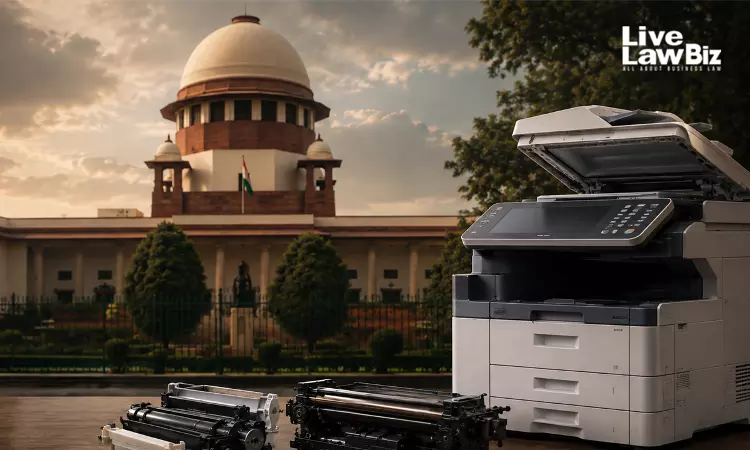
The Supreme Court has held that Xerox India's practice of grouping, plugging and pinning imported photocopier modules according to customers' requirements, commonly known as "kitting", did not amount to "manufacture" under Section 2(f) of the Central Excise Act, 1944.
As no manufacturing activity was found, the company was not liable to pay central excise duty. The court reiterated that a process amounts to manufacture only if it results in a new product with a distinct name, character, and use.
A division bench of Justice S.V.N. Bhatti and Justice N.V. Anjaria dismissed the revenue's appeals challenging orders of the Customs, Excise, and Service Tax Appellate Tribunal (CESTAT), which had set aside excise duty demands against Xerox India.
The dispute arose from Xerox India's practice of importing photocopier machines in completely knocked down (CKD) or semi-knocked-down (SKD) conditions. The company paid customs duty and countervailing duty (CVD) on the imported goods as complete machines under the applicable tariff heading.
At its warehouses in Hyderabad and Rampur, Xerox grouped the imported modules according to each customer's requirements before dispatching them. The Revenue contended that this activity amounted to manufacture because the imported parts were assembled into functional photocopiers and therefore attracted central excise duty.
Xerox maintained that it merely carried out "kitting" by grouping the imported modules according to customers' specifications and that no new product came into existence.
Rejecting the revenue's case, the court observed,
"The Assessee claims the subject activity as 'kitting' of modules to make a photocopier. The Assessee's line of activity is subjected to the tests referred to in the decisions supra. Admittedly, the Assessee has imported the goods under Tariff Heading 8471 and paid Customs Duty against that Heading, which deals with automatic data processing machines and units thereof. The Assessee claims to have paid CVD for photocopiers alone."
Describing the nature of the activity, the bench said,
"In the circumstances accepted by the Tribunal, the activity is one of pinning and plugging different parts together, which is called kitting to make a complete set as per the customer's specification. Before concluding, we would like to refer to the finding recorded by the Tribunal, and are of the view that the activity in the case on hand does not fall within the definition of Section 2(f) of the C E Act."
The Court undertook an extensive review of its earlier decisions explaining the meaning of "manufacture" under the Central Excise Act. It noted that every process involving labour, skill or expenditure does not amount to manufacture. The decisive test is whether the process transforms the original article into a commercially distinct product with a different name, character or use.
The bench observed that the law recognises four broad situations. If the goods remain exactly the same or essentially the same after the process, there is no manufacture. Even where goods are transformed, there is no manufacture unless the transformed product is marketable. Manufacture occurs only when a new, marketable commodity emerges.
Applying these principles, the court found that Xerox had imported the goods as complete machines after paying customs duty and CVD. At its warehouses, the company only unpacked the imported modules and plugged or pinned them together according to customer requirements before dispatch.
The court held that the Revenue failed to establish that this activity created a commercially distinct product. It also failed to prove that the imported goods were incomplete or unfinished so as to attract the deeming fiction contained in Note 6 of Section XVI of the Central Excise Tariff Act.
Rejecting the Revenue's reliance on Note 6 of Section XVI of the Central Excise Tariff Act, the Court observed, "The argument of the Revenue that Note 6 of Section XVI of the C E Tariff Act is attracted is, at best, an additional ground to justify the impugned demand, as the essential requirements of the said provision are not established."
The Court further held that the Revenue could not treat the imported goods as complete machines for customs purposes while at the same time claiming they were incomplete articles to invoke Note 6.
It also clarified that Rule 2(a) of the General Rules for Interpretation of the Tariff Schedule is only a rule of classification. It determines how goods are classified but does not answer whether a manufacturing process has taken place.
The bench also found fault with the manner in which the Revenue attempted to establish its case. It noted that no inspection of Xerox's warehouses had been conducted before concluding that manufacturing had taken place.
The court observed, "In a matter such as the present, the Revenue need not traverse on a winding journey to explain what it wants to establish. It is required to merely justify that there is excisable activity resulting in the excisable duty demanded through the SCN and confirmed via the O-I-O dated 28.03.2008. Therefore, in an era of technological advancement and available wherewithal through information technology, the Revenue could have proved, through best evidence, that the photocopier is a product of change, not a result of “kitting”. The process ought to have been captured in the photos as a manufacturing activity to bring a photocopier into existence. This Court is not finding fault with the Revenue but is compelled to observe that, in the present era, what can be proved in a straight and simple way need not be induced from the convenient versions of both sides."
The top court also affirmed the factual findings recorded by the CESTAT. It noted that the evidence showed the components were cleared from the warehouses in their original packing. It further found that important components, including the High Capacity Feeder (HCF) and Duplex Automatic Document Feeder (DADF), had already been fitted abroad. The Revenue could not produce evidence showing that Xerox assembled the modules at its warehouses.
Holding that the tribunal's findings were based on evidence and were neither perverse nor unsupported by the record, the Supreme Court dismissed the Revenue's appeals.
For Petitioner: Advocate B. Krishna Prasad, AOR; Advocate Gurmeet Singh Makker, AOR.
For Respondents: Advocate V. Lakshmikumaran; Advocate L. Badri Narayanan; Advocate Charanya Lakshmikumaran, AOR; Advocate Neha Choudhary; Advocate Nitum Jain; Advocate Medha Sinha; Advocate Yashovardhan Singh; Advocate Swastik Mishra; Advocate Adithya Nair; Advocate Ananya Gupta.