
CESTAT Bangalore Grants Customs Duty Exemption To Gem Granites For Quarry Machinery Used To Produce Export Goods
Mehak Dhiman
27 Jun 2026 3:40 PM IST
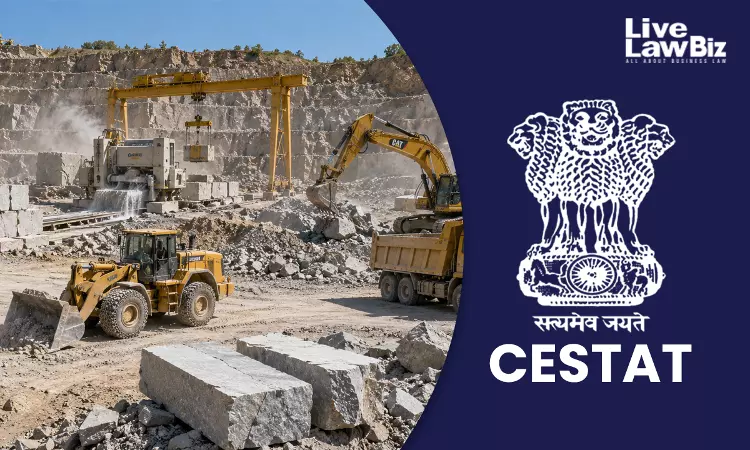
The Bangalore bench of the Customs, Excise and Service Tax Appellate Tribunal (CESTAT) has set aside an order denying customs and central excise duty exemptions to Gem Granites.
It held that, in the facts of the case, imported capital goods used in quarry operations qualified for the exemption because the granite blocks extracted from the quarry were the basic raw material used to manufacture the export products.
The bench of Judicial Member P.A. Augustian and Technical Member R. Bhagya Devi observed that the company's quarry had been approved as an additional manufacturing location under its Export Oriented Unit (EOU) permissions.
It noted that quarrying was undertaken at the approved location and that the extracted granite blocks were used to manufacture the export products.
"The basic raw material for manufacture of granite articles that were to be exported was admittedly granite block recovered by excavating from the quarry; therefore, it cannot be said that the products were not utilized in the manufacture of articles that were exported.", the tribunal noted.
Gem Granites, a 100% Export Oriented Unit manufacturing granite slabs, monuments and other granite products, had imported capital goods and procured indigenous goods without payment of duty under exemption notifications.
The customs department alleged that the machinery had been used for excavating granite blocks at the quarry instead of being used for the purpose of manufacturing the export products as required under the exemption notifications. It treated this as a breach of the notification conditions and demanded duty.
The company argued that its Karnataka quarry had been included as an approved additional manufacturing location before the dispute arose. It submitted that the extracted granite blocks were the essential raw material for its export products. It also pointed out that the movement of capital goods to the quarry had taken place after obtaining the required approvals from the authorities.
After examining the records, the tribunal noted that the imported capital goods and indigenous materials had been transferred under approved documents. It found that the granite blocks extracted from the quarry were used to manufacture the resultant export products. There was no allegation of diversion of the quarried material.
"The goods that were imported and the rough granites which were obtained from quarry were all duly accounted for in terms of the Notifications. Therefore, we do not find any deviation or non-compliance of the conditions of the Notifications based on the documents placed on record before us.", the trribunal observed.
Relying on earlier decisions of the Supreme Court and the Tribunal, the tribunal held that exemption benefits were not confined to machinery directly used in the final stage of manufacture.
It observed that machinery required to obtain the raw material used for manufacturing the resultant export products could also qualify in the facts of the case.
"the capital goods have been used in the quarry to get the granite blocks which were further used to manufacture the resultant products; hence, the question of denying the benefit does not arise."
The tribunal also held that the extended limitation period could not be invoked. It observed that the company had obtained the necessary approvals for removal, transportation, and dispatch of the goods at every stage.
For Appellant: Advocates Ravi Raghavan with Ashwini Nag
For Respondent: Malatesh S Kulakarni, Asst. Commissioner (AR)