
Karnataka High Court Upholds Decree Directing MVJ College To Pay STP Contractor Dues
Kirit Singhania
20 Jun 2026 12:26 PM IST
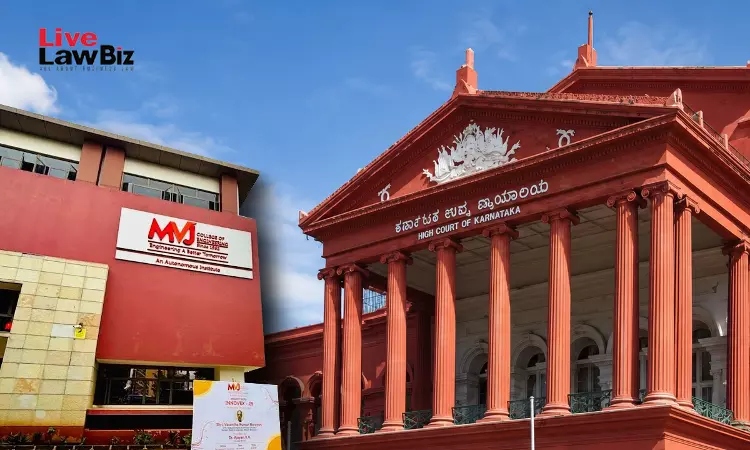
The Karnataka High Court has largely upheld a commercial court decree directing MVJ College of Engineering to pay outstanding amounts claimed by a contractor engaged to refurbish and maintain the institution's sewage treatment plant (STP).
The court, however, reduced the amount payable towards refurbishment works after accounting for tax deducted at source (TDS).
A Division Bench of Chief Justice Vibhu Bakhru and Justice C.M. Poonacha partly allowed the college's appeal. It reduced the refurbishment claim from ₹8.43 lakh to ₹8.26 lakh.
The bench affirmed the findings that the contractor was entitled to payment for refurbishment and operation and maintenance (O&M) works. It also upheld the rejection of the college's counterclaim.
Setting out the final outcome, the court held,
“In view of the aforementioned, the appeal filed by the appellant-defendant is partly allowed with proportionate costs and the judgment and decree of the Commercial Court is modified to the limited extent of holding that the defendant is liable to pay the plaintiff a sum of ₹8,26,865/- instead the sum of ₹8,43,402/- (as indicated in para 1 of the operative portion of the impugned judgment). The rest of the judgment and decree of the Commercial Court remains unaltered and is affirmed.”
Living Water Refine Technologies Pvt Ltd was engaged in June 2017 to refurbish a non-operational STP on the college campus. It was also entrusted with operating and maintaining the facility.
The contractor quoted ₹29.98 lakh plus GST for refurbishment. It quoted ₹57,500 per month for O&M services.
The contractor later claimed that amounts remained unpaid towards refurbishment and maintenance works. MVJ College disputed the claim. It alleged delays and deficiencies in performance. The college also sought about ₹21.74 lakh through a counterclaim. According to it, another vendor had been engaged to carry out rectification works.
While examining the refurbishment claim, the High Court noted that the purchase order required the contractor to supply 16 items. It recorded that the college's witness had admitted that all 16 items had been supplied.
The bench also observed that civil works, including tank leakage repairs and related works, were excluded from the contractor's scope. Those works were to be carried out by the college.
The court referred to a joint inspection conducted on January 27, 2018. The inspection record noted that the STP had been functioning smoothly for three weeks before the inspection. The court also noted that test reports obtained thereafter had been furnished to the college.
Referring to the inspection record and the objections raised by the college, the court observed,
“Although, it is the vehement contention of the learned counsel for the defendant that the STP was not functioning properly, as noticed above, minutes of the joint inspection (Ex. D2) clearly indicate that the STP was functioning and the issues highlighted by the defendant have been addressed by the plaintiff.”
On the O&M claim, the court noted that materials and spare parts continued to be supplied after the initial refurbishment. It also found no material showing that any person other than the contractor had maintained the STP during the relevant period.
Addressing the challenge to the maintenance claim, the court observed,
“Although it is the vehement contention of the learned counsel for the defendant that the invoices towards O & M works have not been sent by the defendant to the plaintiff and were produced for the first time in the suit after remand, it is clear and forthcoming from material on record that the plaintiff, after carrying out the refurbishment works, has continued to maintain the STP.”
The High Court upheld the commercial court's conclusion that the contractor had continued maintaining the STP. It held that the contractor was entitled to payment for those services.
Rejecting the counterclaim, the Bench noted that invoices raised by the subsequent vendor had been produced. However, no representative of that vendor had been examined. The court also found that no evidence had been placed on record to show that the amounts reflected in those invoices had actually been paid.
Explaining why the counterclaim could not succeed, the court held,
“However, the defendant has not examined any representative of Bisineer to prove the incurring of the further expenses. The defendant has also not produced any material to demonstrate that the payments as indicated in the invoices (ExsD16 to D24) have been paid. In the absence of the same, the appellant has failed in demonstrating that the rejection of the counter claim by the Commercial Court is erroneous and liable to be interfered with.”
The bench also upheld interest at 18% per annum on the amounts awarded. It observed that the transaction between the parties was commercial in nature.
For Appellant: Advocate Manasi Kumar
For Respondent: Advocate C.K. Dharaneeswaran