
Supreme Court

Arbitration Cases Weekly Round-Up: 19th January-25th January 2026
Nominal Index1. Prakash Atlanta (JV) vs National Highways Authority of India, 2026 LLBiz SC 172. Jan De Nul Dredging India Pvt. Ltd. v. Tuticorin Port Trust, 2026 LLBiz SC 153. E-City Real Estates Pvt Ltd & Anr. vs IMAX Corporation & Ors., 2026 LLBiz SC 224. Steel Authority Of India Ltd. v. M/S R Haranadha Reddy, 2026 LLBiz HC (MP) 95. Maverick Developer And Colonizers Pvt. Ltd. v. Project Officer, 2026 LLBiz HC (MP) 86. Ashutosh Infra Pvt. Ltd. v. Pebble Downtown India Pvt. Ltd....
Appellate Courts Cannot Disturb Arbitral Awards Merely To Permit A Different View, Supreme Court Reiterates
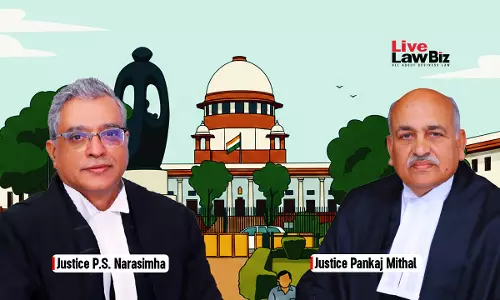
The Supreme Court, recently, set aside a Madras High Court order that had deleted compensation awarded to a dredging contractor and reiterated that appellate courts cannot interfere with arbitral awards merely because they prefer a different interpretation of the contract. A Bench of Justice Pamidighantam Sri Narasimha and Justice Pankaj Mithal held that courts hearing appeals in arbitration matters have a narrow and limited role. Once an arbitral award has been examined and found free from...

Supreme Court Orders Status Quo, Asset Disclosure In IMAX–E-City Arbitration Dispute
The Supreme Court on Friday ordered the E-City group to maintain status quo over all its assets and disclose details of its movable and immovable properties while taking up a fresh challenge to the Bombay High Court's decision that revived enforcement of foreign arbitral awards in favour of IMAX Corporation. A bench of Justices J B Pardiwala and K V Viswanathan issued notice on a special leave petition filed by E-City Real Estates Pvt. Ltd. and another group entity, challenging the Bombay High...
Welfare Boards For Building And Construction Workers Mandatory Before Levy Of Cess: Supreme Court
The Supreme Court has recently held that the constitution of Welfare Boards under the Building and Other Construction Workers Act, 1996 (BOCW), is a mandatory precondition for the effective levy and collection of cess under the Building and Other Construction Workers' Welfare Cess Act, 1996The court ruled that in the absence of such Welfare Boards, cess could neither have been validly levied nor collected, as the statutory scheme under both enactments presupposes the existence of a functional...
Courts Cannot Substitute Plausible Arbitral View Merely Because Another Is Possible: Supreme Court
The Supreme Court has reiterated that courts should exercise minimal interference with arbitral awards and cannot substitute an arbitral tribunal's interpretation of a contract merely because another view is possible. The court also held that although the Building and Other Construction Workers Act, 1996 (BOCW Act) and the Welfare Cess Act were brought into force in the mid-1990s, they could not be given effect to for several years due to the failure of governments to constitute statutory...
Arbitration Cases Weekly Round Up: 11th January To 18th January, 2026
NOMINAL INDEX Bhagheeratha Engineering Ltd. v. State of Kerala, 2026 LLBiz SC 5Motilal Oswal Financial Services Limited v. Santosh Cordeiro & Anr., 2026 LLBiz SC 4Black Gold Resources Private Limitada v. International Coal Ventures Pvt. Ltd & Anr., 2026 LLBiz HC (DEL) 41Om Prakash v. Smt Laxmi Maurya, 2026 LLBiz HC (DEL) 54Bharat Heavy Electricals Limited v. Delkon India Pvt. Ltd., 2026 LLBiz HC (DEL) 36 National Highways Authority of India v. Roadway Solutions India Infra Limited,...
Parties Cannot Rely On Pre-Arbitration Steps They Frustrated: Supreme Court
The top court made the observation while restoring a Rs 1.99 crore arbitration award against the State of Kerala
Courts Cannot Decide Arbitrability While Appointing Arbitrators: Supreme Court Dismisses Motilal Oswal's Appeal
The Supreme Court of India recently held that courts cannot decide questions of arbitrability while appointing arbitrators, even when a party relies on a special statute to oppose arbitration. At the Section 11 stage, the court said judges are required to “confine to the examination of the existence of an arbitration agreement” and nothing beyond that. On that basis, the court dismissed an appeal filed by Motilal Oswal Financial Services Limited challenging the appointment of an...
S. 37 Arbitration | Arbitral Awards Not Liable To Set Aside On Mere Error In Law Or Misappreciation Of Evidence : Supreme Court
The Supreme Court on Thursday (December 18) overturned the Chhattisgarh High Court's judgment, holding that the High Court had exceeded its jurisdiction under Section 37 of the Arbitration and Conciliation Act, 1996 by effectively acting as an appellate court, re-appreciating the evidence, and substituting its own interpretation in place of the arbitral award. “High Court, in exercise of limited jurisdiction under Section 37, impermissibly re-appreciated facts and substituted its own...
Issues About Party's Capacity To Invoke Arbitration And Maintainability Issues Fall Within Tribunal's Domain : Supreme Court
The Supreme Court on Wednesday (December 17) reiterated that the questions related to whether an individual is a veritable party to an arbitration agreement, eligible to invoke the arbitration clause, shall be referred for the Arbitral Tribunal's consideration. A Bench comprising Justice P.S. Narasimha and Justice Atul S. Chandurkar declined to interfere with the Telangana High Court's decision referring the dispute to arbitration and rejected the appellant's objection that Respondent No. 1 was...
S. 29A Arbitration Act | Arbitrator's Mandate Terminates On Expiry Of Time; Substituted Arbitrator Must Resume After Extension : Supreme Court
The Supreme Court on Wednesday (December 10) held that once the statutory 18-month period for delivering an arbitral award expires, the arbitrator's mandate automatically comes to an end as per Section 29A(4) of the Arbitration and Conciliation Act, 1996, when no application for extension is made. Therefore, when an extension of time is granted by the Court after the mandate of the arbitrator is terminated, then the substitution of the arbitrator is mandatory under Section 29A(6) of the...
Supreme Court Flags Failure Of New Arbitration Bill In Providing Statutory Appeal Against Arbitral Tribunals' Termination Orders
The Supreme Court criticised the new Arbitration and Conciliation Bill for failing to address the ambiguity regarding the relief against an arbitral tribunal terminating the proceedings, noting that the new Bill made no effort to remedy this gap in the law."It is indeed very sad to note that even after these many years, procedural issues such as the one involved in the case at hand, have continued to plague the arbitration regime of India. The Department of Legal Affairs has now, once again...