
Supreme Court
Supreme Court Directs NHAI To Deposit 50% of ₹1,019 Crore Award In Vadodara-Mumbai Expressway Dispute
The Supreme Court has recently modified a Delhi High Court order that had directed the National Highways Authority of India to deposit the entire arbitral award of over Rs. 1,019 crore in its dispute with Vadodara Mumbai Expressway PKG-08 Pvt. Ltd., and instead ordered it to deposit 50% of the total amount referred to in its order. A bench of Justices J.B. Pardiwala and K.V. Viswanathan was hearing special leave petitions arising out of the High Court's November 19, 2025 order passed in...
Conciliation Gets Award Status Under Arbitration Act Unless Expressly Excluded by Parties: Supreme Court
The Supreme Court has recently restored a civil suit challenging a family partition deed and an alleged conciliation award, observing that any conciliation conducted in accordance with Part III of the Arbitration and Conciliation Act, 1996 would attain the status and effect of an award unless the parties have expressly agreed to exclude its application. “On a reading of Section 61, any conciliation between two parties brought about by following the procedure in Part III of the Act of 1996 would...

Supreme Court Appoints Former SC Judge Abhay Oka As Mediator In IMAX–E-City Arbitration Enforcement Dispute
The Supreme Court of India on Wednesday appointed former apex court judge Justice Abhay S. Oka as mediator to explore the possibility of settlement between IMAX Corporation and the E-City Group in their dispute concerning enforcement of foreign arbitral awards.The court was hearing the matter arising out of the Bombay High Court's December 2025 judgment reviving enforcement proceedings in favour of IMAX.A bench of Justices J.B. Pardiwala and K.V. Viswanathan was further informed that the hearing...
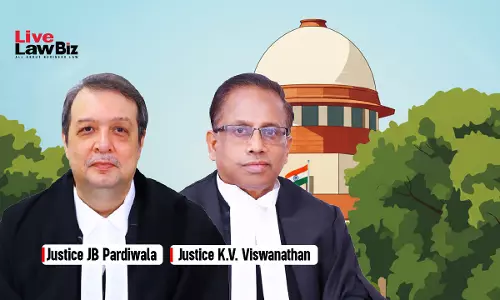
High Courts Cannot Nullify Prior Arbitral Proceedings While Substituting Arbitrator: Supreme Court
The Supreme Court of India has recently observed hat while appointing a substitute arbitrator under Section 15(2) of the Arbitration and Conciliation Act, 1996, High Courts cannot invalidate prior arbitral proceedings or orders. A Bench of Justices J.B. Pardiwala and K.V. Viswanathan set aside a portion of an order passed by the Bombay High Court, which, while appointing a substitute arbitrator, had declared arbitral proceedings conducted on seven dates between March 17, 2022 and August 25,...
LiveLawBiz Arbitration Weekly Round-Up: February 02 - February 08, 2026
NOMINAL INDEX Rajia Begum vs Barnali Mukherjee, 2026 LLBiz SC 36C Velusamy v K Indhera, 2026 LLBiz SC 39Eminent Colonizers Private Limited v Rajasthan Housing Board & Ors, 2026 LLBiz SC 48A2Z Infraservices Ltd and Anr v Quippo Infrastructure Ltd and Anr, 2026 LLBiz SC 42Avneet Soni v Kavita Agarwal, 2026 LLBiz HC (DEL) 108Union of India v Reliance Industries Ltd & Anr, 2026 LLBiz HC (DEL) 11Puri Constructions Pvt Ltd & Ors v Larsen & Toubro Ltd, 2026 LLBiz HC (DEL) 119Dusters...

Arbitration Cases Monthly Digest: January 2026
SUPREME COURTAppellate Courts Cannot Disturb Arbitral Awards Merely To Permit A Different View, Supreme Court Reiterates Case Title : Jan De Nul Dredging India Pvt. Ltd. v. Tuticorin Port Trust Case Number : Civil Appeal No. 98 of 2026 Citation: 2026 LLBiz SC 15 The Supreme Court, recently, set aside a Madras High Court order that had deleted compensation awarded to a dredging contractor and reiterated that appellate courts cannot interfere with arbitral awards merely because they prefer a...
Parties Cannot Challenge Arbitration Clause After Accepting Court-Appointed Arbitrator Under Pre-2015 Regime: Supreme Court
The Supreme Court on Wednesday (February 4) reaffirmed that parties who accept a court order appointing an arbitrator under the pre-2015 arbitration regime cannot later challenge the existence or validity of the arbitration clause while assailing the arbitral award. The ruling was delivered by a bench comprising Justices J.B. Pardiwala and K.V. Viswanathan. Under the law as it stood before the 2015 amendments, the Chief Justice or the designated judge exercising powers under Section 11 was...
Supreme Court Sets Aside Interim Relief In Arbitration Case Involving Pure Money Claim
The Supreme Court recently set aside a Calcutta High Court order directing escrow of payments arising out of a master service agreement, holding that in the facts of the case, where the dispute involved a pure money claim and there was no risk of irrecoverability, the High Court ought not to have granted interim protection after arbitration had been invoked. A Bench of Justice Manoj Misra and Justice Manmohan held that in such circumstances, the High Court should have deferred to the arbitral...
Arbitral Award Passed After Arbitrator's Mandate Expires Can Be Enforced If Court Extends Time Subsequtently: Supreme Court
The Supreme Court on Tuesday (February 3) held that arbitral awards delivered beyond the statutory timeline prescribed under Section 29A of the Arbitration and Conciliation Act, 1996, do not automatically become ineffective. The Court clarified that such awards remain ineffective and unenforceable at that stage but may still be given effect if a party approaches the competent court seeking an extension of the arbitral tribunal's mandate under Section 29A. “…we are of the opinion that...

Dispute Cannot Be Referred To Arbitration When Arbitration Agreement Itself Is Alleged To Be Forged: Supreme Court
The Supreme Court on Monday observed that disputes cannot be referred to arbitration when the very existence of the arbitration agreement is in question, particularly where the document relied upon is alleged to be forged. A bench of Justice Pamidighantam Sri Narasimha and Justice Alok Aradhe said courts must first satisfy themselves that an arbitration agreement actually exists before sending parties to arbitration. The court clarified that challenges going to the root of the arbitration...
Arbitration Cases Weekly Digest [26th January - 1st February, 2026]
Nominal Index Jan De Nul Dredging India Pvt. Ltd. v. Tuticorin Port Trust, 2026 LLBiz SC 15Jagdeep Chowgule v. Sheela Chowgule and Ors, 2026 LLBiz SC 30 M/s Angel One Limited v. S.X.J. Vasan, 2026 LLBiz HC (MAD) 30M/s Ramacivil India Construction Pvt. Ltd. v. Central Public Works Department, 2026 LLBiz HC (DEL) 77Arun Mehrotra Versus Kishan Lal, 2026 LLBiz HC (DEL) 85 To ReaVedanta Limited v. Gujarat State Petroleum Corporation Ltd., 2026 LLBiz HC (DEL) 88IFFCO TOKIO General Insurance...

Only Civil Court Can Extend Arbitration Time Even When Arbitrator Is Appointed By High Court: Supreme Court
The Supreme Court has held that an application seeking extension of time for an arbitral tribunal under Section 29A of the Arbitration and Conciliation Act lies before the civil court, even in cases where the High Court has appointed the arbitrator. The court clarified that the High Court's role ends with the appointment of the arbitrator and does not continue during the arbitration. A Bench of Justice Pamidighantam Sri Narasimha and Justice R. Mahadevan said the jurisdiction exercised by a...