
J&K And Ladakh High Court Holds SIDCO MD Ineligible To Act As Arbitrator In Contract Dispute With UT
LiveLawBiz News Desk
26 Aug 2026 11:20 AM IST
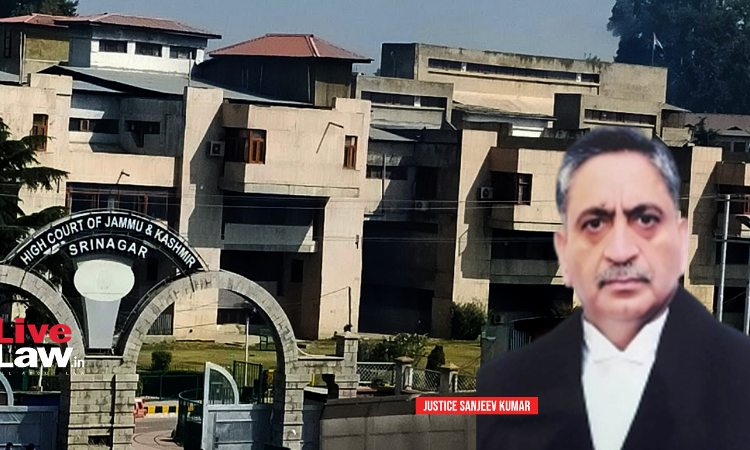
The High Court of Jammu & Kashmir and Ladakh on 21 August held that the Managing Director of J&K State Industrial Development Corporation (SIDCO) was ineligible to act as an arbitrator in a dispute between Abraq Infrastructures LLP and the Union Territory, as he was an employee of one of the respondents.
Acting Chief Justice Sanjeev Kumar allowed Abraq Infrastructures LLP's petition under Section 11(6) of the Arbitration and Conciliation Act, 1996, and appointed a Retired District and Sessions Judge as the Sole Arbitrator to adjudicate the disputes arising between the parties. He observed:
“The Managing Director, SIDCO being an employee of respondent No. 1, and thus a person having an interest in the outcome of the dispute, is rendered ineligible, by operation of Section 12(5) read with the Seventh Schedule of the Act.”
Background:
The petition concerned disputes arising from an agreement dated 16 August 2018 for construction of the National Institute of Fashion Technology (NIFT), Package-III, Ompora, Budgam, at an allotted cost of Rs. 43,99,92,907.
Abraq Infrastructures LLP had been awarded the NIFT Package-III construction contract pursuant to an allotment and agreement. According to its case, repeated interference by the respondent Department and variations in quantities of work led to disputes. The contract was terminated on 5 February 2024, following which fresh Notices Inviting Tenders (NITs) were issued for the balance work.
The petitioner challenged these actions before the Commercial Court and the High Court. Those proceedings ultimately culminated in the withdrawal of two writ petitions with liberty to the petitioner to invoke the arbitration clause.
Thereafter, the petitioner issued a notice under Section 21 of the Arbitration and Conciliation Act invoking Clause 34 of the agreement. The respondents did not dispute the existence of the arbitration agreement but opposed the petition on grounds including alleged default by the contractor, prior proceedings, payment for work already executed and pendency of another arbitration application.
Court's observations:
The Court first considered the scope of its jurisdiction under Section 11(6) read with Section 11(6A) of the Arbitration and Conciliation Act. It held that questions concerning alleged default by the contractor, accord and satisfaction, limitation, the effect of earlier proceedings and the merits or arbitrability of the claims were matters for the Arbitral Tribunal to consider.
It observed that “these are for the Arbitral Tribunal to examine and decide under Section 16 of the Act, on the well-recognised principle of kompetenz-kompetenz.” Therefore, it left these objections open for consideration by the Arbitral Tribunal.
The decisive issue concerned Clause 34(II) of the agreement, which provided that the Managing Director, SIDCO, or a person nominated by him or her, would act as the Sole Arbitrator where the parties failed to agree on an arbitrator.
The Bench held that the Managing Director, SIDCO, being an employee of respondent No. 1 and having an interest in the outcome of the dispute, was rendered ineligible to act as an arbitrator under Section 12(5) read with the Seventh Schedule of the Act.
It further held that a person who is himself ineligible to act as an arbitrator cannot nominate another person as arbitrator. It stated that “it is equally well settled that a person who is himself ineligible to act as Arbitrator cannot nominate another person to act as such.”
The Chief Justice also observed that permitting an ineligible person to nominate an arbitrator would defeat the requirement of neutrality and independence introduced by the 2015 amendment to the Arbitration and Conciliation Act.
Relying on TRF Ltd. v. Energo Engineering Projects Ltd., (2017) 8 SCC 377, and Perkins Eastman Architects DPC v. HSCC (India) Ltd., AIR 2020 SC 59, the Bench held that the contractual mechanism designating the SIDCO Managing Director or his nominee as the Sole Arbitrator could not operate.
It also observed that Clause 34(II), “to the extent it designates the Managing Director, SIDCO or his nominee as sole arbitrator, is accordingly rendered unworkable”, making it necessary for the Court to appoint an independent arbitrator under Section 11(6).
Accordingly, the High Court allowed the petition and appointed a Retired District and Sessions Judge as the Sole Arbitrator to adjudicate the disputes arising between the parties under the contract.
For Petitioner: Advocate Mohammad Yawar Hussain
For Respondents: Advocate Waseem Gul, Government