
ARBITRATION
Emden Formula For Calculating Construction Contract Damages Can't Apply To Dealership Agreements: Madras High Court
The Madras High Court has recently held that the Emden formula, developed to quantify damages in construction contracts, cannot ordinarily be used to assess compensation in disputes arising from automobile dealership agreements.A Division Bench of Justice P. Velmurugan and Justice K. Govindarajan Thilakavadi observed that the formula is rooted in the unique features of construction contracts and cannot be mechanically extended to commercial distribution arrangements. "A dealership agreement is a...
Though Mandatory, 75% Pre-Deposit To Challenge MSME Award Need Not Accompany Plea: Rajasthan High Court
The Rajasthan High Court at Jaipur has held that while a 75% pre-deposit under the Micro, Small and Medium Enterprises Development Act, 2006 (MSME Act) is mandatory for challenging an arbitral award, courts can grant reasonable time to make the deposit instead of insisting that it accompany the challenge at the time of filing. The court said the statutory requirement must be met before a petition under Section 34 of the Arbitration and Conciliation Act, 1996 is heard on merits, and, in...
Return Of Title Deeds Dispute Remains Arbitrable Despite Mandatory Injunction Relief: Kerala High Court
The Kerala High Court on 14 July 2025 held that a claim for return of title deeds remains arbitrable even when framed as a suit for mandatory injunction, ruling that the nature of the relief claimed does not determine arbitrability when the dispute arises from an agreement containing a broad arbitration clause. Justice T.R. Ravi allowed the reference of the dispute between The Indian Hotels Co. Ltd. and KTC Group entities to arbitration, holding that the expression “any matter in any way...
Chhattisgarh HC Says Fraud Claims Need Trial Despite Arbitration Clause, Allows Sierra Takeover Dispute
On 29 July, the Chhattisgarh High Court held that the existence of an arbitration agreement does not bar criminal prosecution where the allegations prima facie disclose cognizable offences, and that allegations of fraud, concealment of liabilities and fabricated Board resolutions cannot be treated as a mere contractual dispute but must be tested at trial after appreciation of evidence. A Division Bench of Chief Justice Ramesh Sinha and Justice Ravindra Kumar Agrawal dismissed a petition seeking...

Service Of Arbitral Award Through Spouse At Same Address Triggers Limitation: Bombay High Court
The Bombay High Court on 28 July held that delivery of a signed copy of an arbitral award to one party on behalf of another party residing at the same address constitutes valid delivery under Section 31(5) of the Arbitration and Conciliation Act, 1996, and triggers the limitation period for challenging the award. Justice Sharmila U. Deshmukh held that K. Samad had received the signed copy of the arbitral award passed in favour of Reliance Capital Limited on behalf of his wife Mekarunisa Samad...
Jurisdiction Order U/S 16 Arbitration Act Cannot Be Independently Challenged: Bombay High Court
The Bombay High Court on 27 July held that an arbitral tribunal's ruling under Section 16 of the Arbitration and Conciliation Act, 1996 (which empowers a tribunal to decide its own jurisdiction) cannot be challenged under Section 34 merely because it upholds the existence of a valid arbitration agreement, as such a ruling is not an interim award. Justice Sharmila U. Deshmukh dismissed a petition filed by I.A. & I.C. Private Limited & Ors. challenging an arbitral tribunal's order...

Bombay High Court Says Freezing Bank Accounts Cannot Be Routine Interim Relief Under Arbitration Act
The court partly allowed Tata Capital's petitions seeking freezing of borrowers' bank accounts, disclosure of assets, and appointment of a court receiver.
![Manipur High Court, denies bail, Conspiring, Secede, From India, Establish Kukiland, Secession, Mark Thangmang Haokip, Justice M. V. Muralidaran, People’s Democratic Republic of Kukiland, waging war against state, Mark Thangmang Haokip v. State of Manipur and another [Bail Appln. No. 11 of 2022],](https://assets.livelawbiz.com/h-upload/2022/11/06/500x300_442766-manipur-high-court-imphal.jpg "Manipur High Court, denies bail, Conspiring, Secede, From India, Establish Kukiland, Secession, Mark Thangmang Haokip, Justice M. V. Muralidaran, People’s Democratic Republic of Kukiland, waging war against state, Mark Thangmang Haokip v. State of Manipur and another [Bail Appln. No. 11 of 2022],")
Manipur High Court Sets Aside Arbitral Award On Parties' Consent In Thoubal Multipurpose Project Dispute
The Manipur High Court has, recently, with the consent of Progressive Construction Limited and the State of Manipur, set aside an arbitral award relating to the Thoubal Multipurpose Project (Construction of Earth Dam) and ordered a de novo arbitration.Chief Justice M. Sundar, while disposing of an arbitration petition filed by Progressive appointed former Chief Justice of the Manipur High court Justice D. Krishnakumar as the substitute sole arbitrator to conduct the arbitration proceedings and...
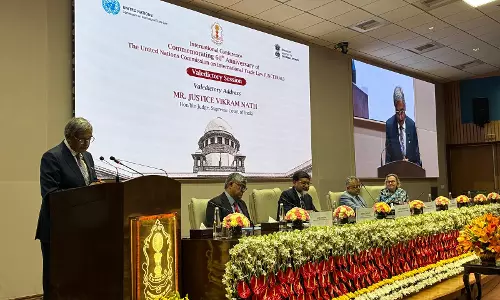
'Meeting Of Minds' To 'Meeting Of Algorithms': Justice Vikram Nath Flags AI Challenges At UNCITRAL Event
On Sunday, 26 July, Supreme Court Judge Justice Vikram Nath delivered the valedictory address at an international conference marking the 60th anniversary of the United Nations Commission on International Trade Law (UNCITRAL). He told delegates that contract law may need to reconsider how it attributes legal intention in the age of artificial intelligence (AI)-driven commercial contracting, questioning whether the traditional doctrine of consensus ad idem still holds as autonomous systems...
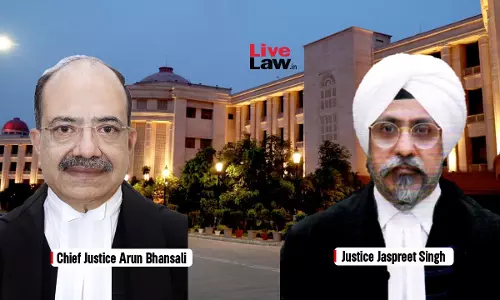
Allahabad High Court Partly Sets Aside ₹157.57 Cr Arbitral Award Against U.P. State Highways Authority
The Allahabad High Court on 23 July held that a financial model based on assumptions cannot, by itself, quantify a claim for loss of profits in arbitration, and set aside the Rs. 157.57 crore loss of profits award against the U.P. State Highways Authority. A Division Bench of Chief Justice Arun Bhansali and Justice Jaspreet Singh partly allowed the Authority's appeal under Section 37 of the Arbitration and Conciliation Act, 1996, severed the loss of profits component of the arbitral award,...
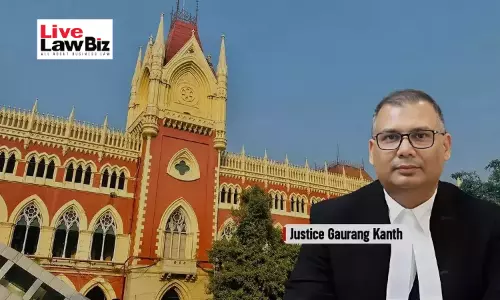
Arbitral Tribunal Cannot Compel Production Of Evidence Through Interim Relief Mechanism: Calcutta High Court
The Calcutta High Court has held that an arbitral tribunal cannot use its power to grant interim relief as a mechanism to compel a party to produce evidence. Justice Gaurang Kanth observed that interim powers under Section 17 are meant to protect the subject matter of a dispute, while matters relating to production of evidence are governed by Section 19 of the Arbitration and Conciliation Act, 1996.The judge observed, “Two features of this provision merit immediate attention. First, the powers...
Madras High Court Sets Aside Land Compensation Award, Says Arbitrator Must Give Reasons After Remand
The Madras High Court on 22 July held that an arbitrator reconsidering a matter after remand must independently apply his mind and provide reasons for accepting or rejecting the parties' objections, as merely reproducing pleadings and submissions does not constitute a reasoned arbitral award. A Division Bench of Justices P. Velmurugan and K. Govindarajan Thilakavadi allowed appeals filed by the National Highways Authority of India (NHAI), set aside the arbitral award enhancing compensation from...