
Madras High Court Temporarily Restrains Universal Spirits From Using 'Marco Polo' For Liquor
Riya Rathore
15 Aug 2026 4:09 PM IST
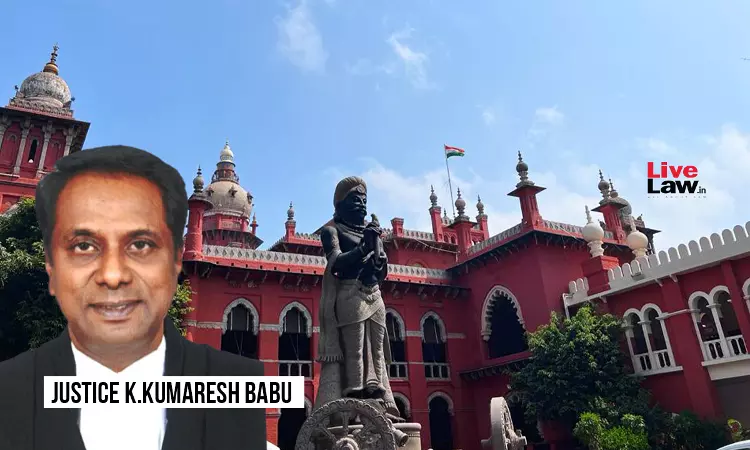
The Madras High Court has restrained Universal Spirits Pvt Ltd from manufacturing, marketing or selling liquor under the marks “Classic Marco Polo Deluxe Brandy” and “Marco Polo Deluxe XXX Rum”, pending disposal of a commercial suit filed by Empee Distilleries Limited.
Justice K. Kumaresh Babu also directed Universal Spirits to submit accounts relating to the manufacture and sale of the products. It must also hand over the unsold products to Empee Distilleries within four weeks of receiving a copy of the order.
Empee Distilleries and Universal Spirits were both originally part of the EMPEE Group. The court noted that both companies were initially promoted by M.P. Purushothaman.
Empee Distilleries entered corporate insolvency resolution proceedings at the instance of a financial creditor on November 1, 2018. SNJ Distillers Private Limited submitted the successful resolution bid, which was approved by the National Company Law Tribunal on January 20, 2020.
The National Company Law Appellate Tribunal confirmed the resolution plan on August 27, 2020. The Supreme Court subsequently approved it on November 26, 2020.
Under the resolution plan, Empee Distilleries was taken over as a going concern by SNJ Distillers. The takeover included its movable and immovable assets, licences, permissions, trademarks and intellectual property. A new board subsequently took over the company's management.
Empee Distilleries owned the registered “Marco Polo” trade name in Class 33. The court noted that the mark had been widely used for its IMFL products. Its registration is valid until May 9, 2036.
Universal Spirits remained part of the EMPEE Group. Empee Distilleries told the court that although it was not currently manufacturing products in the “Marco Polo” trade name, Universal Spirits was manufacturing and marketing “Classic Marco Polo Deluxe Brandy” and “Marco Polo Deluxe XXX Rum” through Kerala State Beverages (M&M) Corporation Limited.
The court was also told that Universal Spirits had knowledge that the “Marco Polo” trade name had been transferred to Empee Distilleries under the resolution plan. Empee Distilleries argued that continued use of the mark would create confusion among consumers about the source of the products.
Universal Spirits, on the other hand, argued that Empee Distilleries had admittedly not been using the trademark. It contended that there was therefore no likelihood of deception or confusion.
It also argued that Empee Distilleries was not manufacturing IMFL products in the “Marco Polo” trade name in Kerala or elsewhere in India. Universal Spirits further relied on a Supreme Court judgment on the principles governing interim injunctions in trademark disputes.
The court rejected the argument based on non-use.
It noted that although Universal Spirits claimed that the “Marco Polo” name had not been used for more than a decade, Empee Distilleries remained under EMPEE Group management until 2020, when the resolution plan was approved. Universal Spirits had not attributed any reason for the discontinuation of the trademark's use during that period.
“Discontinuous use by the EMPEE Group in the applicant company cannot be a reason that can be put against the applicant now, when it complaints the infringement of its registered trademark,” the court observed.
The court further noted that the EMPEE Group had marketed IMFL products under the registered “Marco Polo” name. It was also aware that the trademark was registered in Empee Distilleries' name and had continued with the company after it was sold as a going concern to SNJ Distillers.
The court also relied on the companies' common EMPEE Group history while assessing the likelihood of consumer confusion. It observed that using the registered name with prefixes and suffixes for the same product by companies belonging to the same group could lead consumers to believe that the products came from Empee Distilleries.
“When that being so, the use of the trade name with prefixes and suffixes for the very same product by the very same Group of Companies would prima facie create a deception in the mind of the consumers that it would be the product of the applicant company,” the court observed.
The court then considered the principles governing interim injunctions laid down by the Supreme Court. These included the likelihood of confusion or deception, balance of convenience, irreparable harm and public interest.
Applying those principles, the court found that use of Empee Distilleries' registered trademark on Universal Spirits' IMFL products would prima facie deceive consumers. The court concluded that consumers would believe the products were manufactured and sold by Empee Distilleries.
“It is prima facie concluded that the IMFL product sold by the respondent using the registered trademark of the applicant would definitely cause a deception in the mind of the consumers that the product is being manufactured and sold by the applicant company,” the court observed.
The court was also prima facie satisfied that irreparable harm would be caused to Empee Distilleries. It held that the balance of convenience was in favour of granting the injunction.
The court accordingly restrained Universal Spirits from manufacturing, packing, marketing or selling “Classic Marco Polo Deluxe Brandy” and “Marco Polo Deluxe XXX Rum”.
The injunction also covers deceptively similar marks containing “Marco Polo” as a prefix or suffix, pending disposal of the commercial suit.
A separate injunction was granted against use of the marks to pass off Universal Spirits' products as those of Empee Distilleries.
The court also directed Universal Spirits to submit its manufacturing and sales accounts and hand over its unsold products to Empee Distilleries within four weeks.
For Applicant: Senior Counsel A.R.L.Sundaresan for Advocate AR.Karthik Lakshmanan
For Respondents: Senior Counsel Vijay Narayan for Advocate Rohan Rajasekaran