
Gujarat High Court Sets Aside Order Restraining Trademark Owners From Using Own Mark, Calls It 'Grave Error'
Riya Rathore
1 Aug 2026 6:28 PM IST
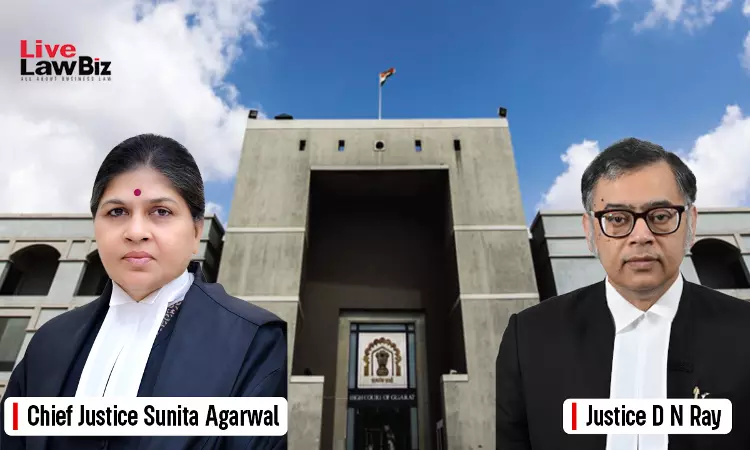
The Gujarat High court has set aside a temporary injunction restraining the registered proprietors of the trademark "Aditya Jewellers" from using their own registered mark, ruling that the Commercial court in Rajkot committed "a grave error of law" by granting the relief.
The court observed that the trial court had assessed the reliability of the appellants' evidence at the interim stage, even though "no mini trial can be conducted" while deciding an application for temporary injunction.
A division bench of Chief Justice Sunita Agarwal and Justice D.N. Ray was hearing an appeal filed by the original defendants against the trial court's order dated 09.03.2026.
The original suit was filed by Alpeshbhai Ranchhodbhai Lunagariya (the original plaintiff, now Respondent in this appeal) against Tinubhai Babubhai Bhalgama (the original defendants, now Appellants in this appeal).
Both parties run jewellery businesses using variants of the name "Aditya".
The Respondent/Plaintiff claimed to run a proprietorship called Aditya Jewellers since 2007, asserting long use of the marks "Aditya", "Aditya Jwelers" and "Aditya Jewellers", though it held no trademark registration and had only applied for one in 2024.
It alleged that the Appellants/Defendants had dishonestly adopted identical or deceptively similar marks — "Aditya Jewellers", "Aditya Jewels", "Adityam Jewels" and "Aditya Fashion" — to ride on its goodwill, and sought an injunction restraining them from using these marks.
Despite the registered proprietors of the "Aditya Jewellers" trademark holding trademark registration, the Commercial court granted an interim injunction restraining them from using the mark.
Before the high court, the registered proprietors argued that the trial court had wrongly conducted a "mini trial" at the interim stage by scrutinising the reliability of their documentary evidence.
The division bench agreed. It held that the trial court's rejection of their bills as unreliable was "completely contrary to the spirit of the law pertaining to the grant of temporary injunction," which rests on three ingredients: prima facie case, balance of convenience and irreparable loss. These must be established by the person seeking the injunction, not disproved by the opposite side.
The court observed that "at the stage of temporary injunction, no mini trial can be conducted" and that the registered proprietors' evidence could not be discarded "on the premise of being unreliable documents when no trial can be conducted at that stage."
Looking at the undisputed facts, the bench noted that the registered proprietors had placed evidence on record showing they commenced business in 2002 and were the registered owners of the "Aditya Jewellers" trademark. It also noted that the jewellery business alleging infringement did not hold any trademark registration.
On that basis, the court held that the claim of infringement and passing off "at least, could not be said to have been proved prima facie."
The bench clarified that whether the jewellery business had, despite lacking trademark registration, acquired goodwill or attained the status of a well-known mark through use since 2007 was "a question to be decided at the stage of trial, after evidence are led by the parties," and could not be assumed merely from its turnover figures.
It also observed that there was "no question of dishonest adoption" because the registered proprietors were prior users and had obtained trademark registration well before the suit was filed.
Holding that the trial court had granted the injunction "merely considering the plaintiff's turnover and customer base," the high court concluded that "the main ingredient for grant of temporary injunction, namely, prima facie case has not been proved in favor of the plaintiff."
The high court allowed the appeal and set aside the trial court's order dated March 9, 2026 granting the interim injunction. There was no order as to costs.
The high court also clarified that the trial court must decide the suit independently on the evidence led at trial, without being influenced by the observations made in the appeal.
For Appellants: Advocate Rushvi N Shah with Zahid K Shaikh, Jawad Z Shaikh and Arbaz A Saiyed
For Respondents: Advocates Chandra Kant and Krunal G Patel