
Gujarat High Court Dismissed Appeal In GULAB vs ROSE Trademark Dispute, Warns Trial Court Against Superfluous Judgments
Riya Rathore
23 Feb 2026 7:26 PM IST
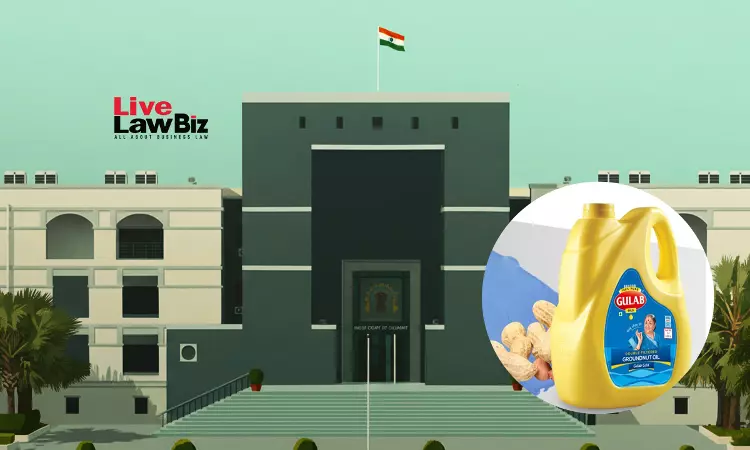
The Gujarat High Court has recently dismissed an appeal filed by Mangrol Oil Mill in its trademark dispute over “GULAB” groundnut oil. The Court refused to interfere with a Commercial Court order that denied interim injunction against Vikas Oil Industries, which markets edible oil under the mark “ROSE”.
A Division Bench of Chief Justice Sunita Agarwal and Justice Sanjeev J. Thaker upheld the November 30, 2024 order of the Commercial Court at Morbi. The trial court had rejected the plaintiffs' application for ad-interim relief on the ground of delay, laches and acquiescence.
Mangrol Oil Mill had argued that “GULAB” and “ROSE” convey the same meaning. It contended that use of “ROSE” for identical goods was likely to cause confusion in the market. The plaintiffs relied on prior use and registration of the “GULAB” mark dating back to the 1980s.
However, the High Court noted that the plaintiffs were aware of the defendants' use of the mark since at least 2008. They had filed objections before the Trade Marks Registry at that time. Despite this, the suit was instituted only in 2022.
The bench declined to interfere with the discretionary refusal of interim relief.
Applying settled principles of trademark law, the Court observed:
“Applying the Anti-dissection rule, distinct words having no similar visual and phonetic, the dominant feature of two device marks, being typically the word “GULAB” and “ROSE” and the other pictorial representation of flower, namely “Gulab” or “Rose” and 'Groundnuts in shells', do not carry any inherent distinctiveness which can be associated with the product to create a consumer base/association so as to consider them uniquely associated with the plaintiffs' goods in the minds of the public"
The bench reiterated that generic or descriptive elements cannot be monopolised unless shown to have acquired distinctiveness through use. It found no ground to disturb the conclusion that the balance of convenience did not favour grant of injunction at this stage.
While dismissing the appeal, the High Court also issued a pointed caution to trial courts against superfluous deliberations in judicial orders. It warned that unnecessary verbosity in the adjudicatory process undermines the credibility of judgments and places an avoidable burden on appellate courts.
It observed:
"The officers of the District Judiciary in the State shall keep in mind that superfluous deliberations in the process of adjudication takes away the credibility of the judgment and rather reflect on the integrity of the process. Such aberrations should be necessasrily avoided, as they do not properly convey the mind of the Judgeadjudicator and further burden the appellate court to indulge in an unwanted laborious evaluation of the record independently, bereft of the benefit of the views of the first adjudicator/trial court."
The Court emphasised that “Clarity, Coherence, and the Conciseness” are the “essential 3-Cs” of judgment writing. It directed that a copy of the trial court's judgment be sent to the Judicial Academy for academic purposes.
For Mangrol Oil Mill: Senior Advocate Shalin Mehta, with Advocates Y J Jasani And Pratik Y Jasani
For Defendants: Advocates Rushvi N Shah, Zahid K Shaikh, Jawad Z Shaikh and Arbaz A Saiyed