
BECO's Ad Campaign Against HUL's Vim, Surf Excel Fails Permissible Comparative Advertising Test: Delhi High Court
Riya Rathore
10 Sept 2026 4:00 PM IST
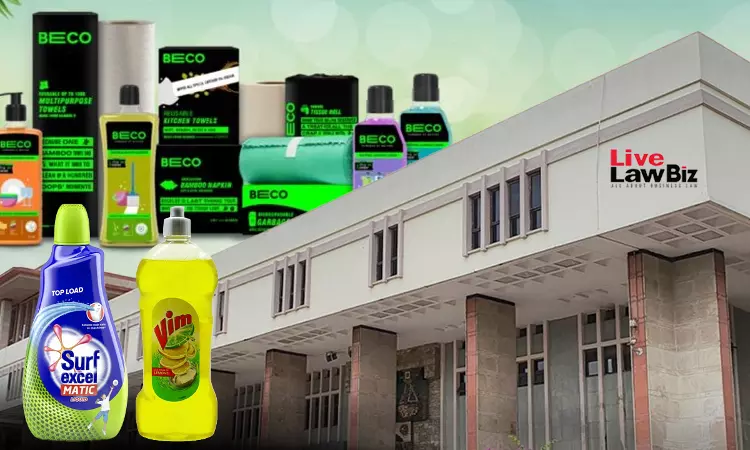
The Delhi High Court on Thursday held that BECO's “War on What's Hidden” campaign against Hindustan Unilever's Vim and Surf Excel products prima facie fails the test of permissible comparative advertising.
Justice A. J. Bhambhani granted HUL interim relief against the campaign.
The advertisements included claims that Linear Alkylbenzene Sulfonate (LAS) and Benzisothiazolinone (BIT) “can cause skin irritation & allergic reactions”, along with directions to “SWITCH TO BECO”.
Kwick Living has been directed to forthwith pull down, remove and recall all advertisements that are the subject matter of the proceedings and contain the offending statements, within one week.
It must file an affidavit of compliance within one week thereafter.
Senior Advocate Chander M. Lall, appearing for Kwick Living, argued that comparative advertising permits a trader to compare its goods with a rival's named products, use the rival's marks and packaging to the extent necessary for identification, and state what is true.
He also argued that restraining the entire campaign would disproportionately curtail the defendant's commercial free speech protected under Article 19(1)(a) of the Constitution.
Senior Advocate Amit Sibal, appearing for HUL, argued that the campaign went beyond merely identifying ingredients and targeted HUL's finished products.
He said it used HUL's trademarks, packaging and advertising expressions such as “Power of 100 Lemons” and “Daag Acche Hain”.
He argued that the “overall message and clear implication” of the campaign led consumers to believe that HUL's products cause skin irritation or allergies, even if the individual ingredient claims were worded differently.
After analysiung the facts, the court clarified the limits of permissible comparative advertising.
It explained that “comparative advertising, which portrays that a party's product is superior to that of a competitor and thereby shows the competitor's product in a poor light, in an effort to dissuade a consumer from buying the competitor's product, is not in and of itself, offensive to the law.”
The caveat, the court said, is that such advertising “must not be based on statements that are not truthful and/or that misrepresent a state of affairs and/or that are deceptive/misleading - in their overall effect and impact.”
Applying that test, the Court held that the campaign's individual statements could not be assessed in isolation. This was so even if some of the statements might be accurate when viewed separately.
“A particular element of an advertisement may, when viewed in isolation, be accurate or truthful, but when juxtaposed with its other elements, the advertisement viewed as a whole may convey a false and/or misleading and/or deceptive message to an average consumer,” it observed.
Reading the panels together, including the product visuals and adjoining “SWITCH TO BECO” prompts, the Court held that “the unmistakable overall message that an average consumer would get is that, since the plaintiff's products contain BIT and LAS, using them would cause skin irritation, including redness, itching, or even eczema.”
It held that the campaign, taken as a whole, “is not mere comparative advertising which eulogises the defendant's products as being superior to those of the plaintiff, but denigrates the plaintiff's products purportedly couched in verified scientific basis”.
The court further noted that the campaign “cites complex chemical names, proportions, and percentages of the harmful ingredients to give the viewer a sense of certitude that the plaintiff's products are risky to use.”
On this basis, the Court concluded, "In the opinion of this court, in doing so, the defendant prima facie crosses the permissible contours of comparative advertising.”
The court ultimately held, “In the opinion of this court, the impugned campaign prima facie falls foul of the above caveats and qualifications, and thereby fails the test of permissible comparative advertising.”
The court further held that HUL had made out a prima facie case and that the balance of convenience lay in its favour. It also found that irreparable harm and injury would be caused if Kwick Living were not restrained from running the campaign.
The Court clarified that the restraint was limited to the impugned campaign. It would not prevent Kwick Living from carrying out comparative advertising vis-à-vis HUL's products otherwise.
For HUL: Senior Advocates Amit Sibal and Rajiv Nayar with Advocates Saikrishna Rajagopal, Sidharth Chopra, Nitin Sharma, Sneha Jain, Vivek Ayyagari, Abhinav Bhalla, Saksham Dhingra and Smriti Nair
For Beco: Senior Advocate Chander M. Lall with Advocates Shwetasree Majumder, Prithvi Singh, Jahnvi Chadha, Rohan Krishna Seth, Devyani Nath, Krtin Bhasin, Ritwik Marwaha, Vanshika Singh and Annanya Mehan