
US Court Strikes Down Trump's $100,000 H-1B Levy, Says It Was A Tax, Not Visa Fee
Kirit Singhania
9 Jun 2026 12:09 PM IST
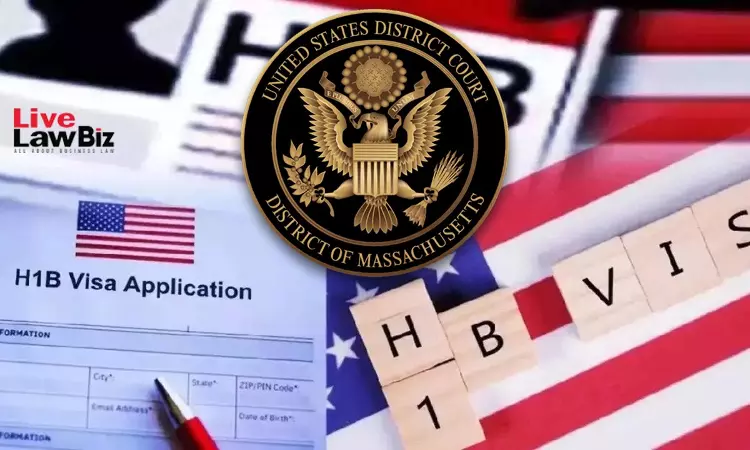
A federal court in Massachusetts has struck down President Donald Trump's $100,000 payment requirement for new H-1B visa petitions. The Court granted summary judgment to a coalition of 20 states led by California and vacated the federal policy implementing the measure.
Judge Leo T. Sorokin of the US District Court for the District of Massachusetts held that the payment requirement functioned as a tax. The Court further held that the Executive lacked authority under the provisions relied upon by the administration to impose it. The Court also issued declaratory relief.
Addressing the nature of the $100,000 payment requirement, the Court held that its legal character depended on its substance and application rather than the label attached to it.
“In any event, the manner in which a particular payment is labeled 'does not determine whether the payment may be viewed as an exercise of Congress's taxing power,' because what matters is the 'substance and application' of the payment, not its 'designation.' Sebelius, 567 U.S. at 564-65. Here, the substance and application of the $100,000 payment reveal that it is a tax, regardless of what the payment is called.”, the court noted.
The challenge was brought by 20 states against a September 19, 2025 Presidential Proclamation. The proclamation imposed a $100,000 payment requirement on employers filing new H-1B petitions. It took effect on September 21, 2025.
The measure was implemented through memoranda, guidance documents, FAQs and other policy materials issued by federal agencies. These included the US Citizenship and Immigration Services (USCIS) and the Department of State.
The states argued that the measure would impair their ability to recruit teachers, university faculty, researchers and healthcare professionals through the H-1B program. They further contended that it would worsen staffing shortages in those sectors.
While examining whether the president had authority to impose the payment requirement, the Court considered the provisions of the Immigration and Nationality Act relied upon by the administration. It concluded that those provisions did not delegate Congress's taxing power.
“Applying Learning Resources to the case at hand, the Court finds that INA §§ 212(f) and 215(a) do not delegate taxing power to the President. These sections allow the President to impose 'restrictions,' 'rules,' 'regulations,' 'orders,' 'limitations,' and 'exceptions' to the entry of noncitizens to the United States. Like the powers delineated in the IEEPA, none of these terms, by their ordinary meaning, include the power to tax.”
The Court nevertheless observed that the payment requirement operated as part of the process governing entry into the United States. It effectively functioned as a restriction on entry by creating an additional payment obligation for H-1B petitions.
“By creating an additional payment obligation for H-1B petitions, the Proclamation narrows the entry of workers who are authorized to enter the country with an H-1B visa. While adding a payment requirement for H-1B petitions does not restrict noncitizens at the moment of entry and instead tacks on an eligibility requirement at an earlier stage of the visa-application process, the payment requirement is part of the process for legally entering the United States and effectively imposes a restriction on entry.”
After concluding that the payment requirement functioned as a tax, the Court examined whether any statute authorised federal agencies to impose such a charge on H-1B petitions. It found that the payment could not be treated as an adjudication fee. The Court further held that the agencies lacked statutory authority to impose it.
“The $100,000 payment requirement plainly does not constitute an adjudication fee under this statutory provision. As Defendants concede, the Proclamation 'does not impose a fee to cover costs, does not displace that fee, and is not collected or used in the same manner.' Doc. No. 93 at 34. Defendants point to no other statute empowering agencies to impose a tax on H-1B petitions. Accordingly, the Court finds that Defendants' actions in issuing the Policy exceeded their statutory authority in violation of the APA. Plaintiffs' motion for summary judgment is ALLOWED for Count II, and Defendants' cross-motion for summary judgment and motion to dismiss as to this claim are DENIED.”, the court ruled.
Having found the policy unlawful, the Court granted the relief sought by the plaintiff states. It vacated the policy materials implementing the proclamation and issued declaratory relief.
“Accordingly, the Court VACATES the Policy materials implementing the Proclamation's $100,000 payment requirement. In addition to vacatur, Plaintiffs seek a 'judicial declaration that the Policy is unlawful in violation of the APA and the Constitution.' Doc. No. 87 at 31. Defendants' only objection to this requested relief is that 'declaratory judgment alone would not redress Plaintiffs' alleged injuries because . . . that judgment would not affect the Proclamation nor would it enjoin any future action.' Doc. No. 93 at 47. But this concern is not applicable here, where the Court has also ordered vacatur of the challenged agency action. Therefore, the Court issues declaratory judgment.”, the court ruled.
Accordingly, the Court granted summary judgment to the plaintiff states. It vacated the policy materials implementing the $100,000 payment requirement and issued declaratory relief.