
Supreme Court Sets Aside ₹425.28 Crore Customs Penalty Over Fake Citations, AI Hallucinations
Kirit Singhania
3 Sept 2026 10:23 AM IST
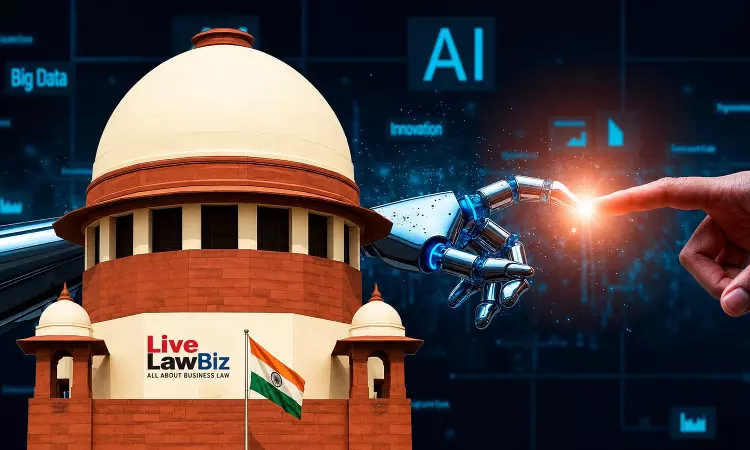
The Supreme Court has set aside a customs penalty of ₹425.28 crore against a diamond trader after finding that the adjudicating authority had relied on non-existent judgments and fake citations.
It also found that legal propositions had been wrongly attributed to existing judgments, which the Court said appeared to be a “hallucination of AI”.
A Division Bench of Justices Dipankar Datta and Sheel Nagu set aside the Gujarat High Court's January 20, 2026, order that had dismissed Vijay Ghanshyam Gadiya's challenge to the penalty.
The Supreme Court also set aside the Order-in-Original passed by the Additional Commissioner of Customs, Surat, on October 8, 2025, and directed fresh adjudication by an officer of the same rank other than the officer who had passed the original order.
The Additional Commissioner had imposed a penalty of ₹425,27,99,100 on Gadiya for misdeclaring a consignment of natural diamonds as lab-grown diamonds to pay a lower tariff. Gadiya's challenge to the penalty before the Gujarat High Court was dismissed, following which he approached the Supreme Court.
Before the Supreme Court, it was contended on Gadiya's behalf that several judgments and articles cited in the October 8, 2025 Order-in-Original had been generated using Artificial Intelligence.
The Court said it had made an effort to individually verify the cited judgments and articles. It found that some of the case laws relied upon were non-existent or had fake citations. It further found that some case laws which did exist did not lay down the ratio attributed to them in the order, which appeared to be a “hallucination of AI”.
Referring to its earlier decision in Pooja Ramesh Singh v. Jammu & Kashmir Bank Ltd., the Court noted that it had called for a zero-tolerance approach towards producing, citing or using AI-generated precedents without verification. The earlier decision also held that the use of fake or hallucinated AI-generated material as precedent violated the sanctity of adjudication.
The bench then went on to comment on the broader use of AI in adjudicatory processes. It noted that the Supreme Court had recently released draft Regulations for the use of Artificial Intelligence in courts in 2026, calling for comments and suggestions, and observed that the use of AI as an assistive tool to speed up decision-making could not be denied.
However, the Court cautioned that assistance can never be substituted for adjudication. Observing that AI could assist in the decision-making process but could not take over the adjudicatory role, the bench observed,
“At this juncture, we may also add a comment on the use of Artificial Intelligence in adjudicatory processes. While this issue incidentally falls upon us to be considered, use of AI in the process of adjudication is not foreign. Quite the contrary, this Court has recently released draft Regulations for Use of Artificial Intelligence in Courts, 2026, calling for comments and suggestions. Notwithstanding that the regulations are yet to be finalised, use of AI as an assistive tool to speed up the decision making process cannot be denied. However, a note of caution must be sounded: assistance can never be substituted for adjudication. AI may well serve as training wheels but entrusting it with the pilot's seat would be both imprudent and dangerous"
The court held that the use of AI in the present case, resulting in reliance on dubious material, proved fatal to the sustainability of the order imposing the penalty. It therefore said that the circumstances compelled it to interfere and remand the matter for fresh adjudication.
Accordingly, the court set aside both the Gujarat High Court's order confirming the penalty and the October 8, 2025 Order-in-Original. The proceedings against Gadiya were revived and will be decided afresh by an officer of the same rank other than the officer who passed the original order.
The top court also left it to the appointing authority to initiate such action against the author of the October 8, 2025 order as may be warranted in the circumstances and in accordance with law.
For Petitioner: Shamik Shirishbhai Sanjanwala, AOR, Advocates Paresh M. Dave, Aditya Tripathai, Shubhangi Agarwala
For Respondent: Gurmeet Singh Makker, AOR