
Can NCLT Allow Withdrawal Of CoC-Approved Resolution Plan? Supreme Court Reserves Verdict
Kirit Singhania
30 Sept 2026 12:23 PM IST
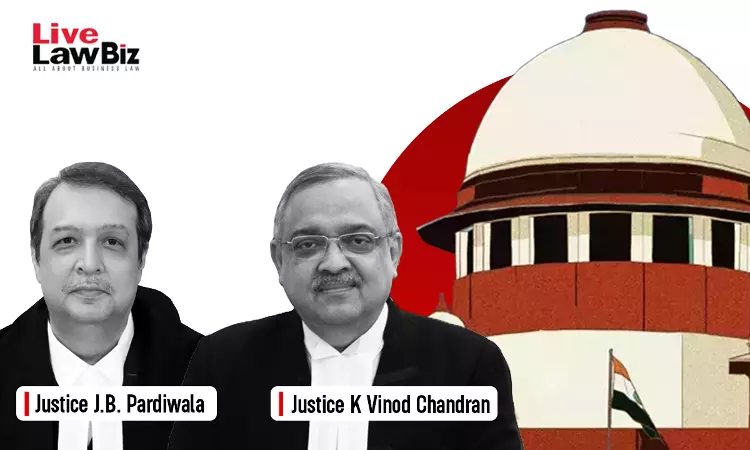
The Supreme Court on Wednesday reserved its judgment on whether the National Company Law Tribunal can permit withdrawal of an application seeking approval of a resolution plan after the Committee of Creditors has approved the plan and submitted it to the Adjudicating Authority
A Bench of Justices J.B. Pardiwala and K. Vinod Chandran was hearing Indian Bank's challenge against the National Company Law Appellate Tribunal's April 20, 2026, order concerning TD Toll Road Pvt Ltd, which had set aside the NCLT's decision allowing withdrawal of the resolution plan approval application.
The NCLAT held that once a resolution plan is approved by the CoC and submitted to the adjudicating authority, the CoC cannot withdraw it.
Senior Advocate Gopal Sankaranarayanan, appearing for Indian Bank, submitted that the central question was whether the CoC retained the power to revisit its decision after approving the resolution plan.
“The question that arises is this, that once a resolution plan has been approved by the CoC does the CoC at all retain a right to revisit, withdraw, dilute, alter its position which it had earlier canvassed?”
He explained that the plan was approved during the COVID 19 period, when toll collections were depressed but that the corporate debtor's financial position subsequently improved substantially.
“We had a series of meetings from the 14th meeting up to our 22nd meeting, where we saw the solvency situation, which had massively increased.”, Gopal Sankaranarayanan said.
Sankaranarayanan submitted that the CoC wanted to invite fresh resolution plans because the company was now in a substantially stronger financial position. He also argued that the NCLT should be allowed to consider the changed circumstances while deciding the pending approval application.
Senior Advocate Nidhesh Gupta, appearing for the successful resolution applicant, opposed the withdrawal. He submitted that a resolution plan cannot be treated as an ordinary contract governed merely by the Contract Act between CoC approval and NCLT approval.
“The resolution plan cannot be construed purely as a contract governed by the Contract Act in the period intervening the acceptance by the CoC and the approval by the Adjudicating Authority. Even at that stage, its binding effects are produced by the IBC framework.”, Gupta argued.
Gupta relied on the judgment in Ebix Singapore and other Supreme Court observations on the binding nature of a CoC-approved resolution plan. He submitted:
“Thus, the ability of a resolution plan to bind those who have not consented to it by way of a statutory procedure indicates it is not a typical contract.”
Relying on the Court's observation in Ebix Singapore, Gupta said, “The language of Section 31 cannot be construed to mean that a resolution plan is indeterminate or open to withdrawal or modification until it is approved.”
Gupta argued that the principle must apply equally to the CoC and the successful resolution applicant.
“It can't be that if the company goes, becomes worse, and the SRA says, 'I want to go out' the company becomes better, the CoC wants to go out. Equally it applies to both.”
The Bench questioned the CoC on how the creditors would recover their dues if the approved plan was abandoned.
“How will you now recover, supposing if you accept this argument? We don't go for this resolution plan. So how will you recover the money?”, Justice Pardiwala asked.
It was submitted that fresh resolution plans could be invited in view of the improved financial position of the corporate debtor.
The Bench also examined Regulation 18(2) of the IBBI regulations which permits CoC meetings to continue until a resolution plan is approved under Section 31 or an order for liquidation is passed under Section 33, and considered whether the CoC could take a decision affecting a resolution plan already submitted for approval.
The Court further considered the fact that the successful resolution applicants had furnished the performance bank guarantee of approximately ₹8.62 crore and had acted pursuant to the CoC's approval.
After hearing the parties, the Court reserved judgment on the issue.