
Supreme Court Issues Notice On Plea Against NCLAT Ruling On NCLT Power To Order EGM
Kirit Singhania
22 Sept 2026 11:14 AM IST
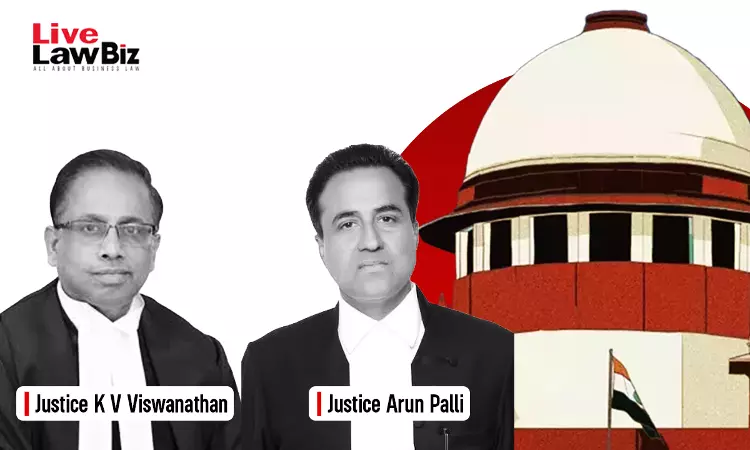
The Supreme Court on Tuesday issued notice on a plea challenging the National Company Law Appellate Tribunal's August 17, 2026 order.
The NCLAT held that the NCLT cannot direct the convening of an Extraordinary General Meeting under Section 98 of the Companies Act, 2013, unless the applicant establishes that holding the meeting without the Tribunal's intervention has become impracticable.
A Division Bench of Justices K.V. Viswanathan and Arun Palli issued notice on the plea and posted the matter for November 6, 2026.
Appearing for the appellant, Senior Advocate C. Aryama Sundaram argued that the case concerned impracticability, rather than impossibility, and that the near even split of the Board created a situation where the requisitionists could not effectively convene the meeting.
“It's a question of impracticability, not impossibility.”, Sundaram submitted,
He argued that Sections 98 and 100(4) of the Companies Act, 2013 operate independently and that Section 98 should not be treated as dependent upon the requisitionists first invoking Section 100(4).
“Section 98 has been recognised rightly so, not to be dependent on 100 at all. 100(4) and 98 are open…”
Sundaram submitted that although Section 100(4) provides a statutory mechanism for requisitionists to convene a meeting themselves, they required cooperation and access to corporate records to practically conduct the meeting.
“I need that cooperation for a 100(4) meeting to requisition myself. You have rejected my application for me to conduct it myself. At the very least, I need a shareholders' list.”, the senior advocate said.
It was also argued that notices had to be issued to shareholders and that the requisitionists required access to necessary corporate information.
“I can't have an extraordinary general meeting without issuing notices. I need cooperation from the company.”
Sundaram also relied on the NCLT's finding that the 3:2 Board division itself indicated a deadlock. He submitted that although his clients held approximately 54% of the general body, they were in a minority on the Board and therefore lacked control over the company's records and infrastructure required to conduct the meeting.
Counsel appearing for the respondents, however, argued that Section 100(4) provides a specific statutory mechanism enabling requisitionists to convene the meeting themselves once the Board refuses to do so.
“100(4) is a statutory mechanism, which provides for the requisitionist to call for the meeting themselves, irrespective of what the Board says or not.”, the counsel argued.
She submitted that the Board had refused to convene the meeting and therefore the requisitionists' remedy was to invoke the mechanism under Section 100(4), rather than approach the NCLT under Section 98.
The Supreme Court also focused on this distinction during the hearing.
Justice Viswanathan asked, “If you're refusing to convene a meeting under 100(2), then the route is clear. They can then go under 100(4).”
The respondent's counsel submitted that the core legal question before the Court was whether a party could invoke Section 98 without first resorting to Section 100(4).
The Supreme Court ultimately issued notice on the challenge to the NCLAT ruling and posted the matter on November 6 for further hearing.
Background
The case arose from a dispute among the directors and shareholders of Pearl City Marine Products Pvt. Ltd. The company's Board originally comprised the appellants along with respondents. Respondents Shurooq Shanavas and Velliyattil Muhammed Haneefa Abuthahir were removed from the Board by a resolution passed at an EGM on November 10, 2025.
Subsequently, Hiras K, Managing Director and shareholder sought to convene an EGM for their re-induction, but the Board rejected his request by a 3:2 resolution dated February 9, 2026.
Hiras K then approached the NCLT Kochi Bench, under Section 98 of the Companies Act, 2013, seeking directions for convening the EGM. The NCLAT on August 17 held that Section 100(4) and Section 98 provide mutually exclusive remedies but the Tribunal's power under Section 98 is exceptional and can be exercised only when it is established that holding the meeting without Tribunal intervention has become impracticable.
Finding that Hiras K had not established such impracticability and had not even attempted to convene the meeting under Section 100(4), NCLAT held that the mere 3:2 division among five directors, despite the company having around 110 other shareholders, was insufficient. It therefore set aside the NCLT order and allowed the appeal.