
Supreme Court Disposes Of PIL Seeking PMLA, Benami Action Against Fake Drug Manufacturers
Kirit Singhania
2 Oct 2026 12:53 PM IST
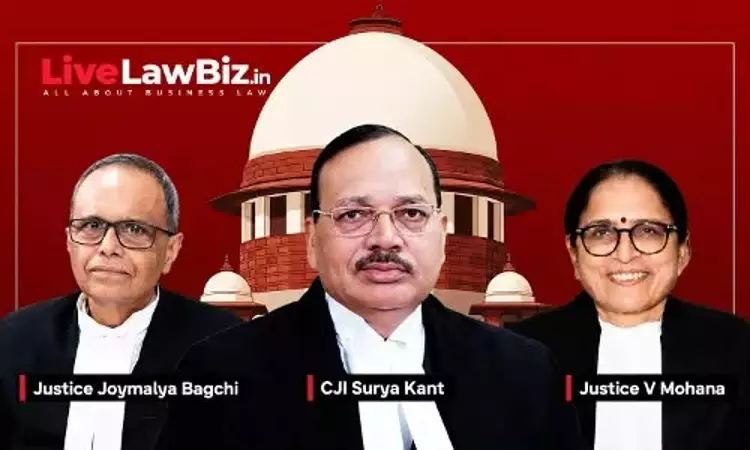
The Supreme Court has disposed of a PIL seeking time-bound assessment and confiscation of properties of fake drug manufacturers, sellers, financiers, and their family members under money laundering, benami property and black money laws.
The PIL also sought completion of investigations into fake drug cases within three months and trials within one year. It sought standard procedures for the search, seizure and sampling of adulterated and spurious medicines.
A Bench comprising Chief Justice of India Surya Kant, Justice Joymalya Bagchi and Justice V. Mohana noted that the petitioner had not approached the respondent authorities before filing the writ petition. The court disposed of the petition without expressing any opinion on its merits and directed the Registry to forward a copy of the petition to the authorities for their consideration.
“We, however, note that the petitioner has not approached the respondent-authorities before filing the instant Writ Petition. In such circumstances, where different kind of actions are statedly required to be undertaken by the respondents, we dispose of this Writ Petition, without expressing any opinion on merits, with a direction to the Registry to forward a copy of the Writ Petition to the respondent-authorities for their consideration,” the court ruled.
The petitioner, Ashwini Kumar Upadhyay, had sought a direction to the Centre and States to complete investigations into fake drug cases within three months and trials within one year.
It also sought time-bound assessment and confiscation of properties of fake drug manufacturers, sellers, financiers and their family members under the Prevention of Money Laundering Act, 2002, the Prohibition of Benami Property Transactions Act, 1988 and the Black Money Act, 2015.
The PIL further sought standard operating procedures for the search, seizure and sampling of adulterated and spurious medicines. It also sought a timeline for submission of forensic science laboratory reports in fake drug cases.
Another relief sought was mandatory digital recording and videography of searches, seizures, sampling and inventory proceedings. The petitioner also sought a graded sentencing policy providing stringent and proportionate punishment for fake drug manufacturers and sellers.
The PIL additionally sought a direction to the Law Commission of India to prepare a report suggesting necessary changes in existing laws to prevent fake drugs. It also sought a direction that sentences in fake drug cases should be consecutive.
The petitioner highlighted what it described as a rise in the manufacture, sale and distribution of spurious, counterfeit and adulterated medicines, injections, and syrups across various States.
The petition referred to contaminated cough syrups causing the deaths of 14 children in Madhya Pradesh, inter-State fake medicine rackets in Delhi, and the supply of counterfeit cancer drugs across over 90 hospitals in Bengaluru.
The petitioner claimed that over two lakh citizens die unnaturally while 20 lakh suffer serious illness every year due to fake medicines.
The petitioner also contended that implementation of the Drugs and Cosmetics Act, 1940 was impeded by the absence of a uniform timeline and investigative standards.
According to the petition, there was a complete absence of standard operating procedures for search, seizure, digital recording and inventory preparation.
The petition further contended that properties acquired through counterfeit drug rackets ought to be confiscated under the Prevention of Money Laundering Act, 2002, the Prohibition of Benami Property Transactions Act, 1988 or the Black Money Act, 2015.
The court did not express any opinion on the merits of these claims. It noted that the petitioner had not first approached the respondent authorities despite seeking different actions from them.
The court accordingly directed the Registry to forward a copy of the writ petition to the concerned authorities for consideration. The petitioner undertook to deposit the requisite copies of the paper book for this purpose.
The order was passed on September 28
For Petitioner: Advocates Ashwini Kumar Upadhyay, Ashwani Kumar Dubey, AOR, Nikhil Upadhyay