
Pre-2016 DRT Recovery Certificate Cannot Trigger Insolvency Under Presidency Towns Insolvency Act: Supreme Court
Kirit Singhania
13 July 2026 6:52 PM IST
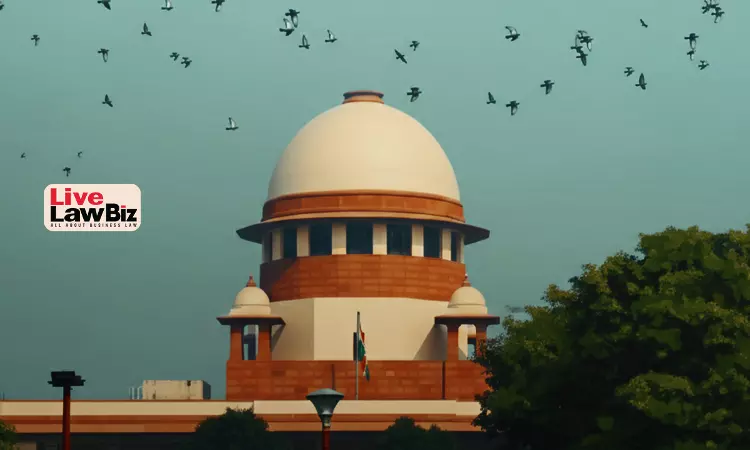
The Supreme Court on Monday held that a recovery certificate issued by a Debt Recovery Tribunal (DRT) before the 2016 amendment to the Recovery of Debts and Bankruptcy Act cannot be treated as a decree or order for initiating insolvency proceedings under the Bombay's Presidency Towns Insolvency Act, 1909.
Dismissing HDFC Bank's appeal, the court observed that Parliament recognised such equivalence only through the 2016 amendment.
A bench of Justices Dipankar Datta and Satish Chandra Sharma upheld the Bombay High Court's decision quashing an insolvency notice issued against personal guarantor Kishore K. Mehta. The notice had been issued on the basis of a DRT recovery certificate.
"Insertion of sub-section (22A) in Section 19 of the RDB Act, we are inclined to the view, instead of supporting the Appellant-Bank demolishes its case. Section 19(22A), as it now stands, aids in settling the issue. The fact that Parliament found it necessary in 2016 to insert sub-section (22A) in Section 19 of the RDB Act for the express purpose of equating a recovery certificate with a 'decree or order' is clear legislative recognition that such equivalence did not exist earlier.", the top court ruled,
The dispute arose from credit facilities extended by a consortium of 15 banks, including HDFC Bank, to Beautiful Diamonds Ltd. Kishore K. Mehta, one of the company's directors, had also executed a personal guarantee.
After the company defaulted, the DRT directed issuance of a recovery certificate for ₹14.74 crore against Mehta. The recovery certificate was issued on November 30, 2004. Based on it, HDFC Bank obtained an insolvency notice under the Presidency Towns Insolvency Act.
Mehta challenged the insolvency notice before the Bombay High Court. A Single Judge held that a DRT recovery certificate could not form the basis of such a notice. The Division Bench affirmed that decision. HDFC Bank then appealed to the Supreme Court.
The bank argued that a DRT recovery certificate was equivalent to a decree or order. It relied on the 2016 insertion of Section 19(22A) into the Recovery of Debts and Bankruptcy Act. Mehta's legal representatives argued that the amendment operated prospectively. They submitted that it could not govern proceedings that had commenced before the amendment came into force.
The court found that the 2016 amendment weakened, rather than supported, HDFC Bank's case. It held that the amendment itself showed recovery certificates had not previously been treated as decrees or orders for insolvency proceedings.
"By necessary implication, a recovery certificate issued prior to the 2016 amendment could not form the basis for initiating insolvency proceedings. To hold otherwise would be to supply what the legislature omitted – a clear casus omissus. That apart, it is significant that the amendment has not been given retrospective effect. Matters would perhaps have been simpler, had the amendment been made earlier.", the court ruled.
The bench further held that the appeal had to be decided on the basis of the law as it stood when the litigation commenced. A subsequent statutory amendment could not alter that position.
"If denying a suitor relief based on accrual of post-natal events because of the Court's delay to decide the lis is impermissible, by the same logic, the converse must also hold. A claim which was untenable on the date the suitor entered the portals of the Court cannot become tenable simply because a fortuitous event during the pendency of the trial has made it so.", the court opined.
The court also relied on Paramjeet Singh Patheja v. ICDS Ltd., which held that an arbitral award is not a decree or order for the purpose of insolvency proceedings. It held that the same principle applied to DRT recovery certificates issued before the 2016 amendment.
The bench also accepted the respondents' submission on an alternative ground. It observed that even if Section 19(22A) were assumed to apply, HDFC Bank could derive no benefit from it. The insolvency notice, which marked the initiation of insolvency proceedings, had already been quashed by the High Court.
The court dismissed the appeal. It also directed that any pending proceedings in the notice of motion before the Single Judge would stand closed insofar as the deceased original respondent, Kishore K. Mehta, was concerned.
The apex court clarified that HDFC Bank would remain free to pursue any remedies available in law against the other certificate debtors, subject to limitation and other legal requirements